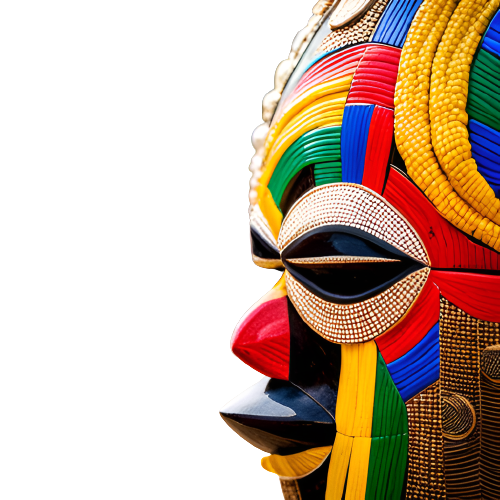
Makonde Lipiko Mask: Initiation, Spirits, and Transformation in Tanzania
Who Are the Makonde People?
The Makonde are a Bantu-speaking people living primarily in the Mtwara region of southern Tanzania and in Cabo Delgado province in northern Mozambique. Separated by the Ruvuma River, which forms the modern border between the two countries, the Tanzanian and Mozambican Makonde share a common language and cultural heritage while developing their own regional traditions. They are best known internationally for two things: their extraordinary wood carving tradition and their complex masquerade rituals, at the centre of which stands the Lipiko mask.
What Is the Lipiko Mask?
The Lipiko mask is a helmet mask worn during the Unyago initiation ceremony, which marks the transition of young men from boyhood into adulthood. Unlike many African masks that are held in front of the face or suspended from a framework, the Lipiko fits over the entire head like a helmet. It is carved from a single block of lightweight wood — traditionally mpingo, the dense African blackwood prized by Makonde carvers, though lighter woods are sometimes used for ceremonial headpieces — and painted to resemble a human face.
What makes the Lipiko immediately recognisable is its detailed facial scarification. The carved face displays raised patterns of dots and lines representing the nsona or viremba scarification marks traditionally worn by adult Makonde men and women. These patterns are not decorative flourishes; they are identity markers encoding information about clan membership, social status, and spiritual connection. When a young man sees the Lipiko mask for the first time during initiation, he is confronting not just a carved object but a materialised ancestor who embodies everything he is about to become.
The Unyago Initiation Ceremony
The Unyago ceremony is one of the most important social and spiritual events in Makonde life. It is an exclusively male affair: women and uninitiated boys are strictly forbidden from witnessing the ceremony or learning its secrets. The initiation takes place in a secluded bush camp, away from the main village, where boys between the ages of roughly twelve and eighteen spend several weeks or months under the guidance of senior men known as elders or masters of initiation.
During this period, initiates undergo physical circumcision, which serves as the central act of transformation from boy to man. But circumcision is only one element of a much richer process. The boys learn traditional history, moral codes, sexual education, and the social responsibilities of adult manhood. They are taught about the world of spirits and ancestors, about the significance of the masks they will encounter, and about the obligations that adult men owe to their families, their community, and the dead.
The Lipiko appears at key moments during the ceremony. Worn by a senior male dancer, the masked figure moves among the initiates, embodying ancestral authority. The masquerader’s identity is completely concealed — not just by the helmet mask but by a full-body costume of woven fabric and fibre. The initiates are told they are in the presence of spirits, not men, and this sacred fiction is maintained with absolute seriousness. To reveal the identity of a masquerader is a serious social transgression.
Lipiko and the World of Ancestors
For the Makonde, death does not sever the relationship between the living and the dead. Ancestors remain active presences in the affairs of the community, capable of offering protection, guidance, and fertility — or, if neglected or offended, capable of sending sickness and misfortune. The Lipiko mask is a technology for mediating this relationship. When a dancer wears the mask, he does not simply impersonate an ancestor; he becomes a vessel through which ancestral power enters the living world.
The specific features carved onto the Lipiko face often reference particular ancestors whose qualities the ceremony aims to invoke. A mask might represent a renowned hunter, a great warrior, or a wise elder — archetypes of ideal manhood that the initiates are encouraged to emulate. Some masks are family heirlooms passed down through generations, accruing spiritual potency with each successive ceremony.
Carving the Lipiko: An Art Form and a Sacred Responsibility
The carving of a Lipiko mask is not a casual craft exercise but a task that carries significant spiritual responsibility. Among the Makonde, master carvers hold a respected position in the community, and the creation of a new mask involves not just technical skill but ritual preparation. Carvers may observe dietary restrictions, abstain from sexual activity, and perform prayers or offerings to the ancestors before beginning work on a ceremonial mask.
The carving process begins with the selection of the wood. The chosen tree may itself be subject to ritual protocols; some traditions require prayers or offerings to the spirit of the tree before it is felled. The carver then works with adzes, chisels, and knives to shape the helmet form, hollowing the interior so that the mask fits securely over the wearer’s head. The facial features — brow, eyes, nose, lips, and the distinctive scarification patterns — are carved with great precision.
Once the carving is complete, the mask is finished with pigments. Traditionally, this meant natural materials: charcoal for black areas, ochre for red, white clay for pale highlights. Today, commercial paints are sometimes used, though master carvers often prefer traditional finishes for ceremonial pieces. Beeswax may be applied as a final protective coating, giving the mask a subtle sheen.
Differences Between Tanzanian and Mozambican Makonde Traditions
Although the Tanzanian and Mozambican Makonde share the Unyago ceremony and the Lipiko tradition, cultural differences have emerged over the centuries of separation by the Ruvuma River. Tanzanian Makonde masks tend to emphasise the scarification patterns and realistic facial features characteristic of the classical helmet mask form. Mozambican Makonde carvers, meanwhile, have developed a more dramatic and elaborate sculptural tradition in their secular woodcarving, particularly in the shetani style — fantastical figures representing dangerous spirits — and the ujamaa communal totem style. These developments were partly driven by commercial demand from collectors and tourists, but they also reflect genuine aesthetic innovations by Mozambican carvers that have been internationally recognised.
The Lipiko in the Modern World
Like many African masquerade traditions, the Lipiko faces pressures from modernisation, Christian and Islamic missionary activity, and changing social norms. In some communities, Unyago ceremonies have been abbreviated or modified. The strict secrecy that once surrounded the masquerades has been partially eroded by photography, film, and academic documentation. Some Makonde communities have responded by actively defending the tradition, limiting access to ceremony grounds and reinforcing the social taboos around mask knowledge.
At the same time, the Lipiko and Makonde carving more broadly have achieved remarkable visibility on the international art market. Makonde sculptors — particularly those working in the secular ujamaa and shetani traditions — are represented in major museum collections worldwide, including the British Museum in London, the Smithsonian in Washington, and the Quai Branly in Paris. This international recognition has created economic opportunities for Makonde artisans, though it has also raised difficult questions about the commercialisation of sacred objects and the removal of culturally significant pieces to overseas collections.
Why the Lipiko Matters
The Lipiko mask is far more than an aesthetic object. It is a social technology that has served the Makonde people for generations as a means of transmitting values, maintaining the authority of elders, connecting the living with the dead, and producing men who are fit to take on adult responsibilities. In a continent where the complexity and sophistication of indigenous cultural life has too often been dismissed or ignored, the Lipiko stands as a reminder that African masquerade traditions represent deep and coherent philosophical systems — systems worth understanding, respecting, and preserving.