Emangungu Mask
Mask (Emangungu)
Attribution follows a published museum catalogue or peer-reviewed scholarship. Object is held in a public collection under a published accession number.
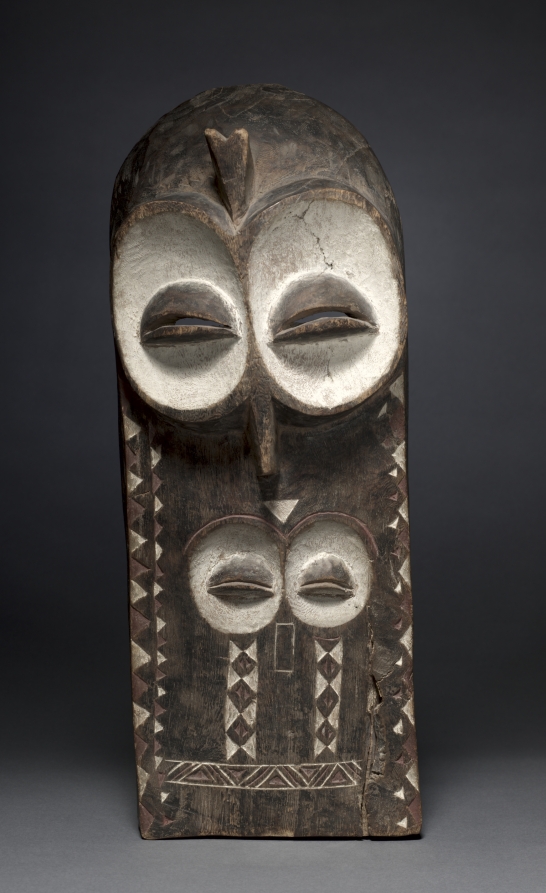
Rare anthropo-zoomorphic plank masks were once used by Bembe people in circumcision rites called butende. Recently initiated boys living in seclusion in the forest wore them with a bark-and-banana-leaf costume, disguising themselves to beg for food in the village. The sculpture’s short projections above the forehead are identified as an owl’s tufts. The two pairs of eyes could refer to divination. The rites associated with this mask had waned by the mid-1960s.
Catalogued by Cleveland Museum of Art as “Mask (Emangungu)”, dated possibly early 1900s. Harvested from the museum’s open-access record; every field below is copied from that record and none of it has been inferred.
Record
| People / culture | Bembe |
|---|---|
| Country | Democratic Republic of the Congo, Zambia |
| Common name | Mask (Emangungu) |
| Materials | Wood, kaolin, colorant, and iron |
| Dimensions | Overall: 46 cm (18 1/8 in.) |
Provenance
Franyo and Gustave Schindler, New York, NY (by 1957–?)
Jacques Boussard, Paris, France (before 1967–1990)
Lucien Van de Velde, Antwerp, Belgium (1990–?)
private collection, Belgium
(Sotheby's, New York, NY, sold to the Cleveland Museum of Art) (2006)
The Cleveland Museum of Art, Cleveland, OH (2006–)
| Collection | Cleveland Museum of Art |
|---|---|
| Accession number | 2006.116 |
Source
https://clevelandart.org/art/2006.116
This record is a catalogue entry, not an appraisal, valuation or legal determination. Nothing here should be read as evidence that an object was lawfully acquired or exported.