Lefem – Commemorative figure
Commemorative figure (lefem)
Attribution follows a published museum catalogue or peer-reviewed scholarship. Object is held in a public collection under a published accession number.
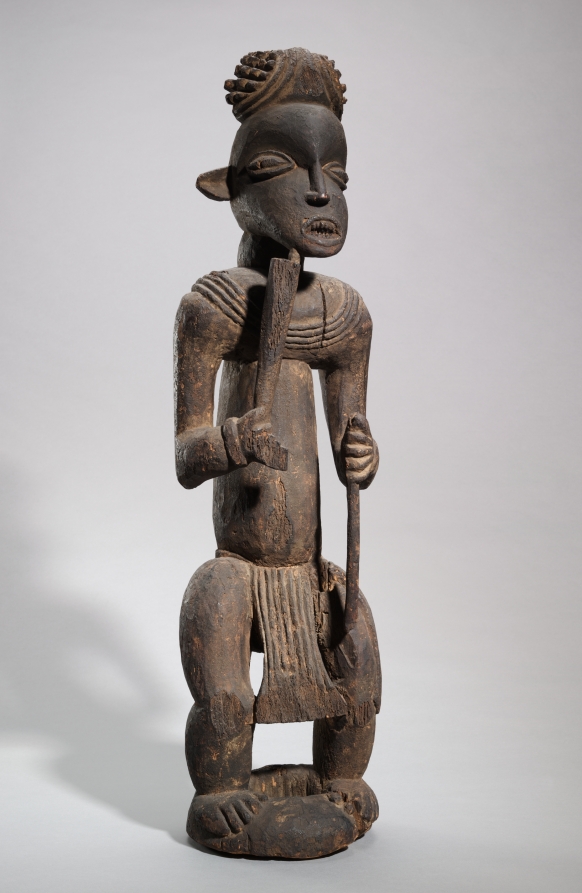
Carved during their subject’s lifetime, such idealized portraits function as their living stand-ins or intermediaries. Adorned with royal attire consisting of a bristled cloth cap, beaded necklace, pleated loincloth, drinking horn, and now-broken pipe, this figure was carved as a commemorative portrait of a historical king or high dignitary. It was kept by a secret association called Lefem, whose members gathered weekly in a sacred space in the forest to discuss matters related to the kingdom’s welfare. Placed in a royal shrine, the figure witnessed sacrifices made to the skulls of the chief’s ancestors. Meant to safeguard the kingdom and protect the fecundity of its inhabitants, it was also exhibited during funerals and royal ceremonies.
Catalogued by Cleveland Museum of Art as “Commemorative figure (lefem)”, dated mid-1800s–1910. Harvested from the museum’s open-access record; every field below is copied from that record and none of it has been inferred.
Record
| People / culture | Bamileke |
|---|---|
| Country | Cameroon |
| Common name | Commemorative figure (lefem) |
| Form category | Figure, staff, or non-mask object |
| Subject depicted | Ancestor or named individual |
| Materials | wood |
| Dimensions | Overall: 92.1 x 20.3 cm (36 1/4 x 8 in.) |
Provenance
probably Ateu Atsa, Cameroon
Charles Ratton, Paris, France (?–1987)
Henri Kamer (?)
Pace Primitive and Ancient Art, New York, NY (1987)
Cleveland Museum of Art by purchase 1987 (1987–)
| Collection | Cleveland Museum of Art |
|---|---|
| Accession number | 1987.62 |
Source
https://clevelandart.org/art/1987.62
This record is a catalogue entry, not an appraisal, valuation or legal determination. Nothing here should be read as evidence that an object was lawfully acquired or exported.