Mother-and-Child Figure
Mother-and-Child Figure
Attribution follows a published museum catalogue or peer-reviewed scholarship. Object is held in a public collection under a published accession number.
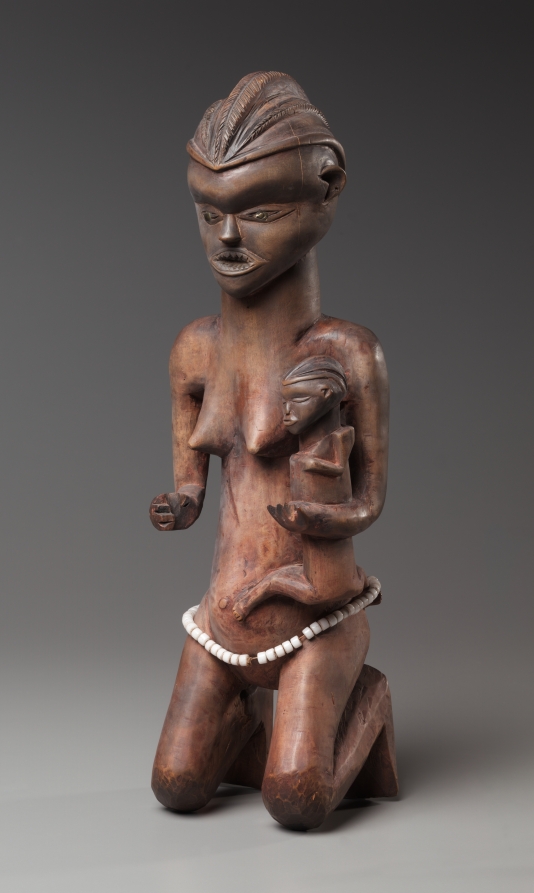
Wearing an elaborate lobed headdress and a beaded waistbelt, and having filed teeth and red-powdered skin, this maternity figure seems to have once carried an ax and a cup, wooden imitations of the two most important chiefly attributes. Perhaps together with a male counterpart, it was secretly kept inside the ritual house, serving as a guardian of the chief’s treasure. Its style places it in the westernmost corner of Pendeland, between the Lutshima and Kwilu rivers.
Catalogued by Cleveland Museum of Art as “Mother-and-Child Figure”, dated late 1800s–early 1900s. Harvested from the museum’s open-access record; every field below is copied from that record and none of it has been inferred.
Record
| People / culture | Pende |
|---|---|
| Country | Democratic Republic of the Congo |
| Common name | Mother-and-Child Figure |
| Subject depicted | Mother and child |
| Materials | Wood, glass beads, upholstery studs, natural fiber, and pigment |
| Dimensions | Overall: 53.4 x 13.1 x 14.6 cm (21 x 5 3/16 x 5 3/4 in.) |
Provenance
Edgar Gustave "Guillaume" de Hondt, Brussels (?–1952) (?–1931)
The African Art Sponsors of Karamu House (1931)
The Cleveland Museum of Art by gift (1931—)
| Collection | Cleveland Museum of Art |
|---|---|
| Accession number | 1931.426 |
Source
https://clevelandart.org/art/1931.426
This record is a catalogue entry, not an appraisal, valuation or legal determination. Nothing here should be read as evidence that an object was lawfully acquired or exported.