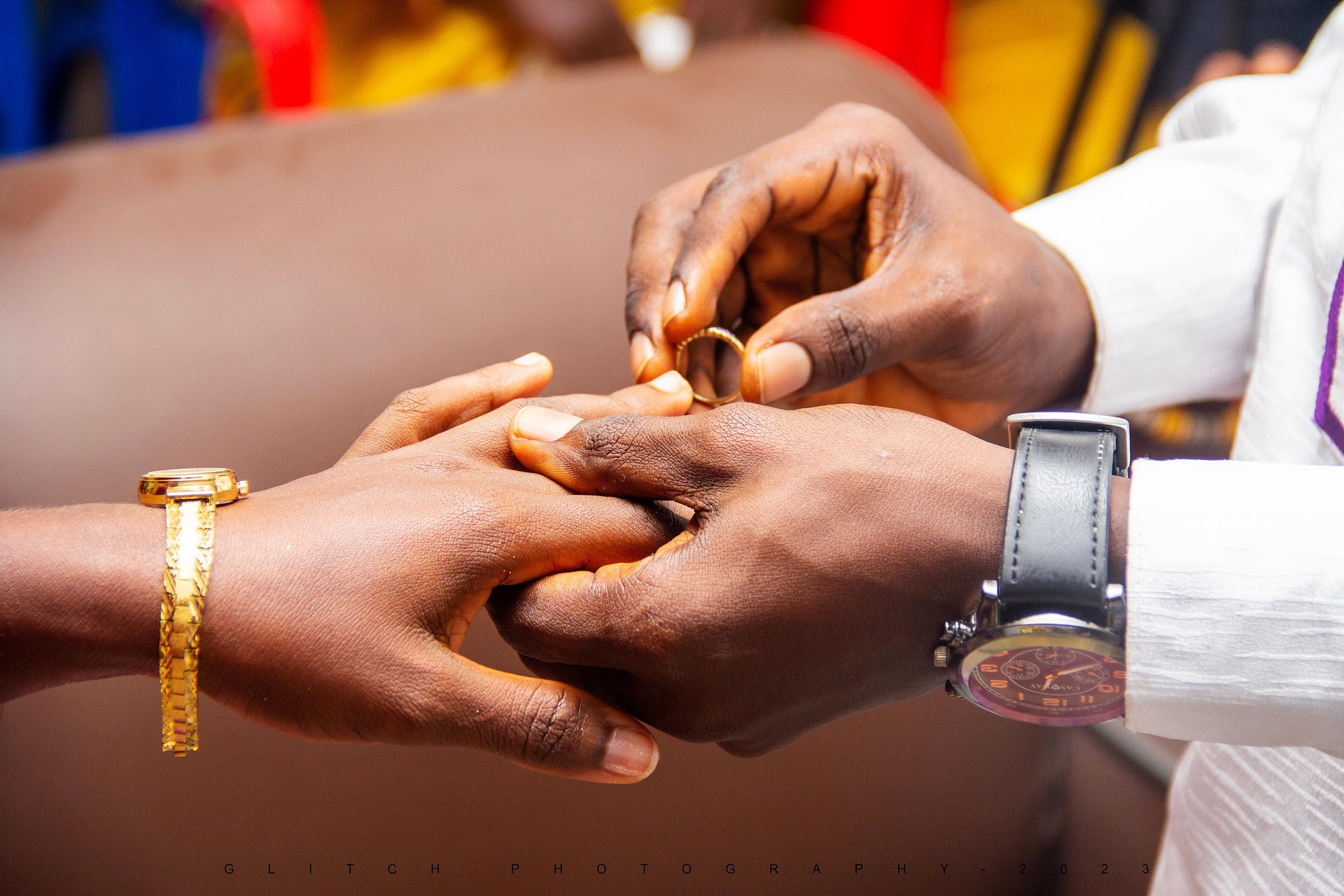
Why should a man kneel to Propose Marriage?
Some modern African women will not accept a marriage proposal if it is not accompanied by the sonorous music of the saxophone, cake, wine, a bouquet of money or whatever is trendy these days, a diamond ring, friends and onlookers chanting, “say yes! Say yes!! Say YESSS! And of course, a proper man on his knees. And yes, he has to speak the divine magic words, ‘Will you marry me?’ It is always interesting to watch and wonder what it would feel like. Especially since, despite being married, I did not get to play a part in this kind of theatrics.
https://youtu.be/pZ4LYkutr5o
Social media has endless documentation of women rejecting a marriage proposal because some components of the proposal were lacking. I often wonder who makes the rules. How does this all come together?
On the flipside, It has been the opinion of many men in Africa that African men should never kneel to propose marriage to a woman. They say it is not African and it was not right for an African man to go down on on a knee on both knees to propose to a lady. In this piece, we will seek the real truth behind this claim. Is there more to this, or just patriarchy fighting for survival?
If a man kneels before a woman, does it amount to giving up everything that makes him manly? Does it amount to a role switch between the sexes so that the lady becomes the lord of the relationship? I think the reasons are far deeper and far-reaching, but then let’s deepdive into the world of marriage proposals.
Marriages and marriage proposals in Africa have deep connections to the culture, the extended family and the entire community. It is hardly ever about the two humans in love.
For context, Africa has a billion residents who come from a thousand different cultures and ethnic groups. Even though we seem to be in the same pond, we are very diverse and unique. There are some similarities we share, and the most common of these would be that marriages almost always involve elders, rituals, exchange of gifts, and formal consent from both families.
Back to the idea of men kneeling to propose marriage. I have seen this practice mostly in movies. In fact, I have never witnessed this event in person and, strange as it may sound, most people I know haven’t either. What we have all seen in movies—a man on one knee with a diamond ring—feels foreign to many traditional African settings. That style comes from European customs. It’s difficult to relate to here.
But come to think of it, we have successfully adopted many Eurocentric practices – religion, dress cultures, music, government and even socio-economic systems. Why’s this such a difficult thing? No one has said that it’s an evil practice.
But our own customs still persist and are also not evil in themselves. Why change it if it’s not broken? Every culture is unique, and I intend to explore as many of them as possible. What I describe might not apply everywhere. Feel free to share how it works in your own community—I’d genuinely love to learn.
Proposals Are Family Business
In most African societies, it would be crazy for a man to simply decide to marry a woman and go ahead with it without family involvement. Dating isn’t taken seriously. A girl would be considered as wasting her time if she was notion a marriage that showed signs of becoming a marriage. The only relationship adults should be in is one that leads to marriage. Families take this on and enforce it. It is customary to have a parent ask a ward’s date, “What are your plans for my child?” If marriage was not in the foreseeable future, the family would intervene and disrupt the relationship, bringing it to an end.
In Nigeria, it would be unthinkable for a young man to walk up to a girl, present a ring privately and ask for her hand in marriage. Even if it happened, it would not be a valid proposal. The natural first step would be for the man to inform his family that he has found a wife. Funny right? It gets even better.
The young man’s family must now get to know the girl. If they approve, then they take on the process. They must collectively visit the girls’ family to make a formal introduction. This practice is known by different names across ethnic groups—Iju Ese among Igbo, Mo mi n’mo among the Yoruba. The groom’s family must declare their intentions to have their son marry the girl. It has to be loud. It has to be clear and usually done in the presence of witnesses. If the woman’s family agrees in principle, further ceremonies follow: list presentation, bride-price negotiation, and engagement rites.
This process of introduction is our equivalent of a marriage proposal. Once the families agree. The lady is considered encumbered. The title of the young man changes from visitors to in-laws and the lady is officially off the market. Any young men asking after her well-being or indicating an interest in having a relationship with her must be informed that she’s no longer available. In principle, the marriage already started, but it is complete when the rites are complete.
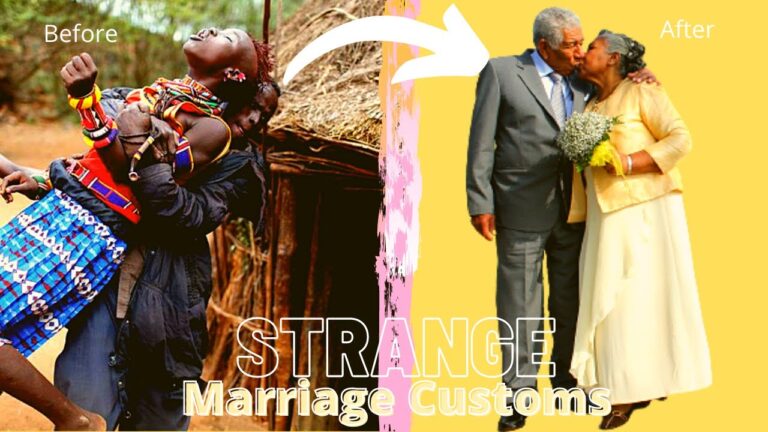
Know that even communities that practised the symbolic rites of “bride kidnapping” and in places where this is still a thing, the groom’s family must have either sought the permission of the bride’s family or must still return afterwards to do the needful. Until the blessing is given and the respect due to the bride’s family is fully paid, a marriage is not recognised.
In case you are hearing about the practice of bride kidnapping, let me explain what it is. A man’s family approach a girl’s family and often agree terms to join their children in matrimony. When the agreement is made, the girl has to be kidnapped by the groom’s family, and she’s forcefully taken to her husband’s home. There, they prepare a feast in her honour. They must offer her new clothes, jewerly and gifts to cheer her up. She has to agree to stay and become a wife. There’s more about this and other strange wedding practices in Africa here.
Before you get outraged about wife kidnapping, understand that it is their culture. Every woman married in the community experiences this. Mothers know of this and prepare their children for this. It’s actually not as terrible as it sounds. In many African cultures, marriage severs a girl from her ancestral home, and so, even if she loved her husband dearly, that emotional divide gets quite intense, and brides and their mothers almost always weep copiously.
Even when Africans are practising Christians or Muslims, they still perform the full traditional ceremonies before or alongside the Christian or Islamic wedding. The cultural process always stands on its own.
Gestures of Respect Vary Widely
In the white man’s land, chivalry is shown by many gestures. They may kneel or take off their hats. In Africa, respect is shown differently from one ethnic group to another, and this affects how people feel about certain proposal styles.
– Hausa and Fulani: Men often squat when greeting elders or peers, sometimes clenching fists as a sign of respect. Full kneeling is not the standard gesture. To a Fulani man, this gesture would seem awkward.
– Yoruba: Men prostrate fully (dobale) before elders and in-laws as deep respect. During engagement, a groom’s family presents some symbolic items such as yams, palm oil, honey, kola nuts, and fabrics, among others. It is reported that the couple must perform a beautiful ritual whereby they must taste four flavours (sour, sweet, bitter, spicy) to represent life’s ups and downs.
– Igbo: Men never prostrate or kneel before elders, women or anyone at all. Standing to greet is the norm. In the famous Igbo wine-carrying ceremony (Igba Nkwu), the bride searches through a gathering, finds her suitor, kneels and offers him palm wine as her public “yes.”
These differences above portray why a single gesture can mean very different things depending on where you are.
What Kneeling Means in Different Contexts
The Western-style proposal—going down on one knee—as mentioned above, comes from the European chivalric and Christian traditions. Genuflecting in church shows humility before God. It has come to symbolise romantic devotion and vulnerability. But that’s hardly the outlook of a husband in Africa. The man must never be vulnerable. He is a pillar and must stand strong irrespective of what happens.
In many African cultures, kneeling in any shape or form has other meanings. It is perceived as a sign of weakness, being under punishment, pleading, or extreme submission rather than respect or love. For others, it simply isn’t part of everyday behaviour or ceremonial respect—people use prostration, squatting, or standing instead.
At this point, you probably understand why the idea of a man on a bended knee seems inappropriate to many. The very idea of a man kneeling before a woman to propose can feel out of place or even inappropriate to some.
This is not about refusing romance; it’s about expressing it in a way that aligns with cultural understanding of dignity and mutual respect.
That said, younger generations and urban couples are finding a perfect blend of styles. Many now do a private “ring and knee” moment for themselves, then follow with full traditional rites for the families. My goal is not to condemn any practice but to understand them better and hopefully, help you do the same.
We Do It Differently Across the Continent
Africa’s marriage customs are incredibly varied. Below, let’s consider a handful of options.
– Zulu (South Africa): Lobola, or the payment in cattle or cash. This is negotiated between families as thanks and commitment. The final umabo ceremony sees the bride bringing gifts to her new in-laws.
– Maasai (Kenya/Tanzania): Elders arrange marriages after initiation rites. Polygamy is common, and weddings feature milk blessings and energetic dancing.
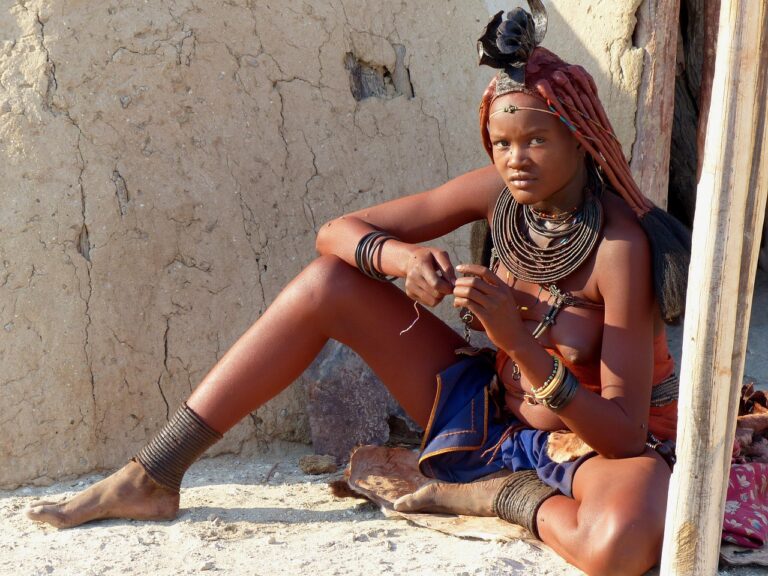
– Himba (Namibia): Marriages are often arranged. The bride is anointed with red ochre butter and prepared in seclusion. Courting involves communal dances.
– Tuareg (Sahel region): Women enjoy a relatively high status; weddings can include camel races or dances, and the groom’s family presents gifts.
– Akan (Ghana): The knocking ceremony (kookoo ko) involves the groom’s family literally “knocking” at the bride’s door with gifts and drinks to request entry and state intent.
Can We Find a Balance?
The times are changing fast, and so are our people. As our beloved African societies change, so should we and how we make marriage proposals. Some couples now mix elements of a ring surprise moment for photos, often followed by the traditional rites.
What matters the most to me is that the partners can honour their love as well as their roots. Not bad since while some practices may prove exciting in one context, in another, it feels awkward or disrespectful. Understanding these differences should help those who are hungry for a proposal to keep away from people not disposed to it.
How are proposals done in your culture? Tell us all about your customs and traditions.
Is this something you have had to do? How did you do it?
Is it mainly between the couple, or does family approval make it official? Does kneeling fit naturally, or is there another gesture that carries the weight of commitment? Every tradition has its own beauty—share yours below.