Mende Sowei Mask: The Female Helmet Mask of Sierra Leone
In the world of African masquerade traditions, the Sande society of the Mende and Temne peoples of Sierra Leone holds a remarkable and perhaps unique distinction: it is one of the only masquerade traditions in Africa in which the masks are owned and performed by women. While masking traditions across the continent are almost universally controlled by men — with women often prohibited from viewing the masked performance at close range or from learning the identity of the masker — the Sande Sowei mask belongs to the senior women of the society and is worn by them in public performance.
The Sande Society
The Sande — known as Bundo among the Temne — is a women’s initiation organisation that is one of the most powerful institutions in Mende and Temne social life. It operates as a parallel structure to the Poro, the men’s initiation society, and together the two organisations govern much of social life in Sierra Leone and parts of Liberia. Senior members of the Sande have authority over female initiates, the management of female initiation ceremonies, the supervision of marriages, and the adjudication of disputes involving women.
The Sande society initiates girls at puberty, bringing them into a period of seclusion during which they are educated in the knowledge, skills, and values expected of Mende women: farming, weaving, cooking, child care, dancing, and the moral and spiritual dimensions of adult female life. The initiation includes female circumcision — a practice that is controversial outside the community and continues to be debated both within Sierra Leone and internationally.
The Sowei Mask
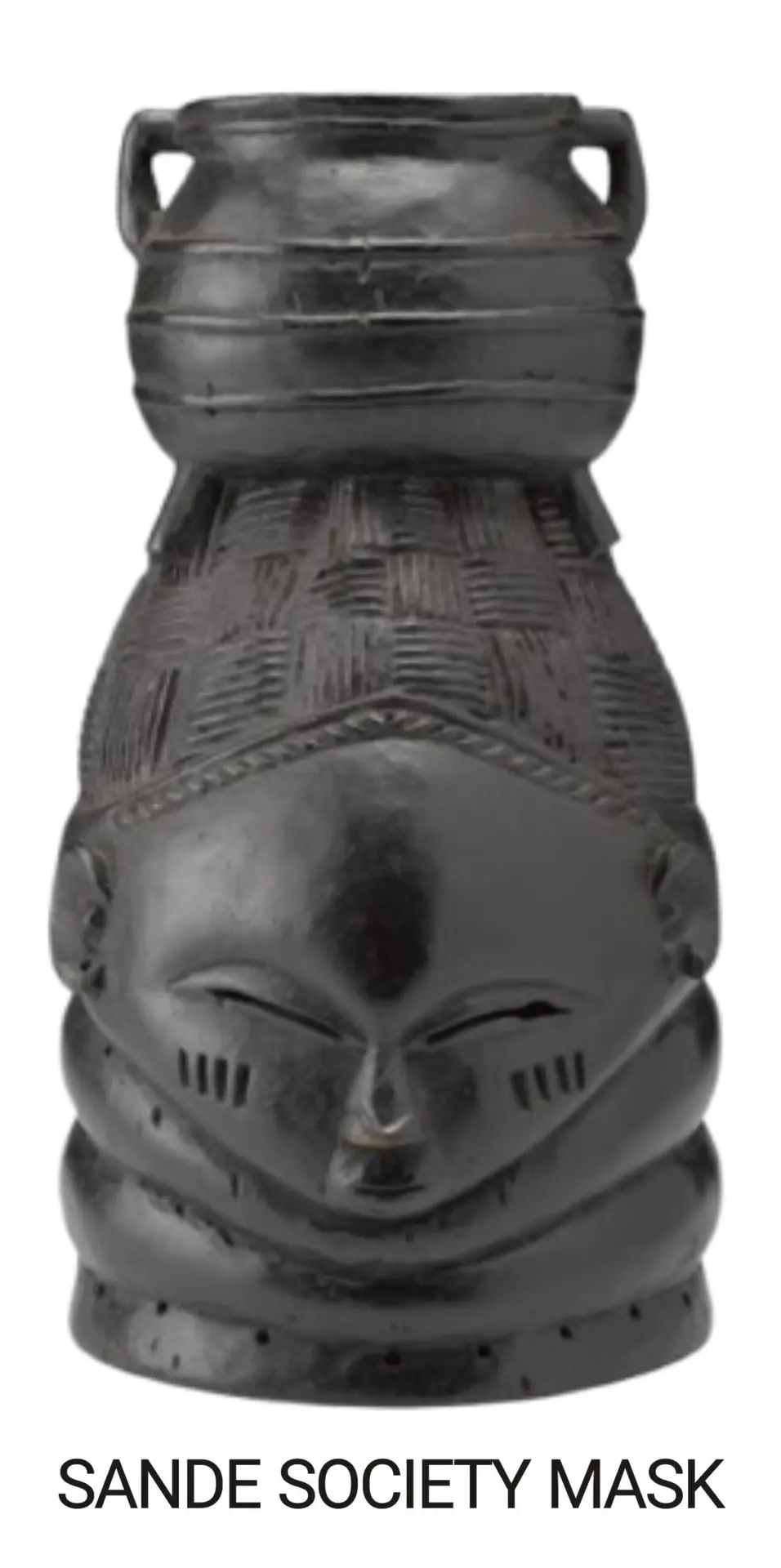
The Sowei is a helmet mask that fits over the performer’s entire head. It is made of wood and is characteristically black, with a highly polished surface achieved through the application of palm oil. The face has finely sculpted features: a high, smooth forehead — a feature of great aesthetic value in Mende culture, associated with intelligence and beauty — almond-shaped eyes, a small neat nose, and a composed mouth. The most distinctive element is the elaborate coiffure on top of the mask: an intricate arrangement of braids, curls, and ornaments that represents idealized Mende feminine beauty and status.
The neck of the Sowei mask is characterised by horizontal rings of flesh, which in Mende aesthetics represent not heaviness or obesity but rather a well-nourished, prosperous state — a sign of good living, good care, and physical well-being. The total image created by the Sowei is one of feminine idealization: everything about the mask’s appearance communicates the qualities that Mende culture associates with accomplished, well-respected womanhood.
Who Makes the Sowei?
The Sowei mask is carved by men — male specialist carvers who are hired by Sande women to produce the masks according to the women’s specifications. This creates an interesting dynamic: the mask is a male artistic product that is then owned and used by women, becoming entirely the property of the female institution. The carver’s involvement ends when he delivers the mask; its ceremonial life from that point is entirely within the female domain.
This arrangement is not unique — in many African artistic traditions, the making of an object and its ritual use are performed by different people. What is unusual here is the gender reversal: typically in African masquerade traditions, it is men who own and perform the masks, with women as the audience. The Sande tradition inverts this completely.
The Sowei in Performance
The Sowei masquerade appears at the conclusion of initiation, when the young initiates are brought out of seclusion and reintegrated into the community as adult women. The masked figure dances, celebrating the successful completion of initiation and demonstrating the ideal of Mende womanhood that the initiates are now expected to embody. The performance is accompanied by music and singing, and the masked figure interacts with the crowd, affirming the bonds between the society and the community.
The Sowei also appears at the funerals of senior Sande women, at naming ceremonies for infants, and at various other moments of community significance. Its presence marks these occasions as under the blessing and supervision of the Sande society.
The Sowei in the World
Sowei masks have been collected extensively and appear in museum collections around the world. They have attracted particular scholarly attention precisely because of their unusual status as female-owned and female-performed masks, challenging the assumption — common in earlier ethnographic writing — that African masquerade is a universally male domain. Contemporary feminist and gender studies scholarship has engaged with the Sowei tradition as an example of female institutional power operating through the medium of material culture.