Kanaga Mask of the Dogon: The Cross-Shaped Mask of Mali’s Funeral Rites
New: the 2nd edition of Within Carved Lines: The Secret Meanings of African Masks is out now. Get the book →
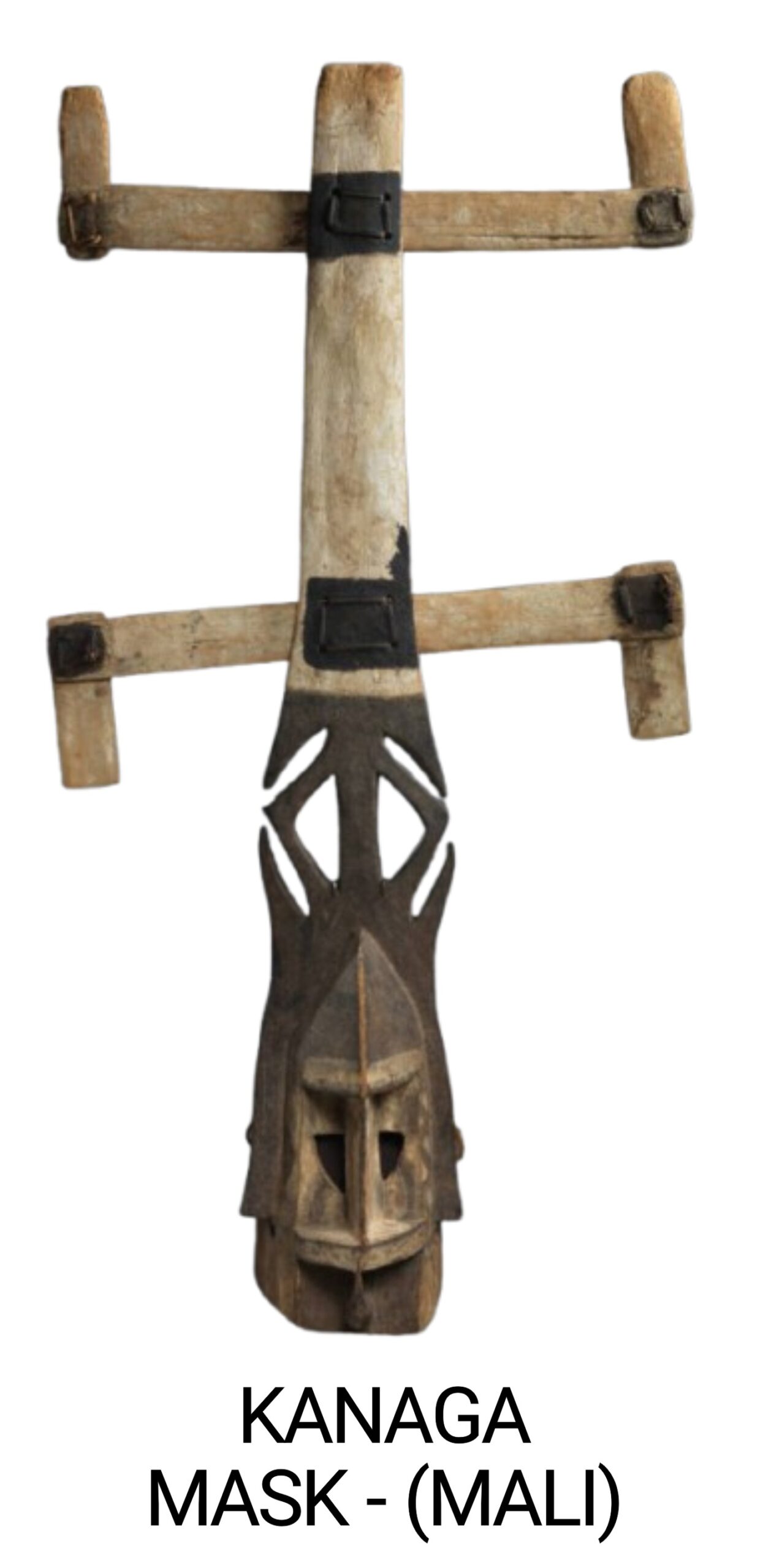
Of all the mask forms carved and danced across Africa, the Kanaga mask of the Dogon people is one of the most visually distinct: a carved wooden face is topped by a tall, double-barred wooden superstructure that rises and spreads like a cross with two crossbars. It is danced, not displayed — the mask’s meaning is inseparable from the demanding, acrobatic performance built around it.

Kanaga mask, Dogon people, Sanga area, Mopti Region, Mali. Brooklyn Museum, 1995.171.11a-c. Photo: Brooklyn Museum, licensed CC BY 3.0.
Who Are the Dogon?
The Dogon live along and around the Bandiagara Escarpment in central Mali, a dramatic sandstone cliff region that has sheltered Dogon communities for centuries and shaped much of their settlement pattern and cosmology. Dogon culture is known for an intricate and highly systematized body of cosmological knowledge, oral tradition, and ritual practice, much of which is expressed through masking — the Dogon maintain one of the most extensive mask vocabularies documented anywhere in Africa, of which Kanaga is the most numerous and most frequently danced type.
The Awa Society and the Dama
Kanaga masks belong to the Awa, the Dogon men’s masking society responsible for the full body of Dogon mask traditions. Their central ceremonial responsibility is the dama, a major funerary rite held periodically — sometimes years after a death, and often collectively for a number of people who have died since the last dama was held — with the purpose of guiding the souls of the deceased out of the world of the living and into the ancestral realm, restoring the social and cosmic order that death disrupts.
The dama is a significant undertaking, often planned and prepared for over an extended period and drawing large numbers of masked performers. Kanaga dancers typically appear in substantial numbers during a dama, making the mask the visual signature of the ceremony as a whole, even though the wider Dogon mask vocabulary includes many other forms performing alongside it, including the towering plank-shaped Sirige masks and the antelope-headed Walu.
Reading the Superstructure
The defining feature of the Kanaga mask is the wooden structure rising above the carved face: a vertical post crossed by two horizontal bars, one above the other, producing a form often compared to a double-barred cross. Interpretations of its meaning vary within Dogon oral tradition and the scholarship that has documented it — some accounts describe the shape as representing the outstretched arms and legs of the creator god Amma reaching toward earth and sky in the act of creation, others connect it to a bird in flight, and still others to a crocodile, an animal with its own cosmological associations in Dogon belief. Rather than a single fixed meaning, the Kanaga superstructure is better understood as a dense symbolic form capable of holding several layered readings at once — a common feature of Dogon visual and cosmological thought, which favors multiplicity of meaning over a single official interpretation. For more on how African mask symbolism resists single, simple readings, see our piece on how we decode African mask symbolism.
A Dance of Endurance
Kanaga is danced, not worn passively. The choreography built around the mask is physically demanding: dancers bend sharply at the waist, sweeping the superstructure low enough to touch the ground on alternating sides in rapid succession, a movement that requires real strength, balance, and stamina, often sustained across a long performance and frequently performed in large coordinated groups rather than by a single dancer. The physical intensity of the dance is not incidental to the mask’s meaning — the visible effort and discipline of the performance is itself part of what marks the occasion as serious and spiritually consequential, tying the dancer’s endurance to the weight of the funerary work being done.
Kanaga Masks in the World
Kanaga masks are held in major museum collections, including the Metropolitan Museum of Art, the Cleveland Museum of Art, and Yale University Art Gallery, and the Bandiagara Escarpment region itself is recognized by UNESCO as a site of exceptional cultural significance, in part because of the continuity of Dogon masking practice. Kanaga masks are also widely produced for the tourist and collector market, distinct from those actually danced at a dama — a distinction worth understanding for anyone evaluating a mask’s history rather than simply its appearance, a topic we cover more fully in our guide to buying authentic African masks.
Frequently Asked Questions
What does the Kanaga mask’s cross-like shape represent?
Interpretations vary within Dogon tradition itself — readings include the creator god Amma’s outstretched arms and legs, a bird in flight, and a crocodile. Dogon symbolism generally favors layered, multiple meanings over one fixed answer.
When is the Kanaga mask danced?
Primarily during the dama, a major Dogon funerary ceremony held periodically to guide the souls of the deceased to the ancestral world and restore social order after death.
Who is allowed to dance the Kanaga mask?
Members of the Awa, the Dogon men’s masking society responsible for the full range of Dogon masquerade traditions.
Why is the Kanaga dance so physically demanding?
Dancers bend low and sweep the tall superstructure to touch the ground on alternating sides in a rapid, repeated sequence — a display of endurance and discipline considered appropriate to the seriousness of the funerary occasion.
See also: Every Traditional African Mask You Should Know · Do African Masks Have Spirits? Cultural Truth vs Popular Myth · Why African Masks Have Horns · African Masks by Region and Tribe
2ND EDITION
Within Carved Lines: The Secret Meanings of African Masks
Go deeper into the stories behind the masks you just read about. Within Carved Lines uncovers the history, symbolism, and ritual meaning of Africa’s traditional masks — now fully revised in its second edition.
GET YOUR COPY