Traditional African Masks: Types, Meaning, and Where They Come From
Africa is not one mask tradition. It is hundreds of them, each tied to a specific people, a specific ceremony, and a specific set of beliefs about what a mask does when it is worn. Treating African masks as a single style flattens traditions that have almost nothing in common except the continent they come from. Here is a clearer way to think about the main categories, and where to look for detail on each.
Masks organised by what they were made to do
Most traditional masks fall into a few broad functional categories, even though the specific forms differ enormously by region.
Initiation masks mark the passage from childhood to adulthood. They appear at ceremonies that induct young people, most often young men, into full membership in the community, and they are often tied to secret societies that control who may see or wear them.
Funerary and ancestral masks are worn to honour the dead, guide spirits to the ancestral world, or allow the living to communicate with ancestors during specific rites. These carry some of the deepest spiritual weight of any mask category.
Spirit and deity masks represent specific nature spirits or deities recognised by a community, and are worn during ceremonies meant to invoke, honour, or negotiate with those forces, often around harvests, rain, or fertility.
Judgment and authority masks appear in societies where a masked figure represents communal law, arbitrating disputes or enforcing social order with an authority that belongs to the mask and the spirit it represents, not to the individual wearing it.
Entertainment and status masks, found in masquerade traditions across West Africa in particular, are worn during festivals and celebrations, and can also signal the wealth, achievement, or social rank of the person or family sponsoring the appearance.
Masks organised by region and people
Different regions developed distinct visual languages and material traditions.
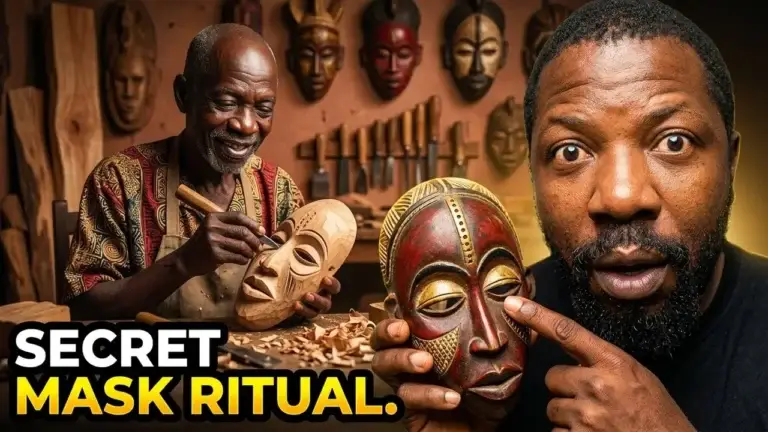
West African masks, including those of the Dan, Senufo, Yoruba, and Igbo peoples, are known for elaborate carved wood forms, frequently used in masquerade festivals, secret society initiations, and funerary rites. The Yoruba Gelede and Egungun traditions and the Igbo mmuo masquerades are among the most widely documented examples.
Central African masks, including Kuba, Fang, and Kota traditions, often combine geometric patterning with abstracted human or animal features, and are closely tied to ancestor veneration and secret society structures.
Southern and East African traditions include masks from peoples such as the Chokwe and Makonde, frequently used in initiation ceremonies for both boys and girls, with forms that range from naturalistic to highly stylised depending on the specific rite.
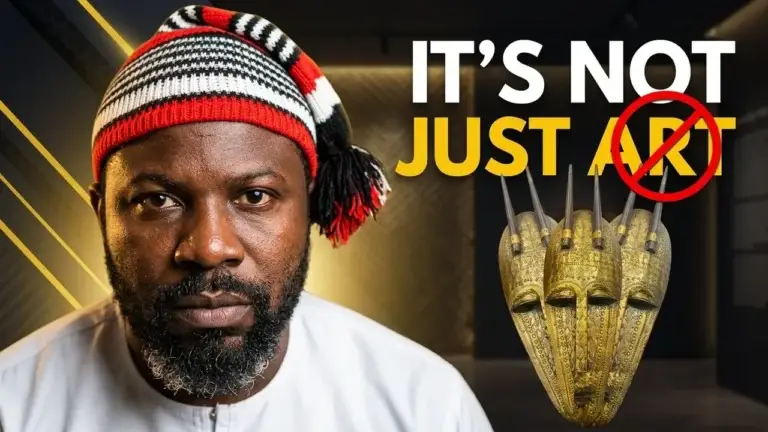
Masks associated with specific royal or spiritual authority, such as the Ashanti gold mask traditions of Ghana, sit in a category of their own, tied less to masquerade performance and more to the visible symbols of a ruler’s spiritual and political legitimacy.
What the materials and colours often signal
Wood is the most common material, but ivory, bronze, copper, fibre, cowrie shells, and pigment all appear depending on the tradition and the wealth of the community or family commissioning the piece. Colour carries meaning that varies by culture: white is frequently associated with spirits and the ancestral world, red with power, danger, or vitality, and black with age, wisdom, or the earth. None of these associations are universal across the continent, and a colour’s meaning in one tradition can differ entirely in another.
Why the details matter more than the category
The most common mistake in how African masks get discussed outside their originating cultures is treating them as a single decorative style rather than as functioning religious, social, and political objects that meant something very specific to the people who made them. A Dan initiation mask, a Yoruba Gelede mask, and a Kuba ancestral mask have almost nothing in common in terms of purpose, even though they might sit side by side in the same photograph online. Understanding any individual mask starts with asking which people made it, what ceremony it belonged to, and what it was believed to do, rather than starting from an assumption that all African masks share one meaning.