Fang Reliquary Mask (Ngil): Guardians of Ancestral Bones in Gabon
New: the 2nd edition of Within Carved Lines: The Secret Meanings of African Masks is out now. Get the book →
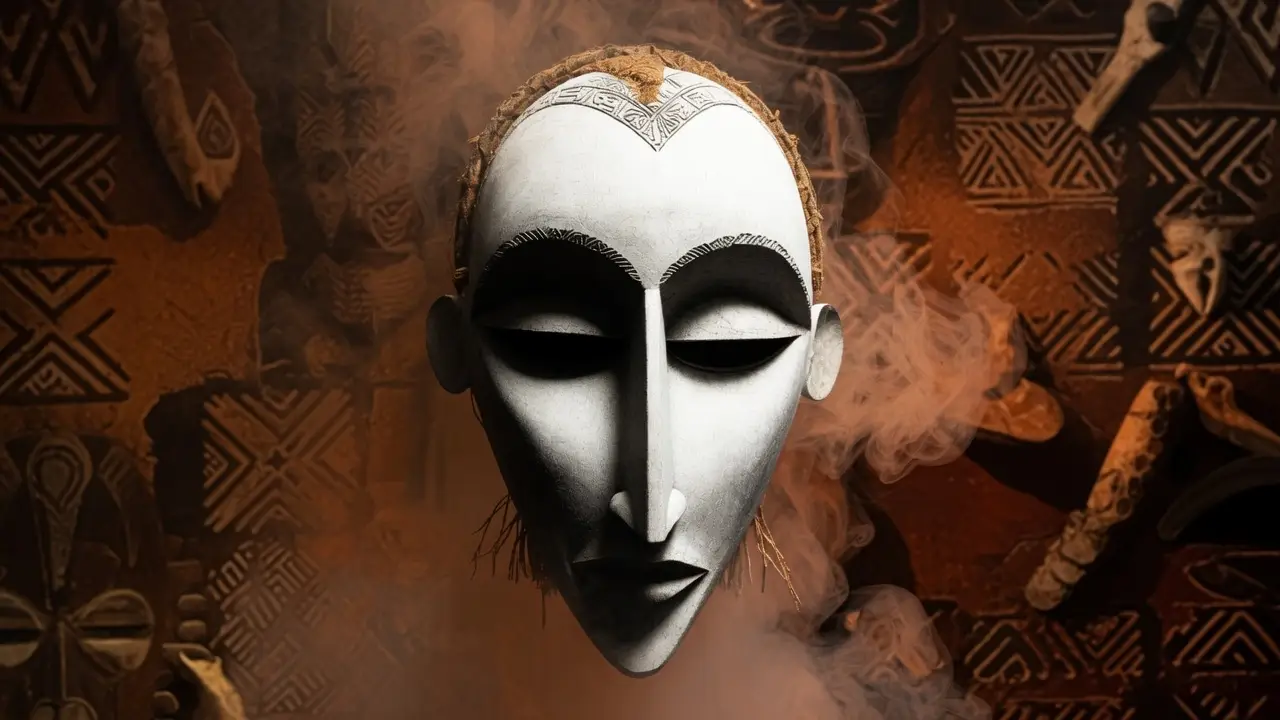
Among the most haunting objects in African art is the Ngil mask of the Fang people of Gabon and Cameroon. White, elongated, and with an expression of serene but implacable authority, the Ngil mask was the face of a secret society that served as the Fang’s primary instrument of social justice. To encounter one was to stand before a force that could investigate, judge, and punish in the name of the community — and that was believed to be supernaturally empowered to do so.
Who Are the Fang?
The Fang are a Bantu-speaking people found in Equatorial Guinea, Gabon, Cameroon, and the Republic of Congo. They are estimated to number around one million people and have historically been organised into patrilineal clans rather than centralised kingdoms. Their art tradition is most celebrated in the Western art world for two categories of objects: the reliquary figures known as byeri, which guarded boxes containing the skulls and bones of important ancestors, and the Ngil masks, which are rarer and even more dramatically powerful in appearance.
The Ngil Society
The Ngil (sometimes spelled Ngi) was a men’s secret society whose primary function was the investigation and punishment of sorcery. In Fang communities, sorcery — the malevolent use of supernatural power to harm others — was considered one of the most serious threats to social well-being. Unexplained illness, crop failure, death, and misfortune were all potential signs of sorcery at work, and the community needed a mechanism to identify and confront the sorcerer.
The Ngil society provided that mechanism. Its members could investigate accusations of sorcery, conduct trials, and administer punishment — which in serious cases could include exile or death. The appearance of the Ngil mask in a village was therefore an event of considerable fear and consequence: it meant that someone had been accused, and that the supernatural machinery of justice was now in motion.
The Mask Itself
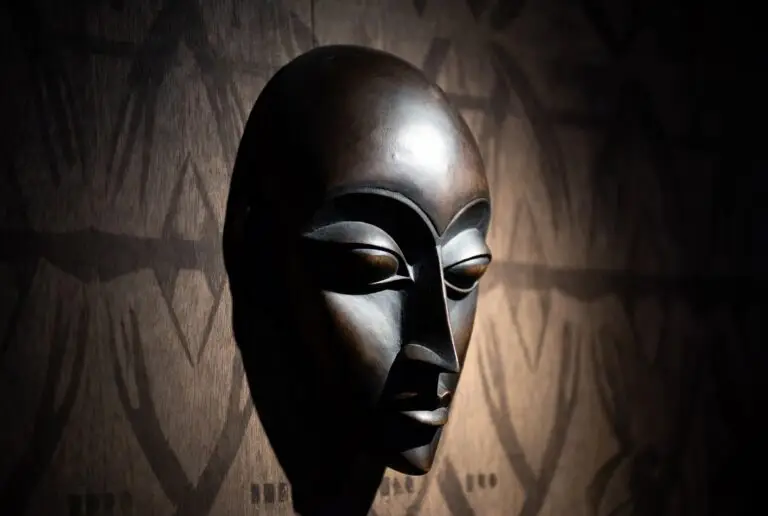
The Ngil mask is a face mask of white kaolin clay applied over carved wood. Its most distinctive feature is its extreme elongation — the face is stretched vertically, giving it a height-to-width ratio unlike almost any other African mask. The features are simplified and schematic: two narrow rectangular eyes, a long straight nose, a small compressed mouth. The surface is entirely white, the colour of the spirit world in many Central African traditions.
The total visual effect is one of otherworldliness: the mask does not look like a human face. It looks like something that has passed through death and returned. This quality was entirely intentional. The Ngil masquerade moved at night, approaching villages in darkness, and the sight of the white mask emerging from the forest darkness must have been extraordinarily frightening.
The performer wore a full costume that concealed his body, and he spoke in a disguised voice that was understood as the voice of the Ngil spirit rather than any individual man. The performance was designed to emphasise the mask’s separation from ordinary human life and its authority as a supernatural force.
The Suppression of Ngil
The Ngil society was suppressed by French colonial authorities in Gabon in the early twentieth century. French administrators viewed the society’s powers of investigation and punishment as a threat to colonial authority, and they prohibited its activities. The suppression was largely effective — Ngil ceased to function as a living institution, and relatively few masks were made after the early colonial period.
Many Ngil masks passed into European collections during this period, often through purchase from communities that could no longer use them ceremonially or from colonial officials who acquired them directly. Today, genuine historical Ngil masks are extremely rare and command some of the highest prices in the African art market.
Legacy and Influence
The Ngil mask became known to Western artists in the early twentieth century and is believed to have been among the African objects that influenced the development of European modernism. Its stark, elongated geometry and its emotional power clearly resonated with artists who were seeking to move beyond the representational conventions of European academic painting. Whatever the precise artistic connections, the Ngil mask stands as one of the most powerful and original sculptural achievements in human history.
Go deeper into the stories behind the masks you just read about. Within Carved Lines uncovers the history, symbolism, and ritual meaning of Africa’s traditional masks — now fully revised in its second edition.
Get Your Copy