Free chapter. This is Chapter 5 of my book Within Carved Lines: The Secret Meanings of African Masks. I have opened a few chapters here so you can read them free. See all the free chapters.
African masks are artistic creations worn over the face, integral to the cultural, social, and spiritual lives of various African communities. They hold profound significance within ancient tribal traditions and continue to be crafted and used today. Revered as gateways to the spiritual world during rituals and ceremonies, they are sacred symbols. While they are often displayed as prized art in museums, their deep cultural importance within their originating communities should never be overlooked.
African masks are remarkable creations, reflecting humanity’s quest for connection with the spirit world while embodying distinct tribal characteristics. Most are carved from wood, reflecting the abundance of this resource in many areas. Trees are believed to possess a living spirit, and the carving process often involves purification ceremonies and sacrifices to transfer this spirit into the mask, enhancing its power. Carvers often undergo preparations like fasting, purification, and abstaining from sexual activity, emphasizing the ritual significance.
Different cultures specialize in various materials: basketwork in the Congo, cast brass and ivory at the court of Benin, metal surfacing with the Marka. Resourceful carvers incorporate sheet metal, fur, animal teeth, feathers, textiles, glass, cowrie shells, and beads. Modern materials like acrylic paints and plastic necklaces have also found their way into some masks.
Masks are typically fastened with bands, scarves, or raffia wigs, and costumes are made from palm leaves, local fabrics, or leather. African mask carvers hold esteemed positions, often learning their craft through apprenticeships or belonging to carving families. Their status varies across cultures.
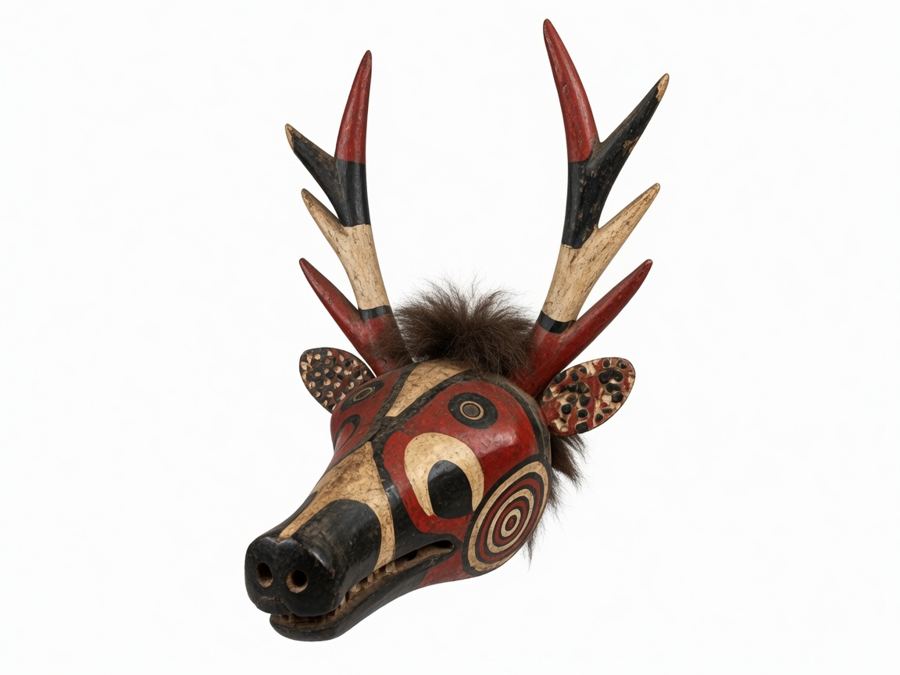
African masks display diverse styles, from naturalistic with clear features to expressionistic idealizations or abstract representations of animals and human expressions. Most lean toward abstraction, reflecting their spiritual intensity and cultural significance.
Historically, mask making was often a collective effort without individual attribution. However, contemporary scholarship recognizes the creative skill and respect accorded to mask makers within their communities.
Beyond face coverings, African masks include helmet masks and headdresses, showcasing a breathtaking array of stylistic features, from naturalistic to abstract, reflecting the rich cultural heritage and spiritual connection of African peoples.
Origin of African Masks
Africa has a rich and ancient mask tradition, dating back long before the first century BC. These masks, with profound cultural significance, served diverse purposes: rituals related to myths, creation, hero worship, fertility, agriculture, funerals, ancestor cults, initiations, and entertainment. This extensive use has been prevalent for centuries.
Evidence of African masks appears in cave paintings in Tassili (Algeria), Fezzan (Libya), and among the San of southern Africa. Tassili’s images of masked dancers came to outside attention in the 1930s and gained wider fame through Henri Lhote’s expedition of 1956 and 1957. These rock paintings suggest mask use for at least 4,000 years. The Nok culture of Nigeria shows how long West African artists have been shaping the human face. Its terracotta heads and figures are sculptures rather than masks, but pieces have been dated to around 360 BC, and they belong to the same deep tradition of giving form to the human and the spiritual. While the original reasons for creating masks remain unknown, their usage and symbolism offer insights.
Facts and Significance of African Masks
-
Spiritual Connections and Ritual Performances: African masks are powerful conduits to the spiritual realm. Used in rituals (weddings, funerals, initiations, agriculture, celebrations), they connect with ancestors, deities, and spiritual forces. The mask’s power is activated within these contexts. Mask wearing is often transformative, the wearer embodying the spirit represented. This transformation is often aided by drumming, chanting, and dancing, sometimes leading to trance states. Masks can also serve as a bridge to ancestors, allowing the living to seek guidance. They can also be used to control or influence forces.
-
A Living Tradition: Mask making is a living tradition, passed down through generations. Master carvers teach apprentices, transmitting technical skills, symbolic meanings, rituals, and spiritual understanding. African artists hold esteemed positions, seen as artists, spiritual practitioners, and keepers of cultural knowledge. While tradition is preserved, the art continues to evolve.
-
Carved in Wood: Wood is the most common material, carrying deep symbolic meaning. The choice of wood is deliberate, based on its properties and connection to the spirit world. Carvers believe the tree’s soul is transferred to the mask. Respect for nature is shown through seeking permission from the tree spirit before felling it. Masks are often adorned with materials like textiles, shells, feathers, and paint, each with symbolic meaning. The tools used also hold significance.
-
Worn by the Honored Few: Mask wearing is often restricted to leaders, elders, or those with spiritual knowledge. These individuals are believed to be best qualified to embody the spirits and interact with the spiritual realm. While mask wearing is often restricted to men, women play significant roles in creation, decoration, and use. In rare instances and in a few cultures, women have been known to wear masks.
-
Cultural Expression: Masks reflect the unique beliefs, values, and artistic traditions of different tribes. Each tribe has a distinct style, characterized by specific shapes, colors, patterns, and materials. Designs and motifs carry symbolic meanings, requiring knowledge of the cultural context. Examples like the large mouthed masks of Gabon and the animal human hybrids of the Ligbi illustrate this diversity.
-
Diverse Forms, From Face to Full Head Coverage and Beyond: African masks exhibit a remarkable range of shapes and sizes, each meticulously designed for a specific ritual context and purpose. They are not simply categorized by size but also by how they are worn, the degree of body coverage they provide, and the specific spiritual or social roles they fulfill.
Types of Masks
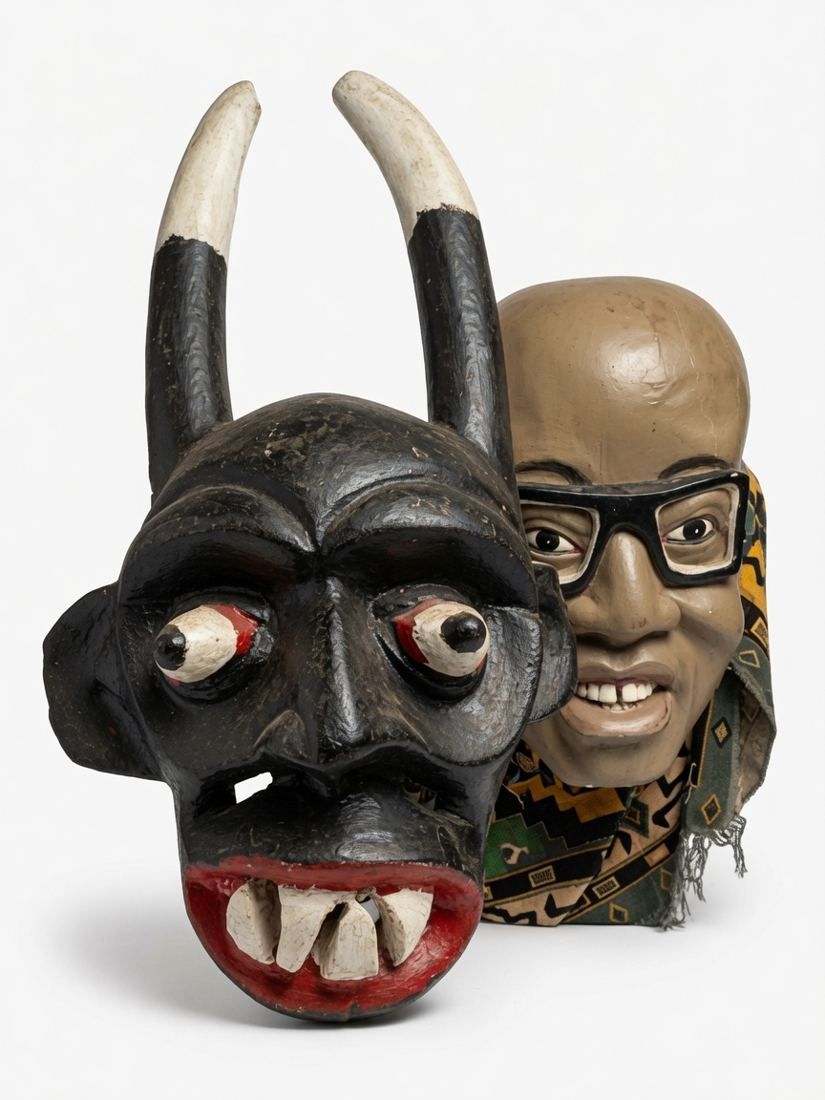
Face Masks
These masks cover only the face, typically secured with a band or strap around the back of the head. They are often relatively lightweight, allowing for greater freedom of movement for the wearer during dances and performances.
Example: The masks of the We (Guéré) people of Côte d’Ivoire are face masks. These powerful masks, used in initiation ceremonies and to enforce social rules, are known for their prominent features, such as tubular eyes, large horns, animal teeth and a fierce expression.
Helmet Masks
These masks enclose the entire head, resembling a helmet. They can be carved from a single piece of wood, sometimes even a whole tree trunk, demonstrating the exceptional skill and artistry of the carvers. These masks often represent powerful spirits or deities.
Example: The sowei masks of the Sande society of the Mende of Sierra Leone are helmet masks, carved from a single block of wood and worn over the whole head. The rings of the neck rest on the wearer’s shoulders, while the face and coiffure rise above, so that the whole head of the dancer is enclosed in the image of ideal womanhood.
Head and Shoulder Masks
These larger masks cover both the head and shoulders, often featuring a heavy base that rests on the wearer’s shoulders. They create an imposing and authoritative presence, frequently used in ceremonies where power, status, and spiritual authority are emphasized.
Example: The D’mba (Nimba) of the Baga people of Guinea is the best known head and shoulder mask. Its massive carved bust rests on the dancer’s shoulders, and the dancer looks out through openings between the breasts. It represents the ideal of mature womanhood and fertility.
Full Body Costumes
In some cases, masks are part of elaborate full body costumes, transforming the wearer into a complete representation of the spirit being embodied. These costumes can be incredibly elaborate and visually stunning, creating a powerful and immersive experience for both the performers and the audience.
Example: The Egungun masquerades of the Yoruba feature full body costumes of layered cloth panels that cover the wearer completely. Not a hand or a foot may show, because the costume is the returning ancestor. The Ekpe masquerades of the Efik and Ejagham peoples of Nigeria and Cameroon likewise use full body costumes of raffia and cloth to maintain social order and enforce community laws, transforming the wearer into a powerful and awe inspiring figure.
Beyond these common types, other mask forms exist
Crest Masks: These masks are worn on the head, often attached to a woven cap or headdress. They are common among various groups, including the Bamana of Mali. The Chi Wara antelope headdress, while often called a mask, is technically a crest mask. The Gelede headdresses of the Yoruba, danced in honour of the mothers, are also worn this way, on top of the head and tilted forward, with the dancer’s face veiled in cloth.
Shoulder Masks: These rest on the shoulders and are often supported by a framework. They can be quite large and elaborate, representing powerful spirits or ancestors.
Historical Masks: The brass and ivory masks of the Benin Kingdom, created by the Edo people of Nigeria, are examples of historical masks. Made of brass or ivory rather than wood, they were used in royal ceremonies and to honour important ancestors. The ivory pendant mask of Queen Idia is the most famous of them. They are renowned for their intricate detail and artistic sophistication.
Decorative Masks: While many African masks serve a spiritual or ritual purpose, some are created primarily for decorative purposes. These masks may still draw inspiration from traditional designs and motifs but are not necessarily used in ceremonies. They may be sold as art objects or used to decorate homes or public spaces.
Working Typology of Mask Forms
For reference and academic use, the following typology cross references mask forms with primary geographic distribution.
Face mask
Covers the face only; secured behind the head. Most widespread form. Found across West Africa (Yoruba Gelede, Igbo mmanwu, Dan of Côte d’Ivoire), Central Africa, and East Africa.
Helmet mask
Encloses the entire head; often carved from a single trunk. Sande and Bondo societies (Sierra Leone, Liberia, Guinea); Kuba Kingdom (DRC); Bamana (Mali).
Head and shoulder mask
Heavy base rests on wearer’s shoulders. Kran (Côte d’Ivoire); Bamileke (Cameroon); some Igbo types.
Forehead or crest mask
Sits atop the head; wearer bends forward. Baga Nimba fertility mask (Guinea); Chi Wara antelope headdress (Bamana, Mali); Ejagham headdresses.
Full body costume
Mask inseparable from entire costume; the whole becomes the spirit. Egungun (Yoruba); Ekpe (Efik and Ejagham, Cross River); Nyau (Malawi, Zambia); Gelede in full performance.
Shoulder mask
Large structure resting on shoulders. Baga Banda (Guinea); some Makonde traditions; Ibibio Ekpo variants.
Bronze or metal mask
Cast metal rather than carved wood; primarily commemorative and royal. Benin Kingdom (Edo, Nigeria): Queen Idia ivory and bronze masks; Akan gold regalia masks (Ghana).
When the Mask Does Not Hide the Performer
The dominant convention in African masquerade is total concealment. The masker is covered head to foot. No part of the man underneath is visible. The audience sees only the mask, the costume, the regalia. This convention is not arbitrary. It is the visible form of a theological position. The man you knew has, for the duration of the performance, been replaced by the spirit that the mask carries. To see any part of the man would be to break the agreement.
But there are exceptions, and the exceptions are theologically interesting. They tell us that the convention is a strong tendency, not an iron law, and that within African masking traditions there is more variation in the performer’s relationship to visibility than is usually acknowledged. I want to discuss two well documented cases.
Kanaga and the Open Face
The Dogon of Mali perform a wide range of masks, and the Kanaga is one of the most visually striking. It is a tall, cross shaped headdress worn at funerary ceremonies, where it represents the cosmic order. The upper crossbar stands for the heavens. The lower crossbar stands for the earth. The central axis is the connection between the two. The Kanaga is danced with vigorous, swooping movements, the wearer bending forward so that the cross arms sweep close to the ground.
What is striking about Kanaga, and about a number of other Dogon masks performed in the same context, is that the dancer’s face is not always fully concealed. In some forms of the Kanaga performance, the lower face of the dancer is visible beneath the headdress. The structure rises above the head. The dancer’s features remain partly exposed. The taboo around identifying the masker still applies. No one names him. No one points to him. No one says aloud who he is. But the visual concealment that one would expect from a more stringent tradition is incomplete.
This is not a flaw in the costume. It is a deliberate feature of how Dogon masking handles the relationship between the dancer and the spirit. The Dogon understand the masker not as wholly replaced by the spirit but as a vessel in active partnership with it. The dancer is performing the spirit, and the spirit is performing through him, but neither displaces the other. The exposed face is the visible mark of this partnership. It says: the man is here, and the spirit is here, and they are dancing together.4
This is a different theology of masking from the Yoruba Egungun, where the slightest exposure of the body of the masker would be a catastrophe. It is not better or worse. It is a different way of solving the same problem of how to bring spirit into community visibly. The Dogon solution preserves the man inside the mask in a way that other traditions do not.
Zaouli Masked Dancers Occasionally Remove the Mask in Public
The Zaouli is a mask of the Guro people of central Côte d’Ivoire. It is a relatively recent tradition. It developed in its current form in the middle decades of the twentieth century, and it has become one of the most internationally visible masquerades from West Africa. Videos of Zaouli dancers performing in village squares and on national stages have circulated widely on the global internet. The dance is famous for the speed and precision of the footwork. The bearer’s feet move in fast, intricate patterns while his upper body remains relatively still. The mask itself is a beautifully carved face mask topped with a small sculptural figure or ornament. The full costume includes a raffia skirt and various coloured cloths.
Zaouli is theologically less rigid than many older masking traditions in the same region. It is performed both in ritual contexts and in entertainment contexts, and the boundaries between the two are not always strict. And it is in this less rigid context that one of the most interesting features of the tradition appears. Zaouli dancers are known to remove their masks in public, sometimes during the performance, sometimes immediately after. The bearer is then visible. His face is uncovered. He is often smiling, sometimes accepting applause and tips from the audience. The mask is set down. The man is shown. The spectacle continues.
This is unthinkable in the more orthodox traditions. To remove the mask of an Egungun in public would be a desecration so severe that the masker’s life could be endangered. To remove the mask of a Sande sowei would be an act of betrayal of the entire society. But Zaouli, by the design of the Guro tradition, allows it. The mask carries less of the strict identity replacement burden than other masks do. It is closer to a ceremonial costume, with sacred elements, than to the total spiritual substitution found elsewhere.5
Why does this matter? It matters because it tells us that even within the West African masking world, the relationship between the man and the mask varies along a continuum. At one end is the absolute concealment of the Egungun, where the masker is wholly replaced. At the other end is the visible bearer of the Ojojo, which we will meet in Chapter 10, where the woman carrying the head is recognised by name. Between them sit traditions like Kanaga, where the face is partly visible, and Zaouli, where the mask can be removed in front of the audience. The principle of concealment is real and important. But it is not absolute, and traditions that bend it are not less authentic for doing so. They are simply solving the problem of sacred visibility in their own way.
The implication for outsiders is that the rules of one masquerade tradition cannot be imposed as a measure on another. To say that Zaouli is less authentic than Egungun because the dancer removes his mask is to apply Yoruba criteria to a Guro tradition. To say that Ojojo is not a real masquerade because the bearer is visible is to apply Igbo concealment conventions to an Aro performance that does not depend on them. African masking is plural. The rules of any one tradition are local, not universal. The traditions that exist on the boundary of the category are not exceptions to the rule. They are the rule, in their own form.
Notes
- On the Dogon Kanaga and the partial visibility of the dancer, see Griaule, Marcel. Masques Dogons. Paris: Institut d’Ethnologie, 1938. The foundational source despite the methodological problems with Griaule’s broader Dogon corpus. For more recent and balanced treatment, see van Beek, Walter E. A. ‘Dogon Restudied: A Field Evaluation of the Work of Marcel Griaule.’ Current Anthropology 32, no. 2 (April 1991): 139 to 167; and the catalogue of the exhibition Dogon: Mondes Africains. Paris: Musée du Quai Branly, 2011. Back to text
- Zaouli is a recent tradition with a thinner scholarly literature than the older West African masking traditions. The most useful printed source is the catalogue of the Musée des Civilisations de Côte d’Ivoire, with field documentation reported in Konaté, Yacouba. Essays on Guro performance traditions. Abidjan, 2007 and later. For documentation of Zaouli in international circulation, see UNESCO Intangible Cultural Heritage list, file 01255 (proclaimed 2017), ‘Zaouli, popular music and dance of the Guro communities of Côte d’Ivoire,’ available at ich.unesco.org. The convention of the dancer removing the mask in performance contexts is documented in video records of the tradition rather than in dedicated scholarly print sources, and is part of why a more rigorous ethnography of Zaouli remains needed. Back to text
Continue reading Within Carved Lines
There are twenty six chapters in the full book, covering the language of masks, colour, texture, the grammar of form, secret societies, women and masking, regional traditions, the diaspora, and how to identify, authenticate and care for an African mask.
Previous: Chapter 3, Are African Masks Evil? | Next: Chapter 6, What Do African Masks Mean to Africans? | All free chapters