Free chapter. This is Chapter 6 of my book Within Carved Lines: The Secret Meanings of African Masks. I have opened a few chapters here so you can read them free. See all the free chapters.
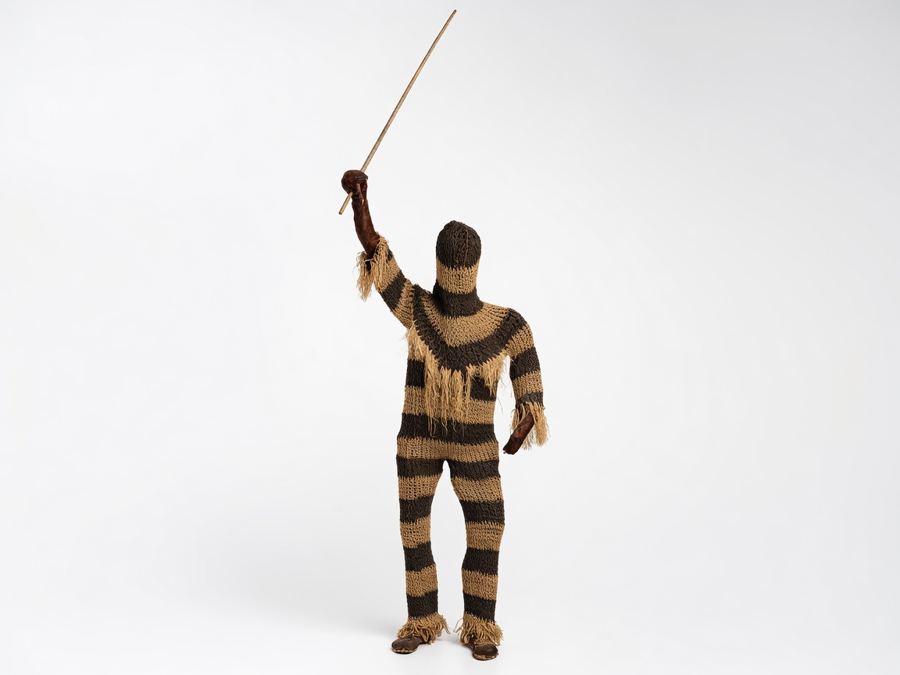
The sight of African masks displayed as decorative objects in Western homes would likely shock our ancestors. Not because the objects are sacred in themselves, though many are, but because the entire premise of a mask as a static, silent thing hung on a wall violates everything the tradition understands masks to be. A mask in a Western living room is a contradiction in terms: it is a verb that has been forced into the grammar of a noun.6
This chapter explores what masks actually mean within African communities, not as outsiders have catalogued them, but as the traditions themselves understand them.
A Worldview, Not a Belief System
Before engaging with what masks mean, it is necessary to understand the worldview from which they emerge. African spiritual life, from which mask traditions cannot be separated, is not a belief system in the way that word is used in Western contexts. It is not a set of propositions held separately from ordinary life and practised on designated occasions. It is a framework through which all of reality is understood and engaged.
This distinction matters enormously for understanding masks. In a Western framework, one might say a mask “represents” a spirit. This word implies separation: the mask is over here, the spirit is somewhere else, and the mask gestures toward it. In most African masking traditions, this is precisely wrong. The mask does not represent the spirit, it manifests it. When the correct preparations have been made, when the correct songs have been sung, when the masquerade emerges from the forest or from the sacred enclosure, the spirit is present. The community is not watching a performance about the spirit; they are in the presence of the spirit itself.7
For the Igbo people of southeastern Nigeria, where my own roots lie, this presence is understood through the concept of chi, the personal spirit that connects an individual to the divine8, and through the more collective concept of alusi, the supernatural forces that inhabit specific places, lineages, and objects.9 A mask activated for ritual is not merely a symbol of an alusi; it is, for the duration of the masquerade, a vehicle through which that force operates in the community.
Animism, Ancestor Veneration, and the Permeable Boundary
African spiritual systems generally recognise that the boundary between the living and the dead, between the material and the spiritual, is permeable, far more permeable than most Western frameworks allow. The ancestors are not gone. They have passed through a threshold into another form of existence, but they remain members of the community, interested in its welfare, accessible through the correct protocols, and capable of both assistance and harm depending on how they are treated.
This is not metaphor. The community’s relationship with its ancestors is as real, as consequential, and as demanding of proper conduct as its relationships with living elders.10 Harvest failures, community conflicts, illness, and infertility may all be understood as symptoms of a broken relationship with the ancestors, not because of superstition, but because the framework understands the community to include its dead members, and relational health requires tending all relationships.
Masks are the primary technology for managing this relationship. They are the medium through which the living call the ancestors back for consultation, for judgment, for celebration, and for farewell. This is why the materials from which a mask is made matter so profoundly, why the carver must observe ritual protocols, and why the performance must follow procedures established across generations. Each element of the process is a message to the ancestor: we have prepared correctly. We have respected you. Come.
The Social Functions of Masks
It is tempting to reduce African mask traditions to the spiritual dimension alone, because this is the element most foreign to Western experience. But masks serve a range of social functions that are inseparable from their spiritual significance.
Justice and Social Control
In many traditions, the masquerade is the community’s highest court. The Ekpe society among the Efik and Ejagham of the Cross River region of Nigeria and Cameroon uses masked performance as a mechanism of social regulation: debts can be enforced, disputes adjudicated, and social norms reinforced through the authority of the masquerade. When the Ekpe masquerade appears to settle a matter, its ruling carries an authority that no human court can match11, because it speaks not merely with human authority but with ancestral and spiritual authority combined.
Among the Yoruba, the Egungun masquerade exercises a comparable judicial function. Egungun is the collectivity of the ancestors, made visible.12 When an Egungun appears, the community is hearing from all of its dead together. Its pronouncements on community matters carry the weight of that collective ancestral authority.
This judicial function explains why interfering with a masquerade, approaching it without authorisation, speaking when silence is required, or breaking the rules that govern its appearance, is treated as a serious community offense in many traditions. One is not merely disrupting a ceremony; one is obstructing justice.
Education and the Transmission of Culture
The masquerade is one of the primary mechanisms through which African communities transmit cultural knowledge across generations. The Gelede tradition among the Yoruba, recognised by UNESCO as a Masterpiece of the Oral and Intangible Heritage of Humanity,13 uses masked performance to teach community values, honour exemplary women and men, satirise antisocial behaviour, and retell the myths on which the community’s understanding of itself depends.
The Igbo tradition of Omabe and Ijele masquerades similarly encodes cosmological and historical knowledge in their forms. The Ijele, the most elaborate and sacred Igbo masquerade14, reserved for the most significant occasions, carries a visual encyclopaedia of Igbo cosmology in its structure. Reading the Ijele correctly is reading a text that contains everything the community needs to understand about its place in the cosmos.
The educational function operates across age groups simultaneously. Children learn one layer of meaning from watching the masquerade; initiates learn another; elders carry meanings that are never publicly disclosed. The mask is the medium of a curriculum that spans a lifetime.
Healing and Protection
Masks are also healing technologies in many traditions. The Dan people of Ivory Coast and Liberia use masked figures in healing ceremonies, where the masquerade’s presence channels the healing power of the spirit world into the physical condition of the patient. Among the Yoruba, Osanyin, the deity of herbal medicine, is associated with masked figures whose knowledge of plants and their spiritual properties forms the basis of traditional healing practice.
Protection is a related function. The Poro society’s masks, active across Sierra Leone, Liberia, Guinea, and Ivory Coast, serve protective functions for the community as a whole: the masquerade polices the boundaries between the forest and the village, between the seen and the unseen, managing the forces that might otherwise harm the community if left unattended.
Commemoration and the Preservation of Memory
Masks serve as the community’s memory technology. Before written records, the masquerade preserved the deeds of significant ancestors, their names, their achievements, their relationships with the divine, in living, performed form. Each generation of performers was also a generation of librarians, carrying knowledge that had to be transmitted correctly or would be lost.
The masks held in family shrines and lineage compounds serve the same function in material form. Queen Idia’s mask, the ivory hip pendant commissioned by the Oba of Benin in the sixteenth century to honour his mother, is not merely a beautiful object. It is a statement about lineage, about political power, about the intersection of the human and the divine, and about the proper gratitude owed to women who produce great rulers. The mask is a text. To see it only as an art object is to read the cover and miss the book.
The Igbo Perspective: What My Own Tradition Teaches
As an Igbo person, I can offer some observations from inside the tradition that external accounts often miss or soften.
First: the fear is real. The awe that African communities feel in the presence of a properly activated masquerade is not a performance of deference or a residue of belief that modernity has eroded. Among communities where the masquerade tradition is strong, the emotional reality of encountering a powerful masquerade, the sense of something vast and not entirely benevolent having entered your space, is genuine and immediate. This is not primitive terror; it is the appropriate response of finite human beings to contact with something beyond the human scale.
Second: the rules matter because the relationship matters. The prohibitions that govern masquerade interaction, do not touch, do not follow, do not look back, do not call the masquerade by the name of the man inside, are not arbitrary conventions. They are the protocols of a relationship, and the relationship has consequences. Relationships with ancestors and spiritual forces are like relationships with powerful people: they must be conducted with care, respect, and the correct etiquette, or they go wrong.
Third: the knowledge is a gift, not a possession. Within Igbo masquerade tradition, the deepest mask knowledge is entrusted to specific lineages and offices. This knowledge is understood as a gift held in trust for the community, not as property belonging to the holder. An elder who dies without properly transmitting this knowledge to a successor is understood to have failed a sacred responsibility. The knowledge is not theirs to keep; it belongs to the community across all generations.
The Contrast That Reveals the Meaning
Perhaps the clearest way to understand what masks mean to Africans is to observe what is lost when they are removed from their context.
When a mask is placed in a Western museum, several things happen simultaneously. The object is physically preserved, often better than it would be in a humid forest climate. The aesthetic qualities become visible in ways the original performance context does not allow. Scholarship can examine the object in detail.
But the mask is also killed. Its activation, the songs, the preparations, the community gathering, the specific occasion, cannot travel with it. Its relationship network, the lineage that cares for it, the society that deploys it, the community that receives it, is severed. The mask in the vitrine is not a mask that has been preserved. It is a mask that has been frozen at the moment of death.
This is not a reason to return all masks to their communities without consideration, the situation is more complex than that, and Chapter 26 engages with it in depth. It is a reason to understand that what you are looking at, in any museum or private collection, is an object that was once part of something vastly larger than itself, and that the larger thing, the living tradition, is the actual subject of this book.
Notes
- On Western misreading of African masks as purely aesthetic objects, see Price, Sally. Primitive Art in Civilized Places. Chicago: University of Chicago Press, 1989. Price’s analysis of the institutional conditions that produce Western misreading of African art objects is directly applicable here. Back to text
- The mask as manifestation rather than representation, the distinction between presence and symbol, is discussed in Drewal, Henry John, and Margaret Thompson Drewal. Gelede: Art and Female Power among the Yoruba. Bloomington: Indiana University Press, 1983, pp. 4 to 5. Back to text
- For the Igbo understanding of chi as personal spirit and its relationship to the divine order, see Uchendu, Victor C. The Igbo of Southeast Nigeria. New York: Holt, Rinehart and Winston, 1965; and Achebe, Chinua. “Chi in Igbo Cosmology.” In Morning Yet on Creation Day. London: Heinemann, 1975. Back to text
- The concept of alusi, the supernatural forces that inhabit specific places, lineages, and objects in Igbo tradition, is developed in Henderson, Richard N. The King in Every Man: Evolutionary Trends in Onitsha Ibo Society and Culture. New Haven: Yale University Press, 1972. Back to text
- The concept of the permeable boundary between the living and the dead in African spiritual systems is examined in Bloch, Maurice, and Jonathan Parry, eds. Death and the Regeneration of Life. Cambridge: Cambridge University Press, 1982; and in Kopytoff, Igor. “Ancestors as Elders in Africa.” Africa 41.2 (1971): 129 to 142. Back to text
- The judicial function of the Ekpe society across the Cross River region is documented in Pratten, David. The Man Leopard Murders: History and Society in Colonial Nigeria. Edinburgh: Edinburgh University Press, 2007; and in Latham, A.J.H. Old Calabar 1600 to 1891: The Impact of the International Economy upon a Traditional Society. Oxford: Clarendon Press, 1973. Back to text
- On the Egungun as the collectivity of the ancestors made manifest, see Drewal, Margaret Thompson, and Henry John Drewal. “More Powerful than Each Other: An Egbado Classification of Egungun.” African Arts 11.3 (1978): 28 to 39. Back to text
- The Gelede tradition’s educational and social commentary functions are discussed at length in Drewal and Drewal, Gelede, pp. 1, 8, 16; and Lawal, Babatunde. The Gèlèdé Spectacle: Art, Gender, and Social Harmony in an African Culture. Seattle: University of Washington Press, 1996. Back to text
- On the Ijele masquerade as a cosmological text encoding Igbo worldview, see Cole, Herbert M., and Chike C. Aniakor. Igbo Arts: Community and Cosmos. Los Angeles: UCLA Museum of Cultural History, 1984. Back to text
Continue reading Within Carved Lines
There are twenty six chapters in the full book, covering the language of masks, colour, texture, the grammar of form, secret societies, women and masking, regional traditions, the diaspora, and how to identify, authenticate and care for an African mask.
Previous: Chapter 5, What Are African Masks? | All free chapters