Free chapter. This is Chapter 1 of my book Within Carved Lines: The Secret Meanings of African Masks. I have opened a few chapters here so you can read them free. See all the free chapters.
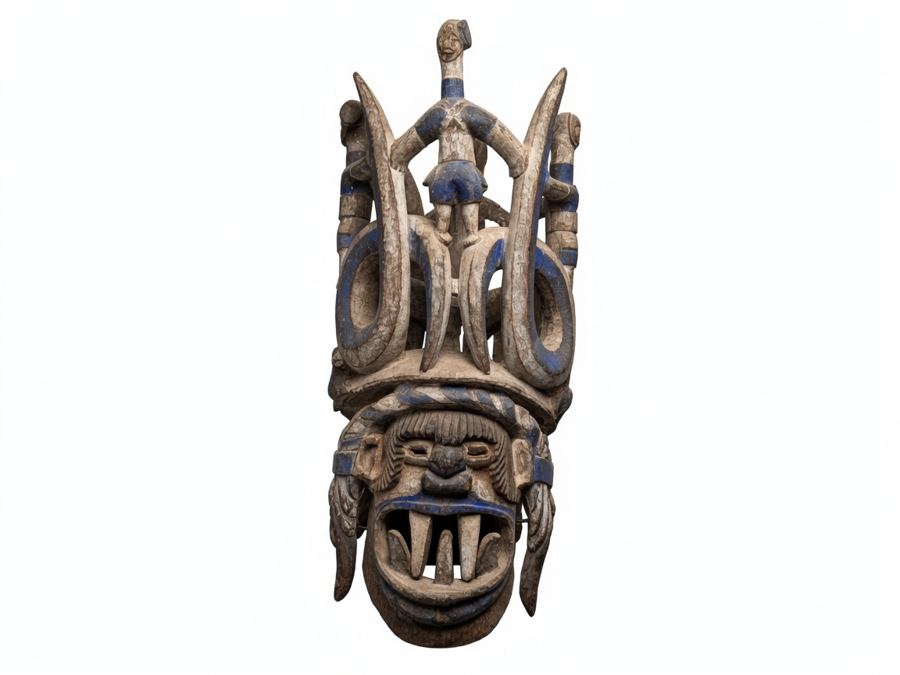
My fascination with masks, and African art in general, fuels this book. Initially, my desire to learn about these subjects was met with a frustrating lack of resources. Extensive searching led me to self study, including traveling to witness masquerade dances firsthand. My purpose wasn’t entertainment, but rather to absorb the nuances of music, song, and movement, to truly observe and understand the masks. This hands on approach proved invaluable, transforming each encounter with a masquerade into a learning experience. Of course, my childhood experience with a masquerade, which left such a powerful impression, may have been the initial spark of this interest.
Despite their central role in African life and cosmology, written resources on African masks remain scarce. While it’s often stated that our ancestors relied solely on oral tradition, this isn’t entirely true. Africa was home to ancient writing systems, some predating even hieroglyphics. Yet, much of the knowledge associated with masks has been lost, a disheartening reality. There is, quite simply, no Africa without masks, and I offer two key reasons for this assertion; one is spiritual and the other, physical.
First, we were the first to encounter the divine. It’s widely accepted that life and civilization originated in Africa. Prehistoric cave drawings in Fezzan (Libya), Tassili (Algeria), and among the San of southern Africa suggest the existence of African masks from the earliest times. Consider the biblical story of Moses, whose face radiated after encountering God (Exodus 34), requiring a veil for his return to human society. Similarly, the Ethiopian Orthodox Church of Our Lady Mary of Zion recounts stories of priests blinded by the Ark of the Covenant.
Close proximity to the divine often necessitates a protective barrier. Masks, as you will learn, symbolize a divine encounter or covenant, opening portals for both the wearer and the audience to experience the spiritual realm. Numerous African cultures reflect this concept. Igbo participants in certain rituals hold palm fronds between their lips, preventing idle chatter and allowing communication only with the divine. Yoruba kings (Obas) wear beaded crowns, shielding their faces from the public, as they were considered beyond human and should never be looked in the eyes.
Second, masks are art forms crafted to convey profound meanings, teach moral lessons, and recount our origins. This artistic aspect is perhaps the most readily recognized, even by those who don’t fully grasp the deeper symbolism. Masks embody intergenerational knowledge and history. Removing masks with cultural, historical, or spiritual significance disrupts entire civilizations, creating chasms that Western education, spirituality, and philosophy cannot bridge. We end up with two cultures, each possessing artifacts they no longer fully understand.
The widespread occurrence of masks across Africa and in such great numbers coming from as early as prehistoric times, tells a profound tale. There are millions of mask pieces from before we were colonised. To Africans of all ages, the mask meant so much and held such great value. Some of these we uncover in the coming pages.
This book aims to provide a resource for students of various arts, particularly African arts, offering insights into African masks from an African perspective. It will also help mask owners understand the meaning behind their possessions, guide aspiring collectors, and encourage ethical practices among established collectors. Most importantly, I hope this book serves African artists. Our ancestors, despite lacking formal education, created some of the world’s most remarkable art. We can do so again. I hope the knowledge shared here will inspire a resurgence in African mask making, satisfying the European appetite for African art, but this time, offering art, not icons of spiritual realities. There’s a huge difference between the two.
But… We are not our Ancestors…
The more I studied African masks, the more I realised that we are not our ancestors. The generations of Africans alive today are nothing like the people who made these ancient masks and held them to such great values. The same I can say to the Europeans whose ancestors, seeing the great value our people had for these sacred objects, looted them as a sign of their dominance and conquest. Those days are long gone and for most people holding onto an ancient African mask today, the meaning must be different.
We are frozen in time, all stuck in the past and fixated on creations of a different time. The spirit to create new exciting masks is gone. I do not imply that we lack artists capable of creating beautiful masks. Aesthetics was not what made the masks priceless. It was community.
Call it quagmire and you will be right, because we have Africans who have no need for their masks anymore and non Africans who have no idea what they have. The use of African masks as art pieces can be equated to using a shotgun as a cooking spoon. Simply because it stirs the soup, does not make it a good cooking utensil.
Yes, we are not our ancestors and have come so far that a few more generations and we might totally lose the last strands of knowledge of who they were. This book might help other Africans who are like I was to start their journey to rediscovering their roots.
Continue reading Within Carved Lines
There are twenty six chapters in the full book, covering the language of masks, colour, texture, the grammar of form, secret societies, women and masking, regional traditions, the diaspora, and how to identify, authenticate and care for an African mask.
Next: Chapter 2, Am I Giving Away Secrets? | All free chapters