Kuba Kingdom: Art, Masks, and the Legacy of Central Africa’s Greatest Empire
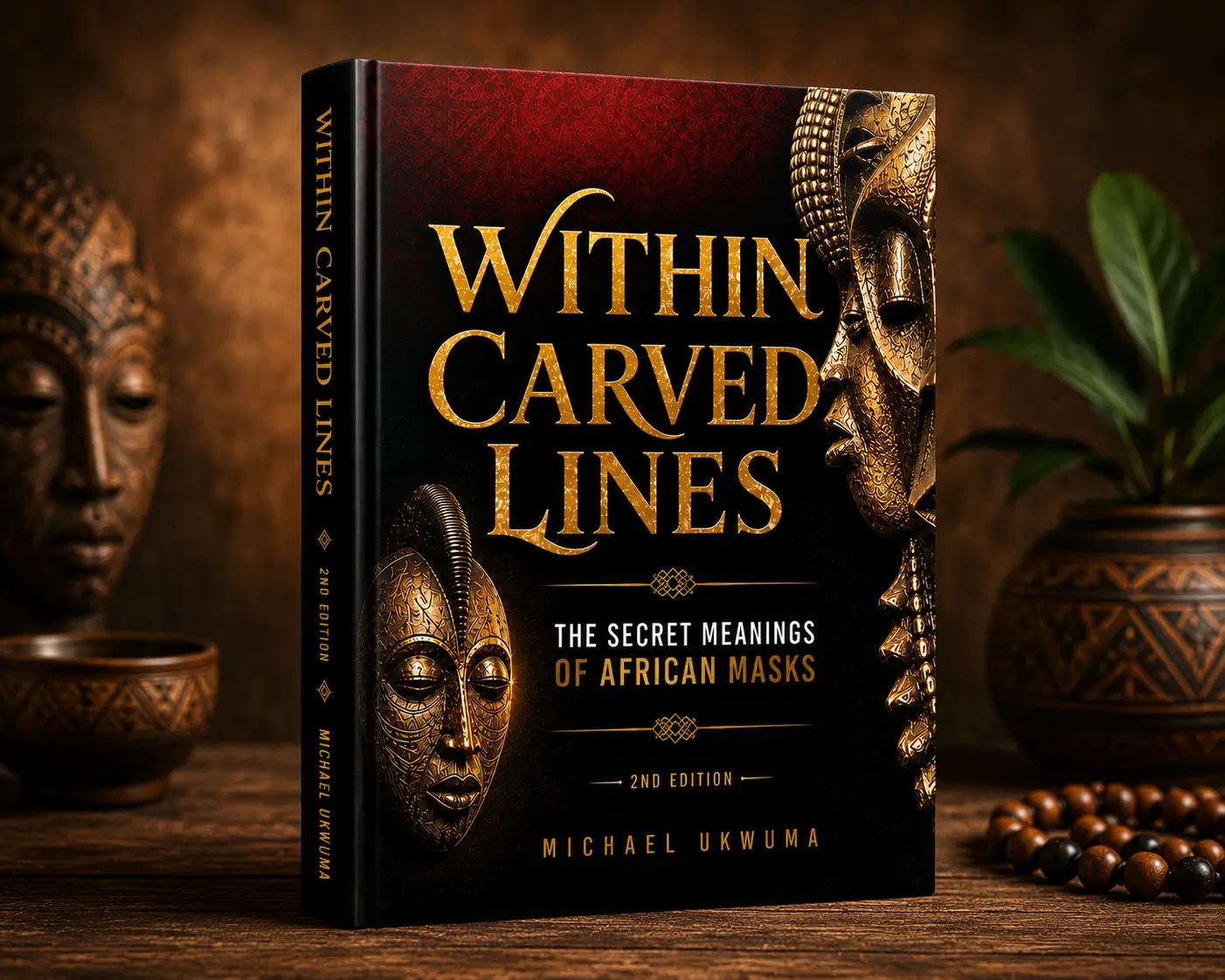
New: the 2nd edition of Within Carved Lines: The Secret Meanings of African Masks is out now. Get the book →
In the heart of what is now the Democratic Republic of Congo, between the Kasai and Sankuru rivers, there flourished from roughly the seventeenth to the nineteenth century a kingdom that produced some of the most astonishing art in human history. The Kuba Kingdom — known to its own people as the Bushoong Kingdom — was not only a powerful political entity but a civilisation that elevated artistic production to a central principle of governance and identity.
Origins and Rise
According to Kuba tradition, the kingdom was founded by a hero-king named Woot, the mythological ancestor of the Bushoong people, who settled the region and established the social and spiritual order that the kingdom would follow. Historical research suggests the Bushoong arrived in the region around the sixteenth century and established dominance over neighbouring groups through a combination of military power and sophisticated political organisation.
The great cultural flowering of the kingdom is associated with the reign of Shyaam aMbul aNgoong, the ninety-third Kuba king (or nyim), who came to power around 1600. According to both tradition and historical evidence, Shyaam was a traveller and innovator who introduced new crops — including corn and tobacco from the Americas via Portuguese traders — new weaving techniques, new art forms, and new political structures. He is credited with developing the distinctive Kuba style that would mark the kingdom’s art for the next three centuries.
Kuba Masks
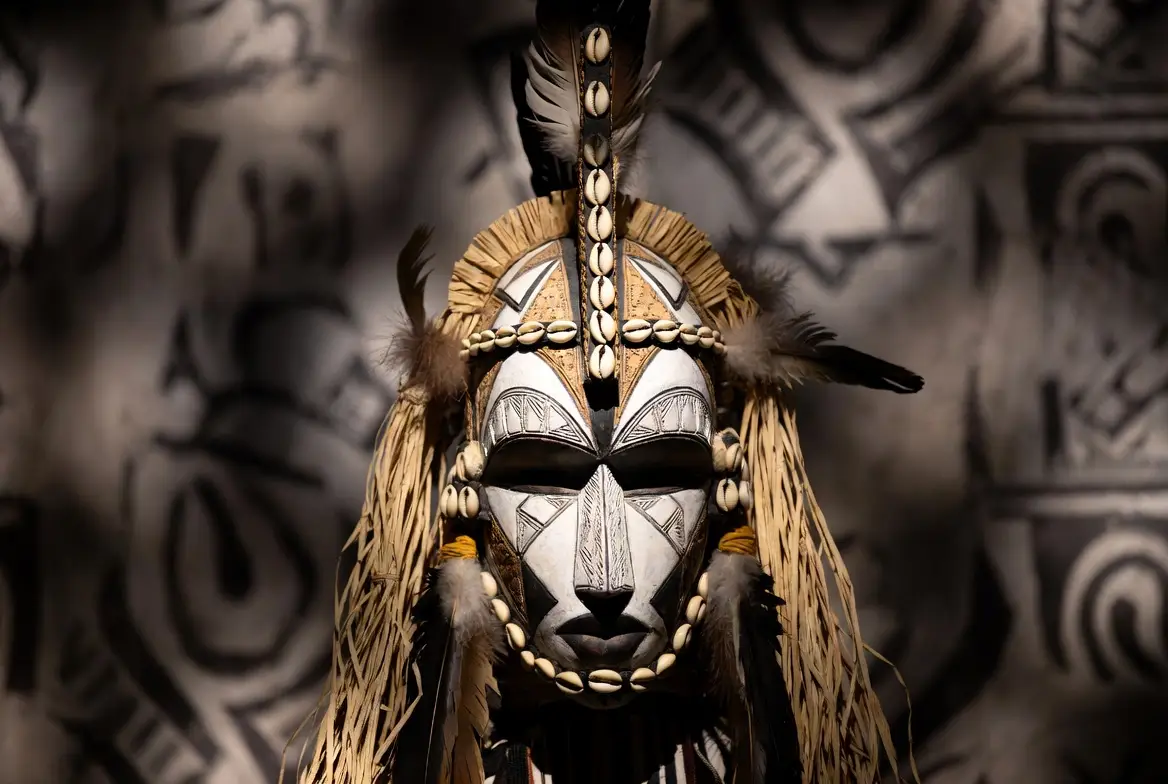
The Kuba masquerade tradition centres on three primary mask types that represent the royal family and the founding myth of the kingdom. The Mwaash aMbooy mask represents the king himself, Woot, and is one of the most elaborate and visually complex masks in Africa. It is a helmet mask entirely covered in beads, cowrie shells, feathers, and cloth panels of intricate geometric design. The colours and patterns are not decorative but symbolic, each element corresponding to specific aspects of royal identity and cosmic order.
The Bwoom mask represents a rival — in some accounts a commoner, in others a dwarf brother of the king — who challenges royal authority. The Bwoom mask has a dramatically different appearance from the Mwaash aMbooy: it is a large, rounded helmet mask with a prominent, protruding forehead and cheeks, painted in blues, reds, and whites. Where the Mwaash aMbooy represents refinement and royal dignity, the Bwoom represents earthly power and the perspective of the people.
The Ngady aMwaash mask represents the wife and sister of Woot, the central female figure in the founding myth. It is a face mask with distinctive white triangular and linear patterns against a black ground, representing tears. The presence of all three masks together — king, rival, and woman — creates a complete dramatic representation of the kingdom’s foundational narrative.
Kuba Art Beyond Masks
The Kuba Kingdom is equally celebrated for its textiles, which are considered among the most sophisticated in Africa. Kuba cloth is woven from raffia palm fibre on a fixed-heddle loom, then decorated using cut-pile techniques that create a velvet-like surface with geometric patterns of extraordinary intricacy. The geometric vocabulary of Kuba design — which involves complex interlocking patterns with no repeating elements — has been compared to mathematical concepts such as recursion and fractal geometry.
Kuba artisans also produced elaborate wooden prestige objects: carved boxes, cups, and staffs decorated with the same geometric patterns that appear in their textiles. The ndop — a royal portrait figure carved in wood — represents a specific king seated in a cross-legged position, with an identifying emblem at the front of the base that distinguishes each ruler from his predecessors.
The Kingdom Today
The Kuba Kingdom continues to exist today, with a living nyim (king) who maintains the ceremonial and political traditions of his predecessors. The kingdom operates within the modern political structure of the DRC, but its internal governance, artistic traditions, and ceremonial life continue. Kuba weavers still produce raffia cloth using traditional techniques, and the masks are still used in royal ceremonies. The kingdom has also engaged actively with the international art market, with mixed results — Kuba objects are among the most valued in the market for African art, creating both opportunities and challenges for the community.
Go deeper into the stories behind the masks you just read about. Within Carved Lines uncovers the history, symbolism, and ritual meaning of Africa’s traditional masks — now fully revised in its second edition.
Get Your Copy