African Traditional Tattoo: Tribes That Tattoo and What the Marks Mean
Tattoos in Africa: A History as Old as Civilisation
When Ötzi the Iceman, a Neolithic hunter whose preserved body was discovered in the Alps in 1991, was found to have tattoos dating to around 3,300 BCE, the discovery reshaped assumptions about the antiquity of tattooing. But Africa has its own ancient tattooing traditions that are at least as old, and in some cases older. Tattooed mummies have been found at ancient Egyptian and Nubian burial sites dating to as early as 3,000 BCE, and the practice of permanent body marking has been documented across the continent from the Sahara to the Cape. African tattooing is not a recent import or a peripheral curiosity — it is one of the foundational chapters in the global history of human self-expression.
The Distinction Between Tattooing and Scarification
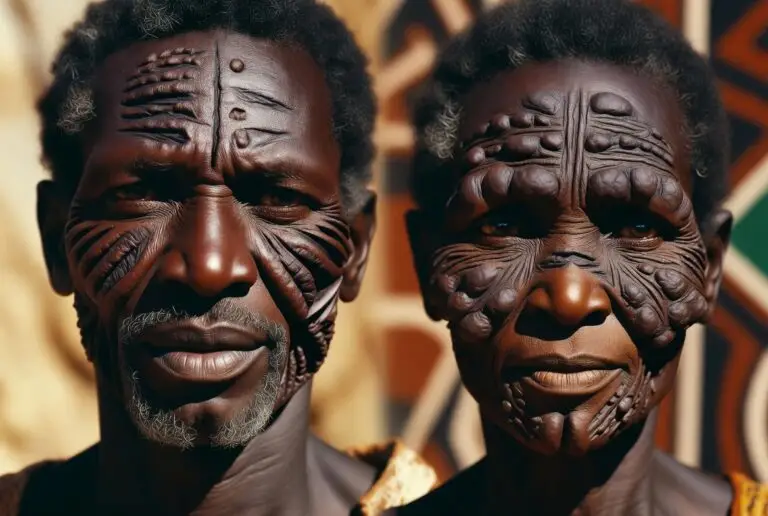
Before exploring specific African tattoo traditions, it is important to draw a distinction between tattooing — the introduction of ink or pigment beneath the skin using needles or cutting tools — and scarification, which creates permanent marks by cutting, burning, or abrading the skin and allowing it to heal in raised patterns. Both are forms of permanent body modification, and both serve many of the same social and spiritual functions in African cultures. However, they are distinct practices with different histories and distributions across the continent.
Tattooing in the strict sense — using pigment inserted into the skin — has historically been more common in North Africa and the Horn of Africa, where lighter-skinned populations allow the marks to be clearly visible. Scarification, which creates relief patterns on the skin, has been more prevalent across sub-Saharan Africa, where darker skin makes tattooed pigment difficult to see. This is a practical rather than cultural distinction; where both practices exist, they often serve similar purposes.
Amazigh Tattoo Traditions of North Africa
The Amazigh (Berber) peoples of North Africa — Morocco, Algeria, Tunisia, Libya, and the Sahara — have one of the most extensive tattooing traditions on the continent. Amazigh women traditionally tattooed their faces, hands, feet, and ankles with geometric designs that served multiple purposes simultaneously: they marked tribal and clan identity, provided protection against the evil eye, enhanced fertility, and served as permanent jewellery that could not be stolen or lost.
The geometric vocabulary of Amazigh tattoos — crosses, diamonds, parallel lines, triangles, and the protective eye symbol — draws on the same symbolic repertoire found in Amazigh carpet weaving, pottery, and silver jewellery. Many of these symbols have been in use for thousands of years, and their meanings, though sometimes no longer known to individuals, are encoded in the tradition itself. The practice of facial tattooing was widespread among Amazigh women until the mid-twentieth century, when it began to decline under the influence of Islamic interpretation that regards permanent body modification as forbidden, and under the pressure of urbanisation and Arabisation.
Today, older Amazigh women with facial tattoos are increasingly rare, and the practice has essentially ceased among younger generations in most communities. However, there is a growing revival movement among younger Amazigh women who see tattooing as an act of cultural reclamation and identity affirmation — a way of reconnecting with a heritage that was suppressed by colonial and religious pressures.
Ethiopian Tattoo Traditions
In Ethiopia, tattoo traditions are particularly associated with the Coptic Christian community, where tattooing the Coptic cross on the wrist or forehead has served for centuries as a mark of Christian identity. In the context of a region where Christians, Muslims, and followers of traditional religions have coexisted — and sometimes competed — for centuries, a permanent mark of religious identity on the body is not merely decorative but a statement of faith and community belonging that cannot be removed.
The practice of tattooing the cross is widespread among Ethiopian and Eritrean Orthodox Christians, particularly as a coming-of-age practice for children. Parents take their children to the church or to a specialist to have the cross applied using traditional methods — typically using soot or another black pigment and a needle or thorn. The tattooed cross is understood as a form of divine protection as well as a mark of identity, analogous to the physical mark through which livestock are identified as belonging to a particular owner — in this case, belonging to God.
The Fulani and Their Face Tattoos
The Fulani (also known as Fula or Peul), a largely pastoralist Muslim people spread across the Sahel from Senegal to Sudan, have traditionally practised a form of facial tattooing particularly associated with women. Fulani women may have their gums, lips, and the skin around their mouths tattooed with dark pigment, enhancing what is considered a sign of beauty in many Fulani communities — full, darkly pigmented lips and gums. This practice, known in some regions as kanki, combines cosmetic and identity-marking functions, since the specific pattern and extent of the marking varies between different Fulani clans and regions.
The Nuba Mountains: Body Art as a Total Art Form
The Nuba peoples of Sudan’s Nuba Mountains are renowned for developing one of the most sophisticated body art traditions in the world — a practice that incorporates scarification, body painting, and occasionally tattooing into an integrated aesthetic system in which the body itself becomes the primary canvas. Male Nuba youth compete at wrestling festivals to display their physical perfection, their bodies decorated with elaborate geometric patterns that they apply themselves using natural pigments.
Among certain Nuba groups, the permanent body marking that accompanies these traditions includes scarification patterns that identify the individual’s clan, age grade, and personal history. These marks accumulate over a lifetime, creating a permanent autobiography written on the skin. The body art traditions of the Nuba, documented in photographs by Leni Riefenstahl in the 1970s, became internationally famous but were also the subject of considerable ethical controversy given Riefenstahl’s association with Nazi Germany and questions about the exploitation of African subjects for Western audiences.
Tattoos, Colonialism, and the Loss of Tradition
Many African tattoo and body marking traditions declined sharply or disappeared entirely during the colonial period and its aftermath. Christian and Islamic missionary activity often targeted traditional body marking as a sign of “savagery” or as a religious prohibition to be enforced. Colonial administrators associated tattooing and scarification with primitiveness and sought to discourage or ban these practices. Urbanisation and the spread of Western beauty ideals created social pressure against visible traditional markings, particularly for people seeking employment in the colonial economy.
The loss of these traditions represents a profound cultural impoverishment. Each tattoo tradition encodes centuries of social history, cosmological understanding, and aesthetic innovation. When older tattooed women die and are not replaced by a new generation of practitioners, an irreplaceable thread of cultural knowledge disappears. This loss is increasingly recognised by African communities themselves, many of whom are now working to document, revive, and celebrate their body marking traditions as expressions of cultural pride and resistance to cultural homogenisation.
The Contemporary Revival
Across Africa, a growing movement of young people is reclaiming traditional body marking — including tattooing — as a form of cultural identity politics. In Morocco, Amazigh women are getting traditional geometric tattoos as acts of decolonial self-expression. In Ethiopia, the cross tattoo remains widespread. In cities across sub-Saharan Africa, a new generation of tattoo artists is developing contemporary styles that draw on traditional African geometric, symbolic, and figurative vocabularies, creating a modern African tattoo aesthetic that honours the past while engaging with the present.
This revival is part of a broader global reassessment of African cultural traditions — a recognition that what was dismissed as primitive or superstitious by colonial-era observers was in fact sophisticated, meaningful, and worth preserving. African tattoo traditions represent not the absence of civilisation but one of its most enduring and intimate expressions.