Chokwe Cikungu Mask: Chiefs, Ancestors, and Power in Angola
New: the 2nd edition of Within Carved Lines: The Secret Meanings of African Masks is out now. Get the book →
Most masking traditions covered on this site belong to a single people in a single region. The Chokwe tradition is bigger than that. About one million Chokwe are spread across the savanna and river country of eastern Angola, southern Democratic Republic of the Congo, and Zambia, and their masks are not one static form but a working system, ranked from the sacred to the theatrical, still recognized across Central Africa today. Understanding that ranked system, who may wear which mask, and why, is what makes the rest of this piece make sense.
The Chokwe People of Central Africa
The Chokwe are a Bantu speaking people whose homeland spans the border regions of north eastern Angola, southern DRC, and north western Zambia. They were originally a small, subordinate group within the sphere of the Lunda Empire, one of the great Central African polities that flourished from the seventeenth century onward. Through a combination of skilled hunting, trade in ivory and wax, and military expansion in the nineteenth century, the Chokwe grew to become one of the most powerful peoples in the region, eventually challenging and temporarily overthrowing the Lunda Empire itself in the 1880s. Today, the Chokwe are renowned for producing some of the finest sculpture in the African artistic tradition, sculpture that includes the remarkable Cikungu mask.
What Is the Cikungu Mask?
The Cikungu mask is a helmet mask worn during the most sacred ceremonies of the Chokwe, particularly those associated with the installation of chiefs and the invocation of royal ancestors. The name Cikungu refers both to the mask itself and to the powerful ancestral spirit it embodies, a spirit of royal authority, legitimacy, and leadership that connects living rulers to the founding heroes of the Chokwe people. Cikungu is worn only by the current reigning chief, called a Mwangana, and its appearance is one of the most restricted ceremonies in Chokwe culture: only initiated men are permitted to witness it, and its details are kept from women and children.
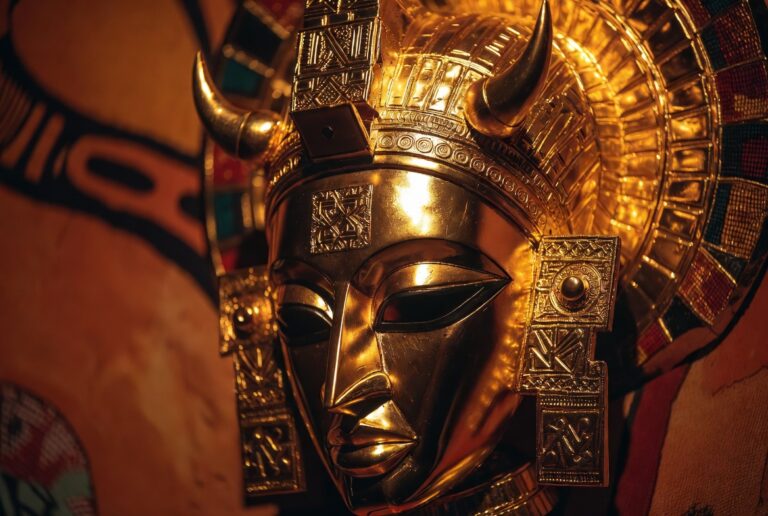
Unlike many African masks that represent supernatural beings of ambiguous or fearsome character, the Cikungu mask wears the features of a dignified, composed, and aesthetically refined human face. The cheeks bear the traditional Chokwe keloid scarification marks, a cross or star pattern called cingelyengelye, that identify the wearer as Chokwe and as belonging to the chiefly class. The overall impression is one of supreme authority: calm, confident, and commanding, and seeing it worn was, for a Chokwe community, direct visual confirmation of exactly who held legitimate power.
A chief’s authority is never treated as a matter of lineage or military strength alone. It rests on his connection to the founding ancestors of the group, particularly Chibinda Ilunga, the great hunter and culture hero who, according to Chokwe oral tradition, married the Lunda princess Lueji and received from her the royal emblems of power. That marriage story is central to Chokwe royal ideology, and it explains the high status accorded to skilled hunters throughout Chokwe society. When the Cikungu is worn, the wearer does not perform a role or impersonate an ancestor. He becomes a vessel for ancestral power, temporarily embodying the entire royal line.
The Carving and Symbolism of the Cikungu Mask
Carving a Cikungu mask is a task reserved for highly skilled specialist sculptors known as songi, who occupy a respected and somewhat mystical position in Chokwe society. A songi works not just as a craftsman but as a collaborator with spiritual forces, and the carving of major ceremonial objects is accompanied by ritual protocols including seclusion, dietary restrictions, and prayer.
The facial features of the Cikungu are highly standardized, reflecting a canonical ideal of chiefly beauty and dignity. The eyes are often half closed, suggesting the inward, contemplative gaze of an ancestor viewing the world from beyond, an expression of spiritual authority rather than worldly alertness. The nose is straight and well formed, the mouth closed and composed, and the scarification marks on the cheeks are always present and precisely rendered. The surface is typically painted in dark brown or black, with the scarification marks picked out in lighter pigment.
Above the face, the mask often supports an elaborate superstructure, a tall domed head covering representing the royal headdress, decorated with geometric patterns and sometimes incorporating bark cloth, fur, or feathers. This superstructure increases the visual height and presence of the figure considerably, making the masked dancer an imposing and unmistakable emblem of royal power.
Mukanda: Masks of Male Initiation
Chiefly power is not the only occasion Chokwe masking serves. Mukanda is the institution through which Chokwe boys are formally brought into manhood, and it is a serious commitment, with training running one to two years. Boys between about eight and twelve are secluded in a wilderness camp, circumcised, and instructed for months in a special lodge, learning both the group’s history and the specific secrets of making and wearing masks.
Mukanda masks are built from barkcloth stretched over a wickerwork armature, coated in black resin, then personalized with pieces of colored cloth while the resin is still workable, a construction that echoes Cikungu’s own barkcloth and resin technique without carrying anywhere near the same restriction. Through mukanda, mask knowledge is passed formally from one generation of Chokwe men to the next, in much the same way that neighboring Congo Basin peoples, the Yaka and Suku among them, pass on their own initiation masking through a parallel forest camp system.
Cikungu, Pwo, and Chihongo: A Fuller System
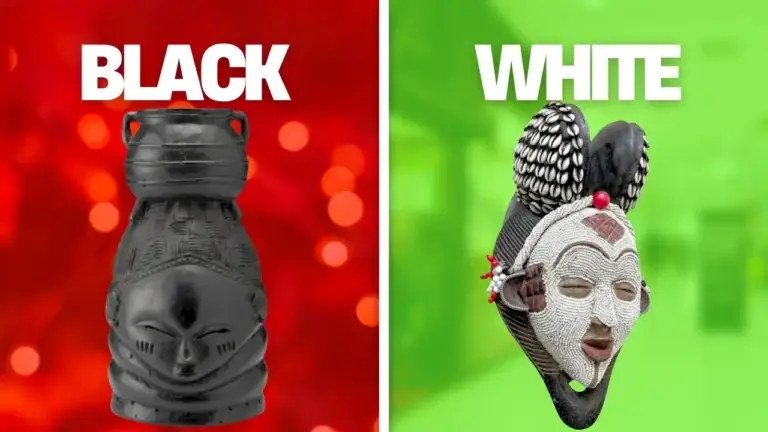
The Cikungu mask does not exist in isolation but within a larger system of Chokwe masquerade that includes several other mask types, each representing a different aspect of social and spiritual life. Its most important complement is Pwo, which represents a female ancestral spirit and is associated with fertility, beauty, and the nurturing side of community life. Where Cikungu represents male authority and royal power, Pwo represents female generative power and the continuation of life. Her eyes are narrowed to slits, evoking the closed eyes of the dead, and her facial markings are read as explicitly feminine. In more recent tradition, Pwo has increasingly been performed as mwana pwo, a young woman rather than an elder, representing girls who have completed initiation and are ready for marriage.
A third figure completes the picture: Chihongo, spirit of wealth, with gaunt features, sunken cheeks, and the jutting beard of an elder. Chihongo was formerly worn only by a chief or his son while traveling through the realm collecting tribute, in exchange for the protection the spirit was believed to offer, and it is traditionally performed alongside Pwo by itinerant actors who travel village to village living on gifts given at their performances.
Together, Cikungu, Pwo, and Chihongo embody the Chokwe understanding of power as inherently layered: royal authority sits at the top, restricted to a single living chief, while wealth and fertility circulate more widely, performed for and watched by anyone. This complementarity shows up visually too. Cikungu is commanding and austere, Pwo is delicate and beautiful, and Chihongo is gaunt and businesslike, but all three are carved with the same technical mastery and conceptual precision.
A Ranked System, Not a Random Assortment
Lay these masks side by side and a clear hierarchy appears. Cikungu sits alone at the top, restricted to a single living person, appearing only at the most consequential political and religious moments a Chokwe community faces. Mukanda masks sit beneath it, restricted to initiated men but shared among many of them, appearing on a fixed generational schedule. Chihongo and Pwo sit further down still, performed widely, watched by anyone, paid for with gifts rather than earned through rank. Nothing about that range is accidental. It mirrors, almost exactly, the same logic found among the Chokwe’s own tributaries, the Salampasu, whose masks are also ranked from feared warrior regalia down to more widely worn forms. A mask’s restriction, in Central Africa’s masking cultures generally, tends to track how much political or spiritual weight it is being asked to carry.
Chokwe Art in Global Collections
The quality of Chokwe sculpture has been recognized by Western collectors since the late nineteenth century, and major Chokwe pieces, masks, figures, chairs, staffs, combs, and other prestige objects, now reside in museum collections worldwide. The most famous single Chokwe object in the West is probably the figure known as Chibinda Ilunga in the Kimbell Art Museum in Fort Worth, Texas, a masterpiece of naturalistic sculpture representing the founding hero of the royal line. Chokwe masks and figures regularly appear at major art auctions, where exceptional pieces can sell for hundreds of thousands of dollars.
The presence of so many Chokwe objects in Western collections raises uncomfortable questions about how they got there. Much of the finest Chokwe art was removed from Angola during the colonial period, often under conditions of conquest, confiscation, or grossly unequal exchange. As Angola rebuilds its national cultural identity after decades of civil war, the question of repatriating significant Chokwe objects has become increasingly urgent. Several major museums have begun to engage with these questions seriously, though the process of restitution remains slow and contested.
The Cikungu Today
The Chokwe people of Angola, the DRC, and Zambia continue to maintain their masquerade traditions, including the Cikungu, as living cultural practices. In communities where traditional chiefly authority is still recognized and respected, the Cikungu ceremony remains an important mechanism for legitimizing leadership and connecting the present generation to its ancestors. Even where modernization has changed many aspects of social life, the memory and significance of the Cikungu tradition persists as a marker of Chokwe identity, and it remains a useful entry point for anyone trying to understand the richness of Central African cultural life: a single object that opens onto political philosophy, spiritual practice, aesthetic tradition, gender dynamics, and the long history of a people who have shaped the Central African interior for centuries.
Frequently Asked Questions
Who is allowed to wear the Cikungu mask?
Only the current reigning chief, the Mwangana. Its appearance is one of the most restricted ceremonies in Chokwe culture, witnessed only by initiated men.
What is the difference between Cikungu and mukanda masks?
Cikungu is a single, sacred mask worn only by a reigning chief during installation and ancestor invocation. Mukanda masks share a related barkcloth and resin construction but are used more broadly in male initiation and personalized with colored cloth.
How are Cikungu, Pwo, and Chihongo related?
They form a layered system rather than three unrelated masks. Cikungu represents restricted royal authority, Pwo represents female fertility and beauty, and Chihongo represents wealth. Pwo and Chihongo are performed widely by itinerant entertainers, while Cikungu is reserved for the chief alone.
Where can Chokwe masks be seen today?
In major museum collections worldwide, including the Kimbell Art Museum’s Chibinda Ilunga figure, though the presence of so much Chokwe art outside Angola has raised ongoing, unresolved questions about repatriation.
See also: African Masks by Region and Tribe · Pende Mask of the Congo: Types, Meanings, and Ceremonial Use · Kuba Kingdom: Art, Masks, and the Legacy of Central Africa’s Greatest Empire · I Decoded African Masks and Their Color Symbolism