West African Mask Styles: A Visual Guide to Regional Differences
Why Region Matters in African Mask Art
Africa is the world’s second largest continent, home to over fifty countries and more than two thousand distinct ethnic groups. Within this enormous diversity, masquerade traditions have developed across many different cultural zones, each shaped by distinct histories, religious systems, social structures, and aesthetic preferences. One of the most rewarding ways to understand African mask art is through the lens of regional geography: by examining how the masks of different regions differ from one another, and why, we begin to appreciate both the diversity of African artistic culture and the underlying unities that connect mask traditions across the continent.
West Africa — and within it the coastal forest zone and the Sahel — is home to the largest concentration of masquerade traditions on the continent and provides the richest comparative material for understanding regional styles.
Senegambia and the Western Sudan
The westernmost region of West Africa — encompassing Senegal, The Gambia, Guinea-Bissau, and Guinea — is characterised by Mande-speaking peoples whose masquerade traditions are connected to the widespread Poro and Sande initiation societies. The masks of this region tend to be relatively naturalistic in their facial features, often combining a carved wooden face with elaborate fibre or cloth costumes. The Landai mask of the Toma (Loma) people of Guinea — a low horizontal mask with serrated top edges — is one of the most recognisable forms of the western Sudan tradition.
Among the Temne and Bullom of Sierra Leone, the Sande society’s Sowei helmet mask represents one of the most aesthetically refined forms in West Africa: a smooth, high-domed head with an elaborate coiffure, half-closed eyes, and a series of horizontal neck rolls symbolising health, beauty, and prosperity. The very high value placed on smooth, light-reflecting skin surfaces in Sande aesthetics — achieved through polishing with palm oil and dark pigment — contrasts with the more textured, painted surfaces of Sahel traditions to the north.
The Gold Coast: Akan and Asante Traditions
The Akan-speaking peoples of Ghana and Côte d’Ivoire have developed masquerade traditions closely connected to their elaborate chiefly court system and their funerary practices. The Akan concept of sunsum — the spiritual aspect of the individual that continues after death — shapes funeral masquerades that help manage the transition from living person to ancestor.
The masks associated with the Asante kingdom’s royal court are particularly refined. The Asante Kɔmfomhene (chief of the priests) figures, the wooden linguist staffs topped with carved golden forms, and the rare funerary masks that have been documented in royal collections all display the Asante aesthetic preference for serene, composed facial features, smooth surfaces, and the restrained elegance appropriate to royal contexts. The use of gold — the material most associated with Asante royal power — as a surface treatment on some prestige objects is unique in West African masquerade traditions.
Nigeria: The Richest Masquerade Country
Nigeria is home to more distinct masquerade traditions than any other country in Africa. The diversity of Nigerian mask art reflects the country’s extraordinary ethnic complexity: more than 250 distinct ethnic groups, each with their own masquerade practices, produce a kaleidoscope of forms and functions. Broad regional patterns can be identified, but exceptions and overlaps are numerous.
In the Niger Delta and Cross River regions, masks tend to be more naturalistic and often incorporate real human hair, teeth, and other organic materials to create an unsettling sense of near-human reality. The Ejagham Ekpe society masks of the Cross River region, sometimes referred to as “skin-covered masks” for their use of animal skins stretched over wooden cores, are among the most psychologically powerful objects in African art. Ekpe society networks extended across ethnic boundaries and into Cameroon and further west, creating one of the most widespread secret society networks in African history.
Among the Yoruba of south-western Nigeria, masks range from the delicate female face of the Gelede tradition to the enormous, terrifying constructions of the Egungun ancestor masquerade, which can rise several metres in height with billowing cloth extensions. Yoruba mask art is characterised by compositional complexity, the combination of multiple figures in a single composition, and a delight in narrative detail. Yoruba carvers enjoy depicting scenes from everyday life and history on the superstructures of their masks, turning each performance into a visual story.
The Bight of Benin and the Court of Benin
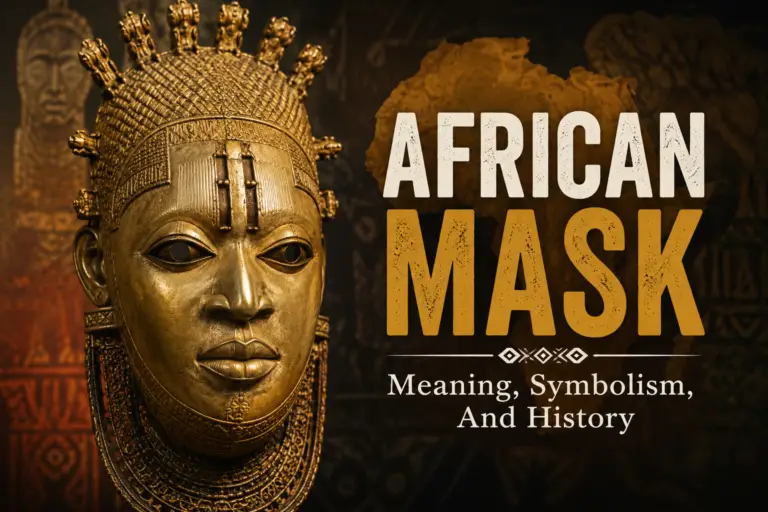
The kingdom of Benin (in present-day Edo State, Nigeria) developed one of the most distinctive royal art traditions in Africa: the Benin bronze plaques, the bronze heads of the Oba (king), and the carved ivory and bronze regalia of the royal court. While the Bini do not have a strong plank mask tradition, their court art — particularly the elaborate helmet masks worn by the Oba during ceremonies — represents a masterpiece of formal refinement. The faces of Benin bronzes are characterised by serene, idealised features and an expression of composed authority that communicates royal power without aggression.
Cameroon and the Grassfields
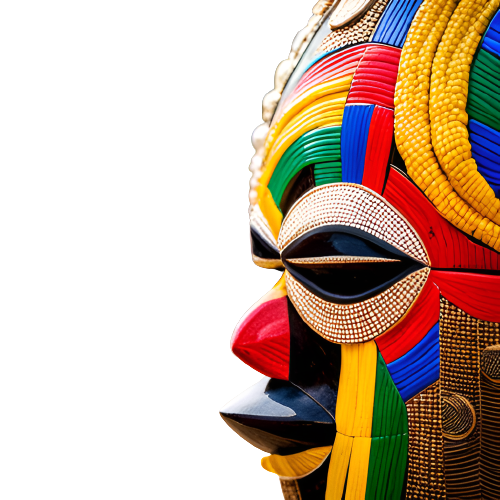
The Grassfields region of Cameroon — the highland plateau of the western part of the country — is home to a remarkable concentration of royal mask traditions. The Bamileke, Bekom, Bangwa, and related peoples of this region have developed mask forms that are among the most formally inventive in Africa: large helmet masks with asymmetric features, carved figures of royal elephant symbolism, beaded mask covers of extraordinary elaboration.
The elephant is the primary royal animal of the Grassfields tradition, and masks incorporating elephant iconography — large ears, a trunk-like nose projection — are associated with chiefly power. The Bamileke Kuosi society masks, used at the funerals of chiefs and at major royal ceremonies, are covered in glass beads arranged in geometric patterns and are among the most technically demanding objects in African craft tradition.
Ivory Coast: A Meeting of Styles
Côte d’Ivoire (Ivory Coast) occupies a fascinating geographic position between the Mande-speaking traditions of the north and west, the Akan traditions of the east, and the distinct styles of the Kru-speaking peoples of the south. This position has produced a mask tradition of remarkable diversity.
The Dan and We (Guéré-Wobe) peoples of western Côte d’Ivoire and Liberia produce face masks of exceptional range: from the smooth, serene, naturalistic Dan deangle (female) masks that embody kindness and beauty, to the wildly aggressive, fibre-studded We masks designed to embody fearsome supernatural power. The contrast between these two poles of the same broader tradition — serenity and terror, beauty and aggression — captures something fundamental about the dual nature of spiritual power as understood in many African traditions.
Understanding Regional Diversity
The regional diversity of West African mask styles is not random but reflects real differences in the social structures, religious systems, and aesthetic values of the peoples who created these traditions. Forest peoples who rely on agriculture have different relationships to the land and to natural forces than Sahel peoples whose lives are shaped by long-distance trade and pastoralism. Royal court societies produce masks oriented toward displaying and legitimising power; egalitarian societies produce masks oriented toward community decision-making and social control. Muslim societies have different relationships to figural imagery than adherents of African traditional religions. All of these differences leave their marks on the masks themselves.
What unifies all these regional traditions is the underlying function of the mask: to make visible forces that are ordinarily invisible, to create controlled encounters between the human world and the world of spirits and ancestors, and to use the power of theatrical performance to manage the deepest needs and anxieties of human social life. That common function, expressed in a thousand different formal vocabularies, is what makes African mask art one of the richest and most profound visual traditions in the history of humanity.