African Mask Meaning, Symbolism, And History
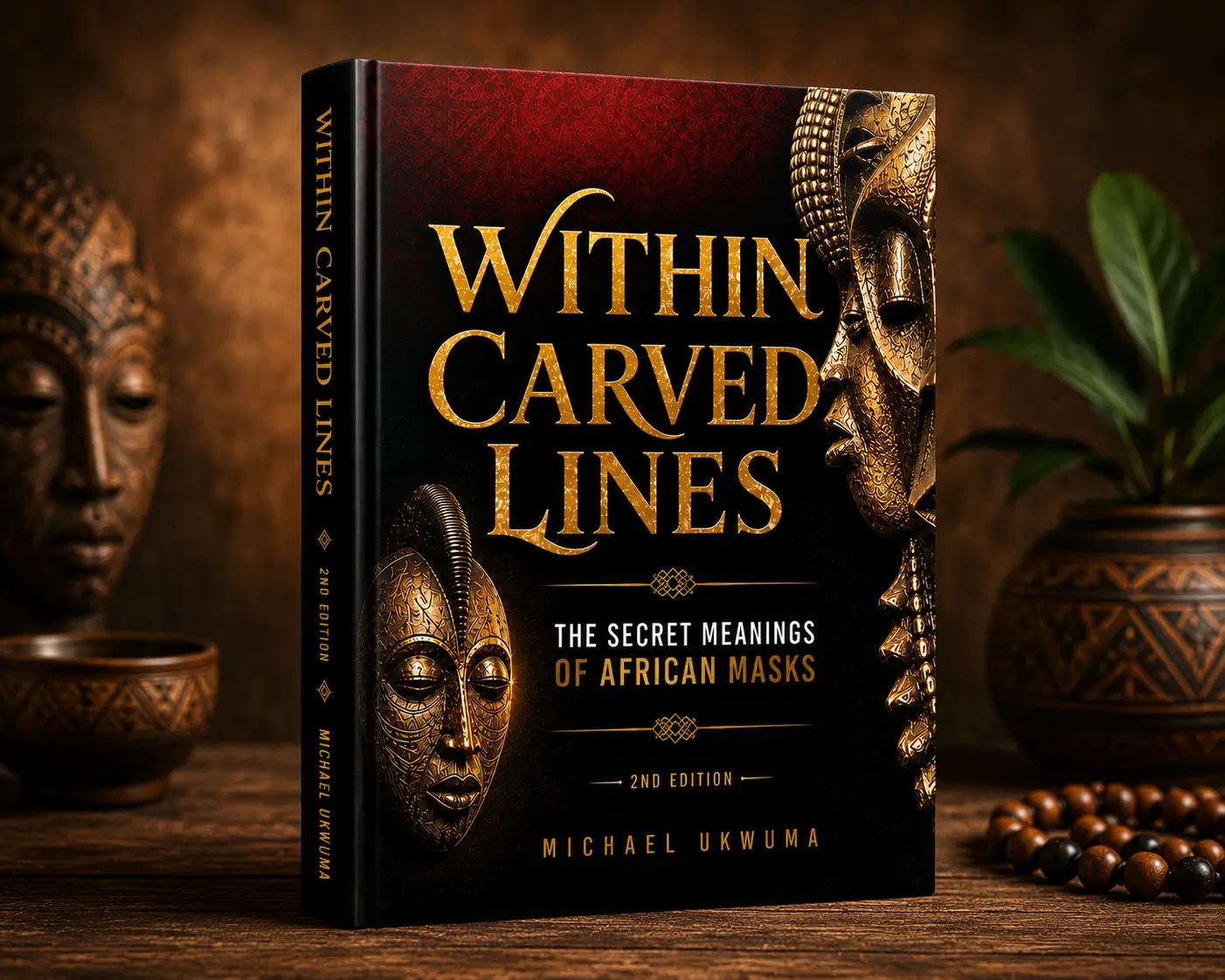
New: the 2nd edition of Within Carved Lines: The Secret Meanings of African Masks is out now. Get the book →
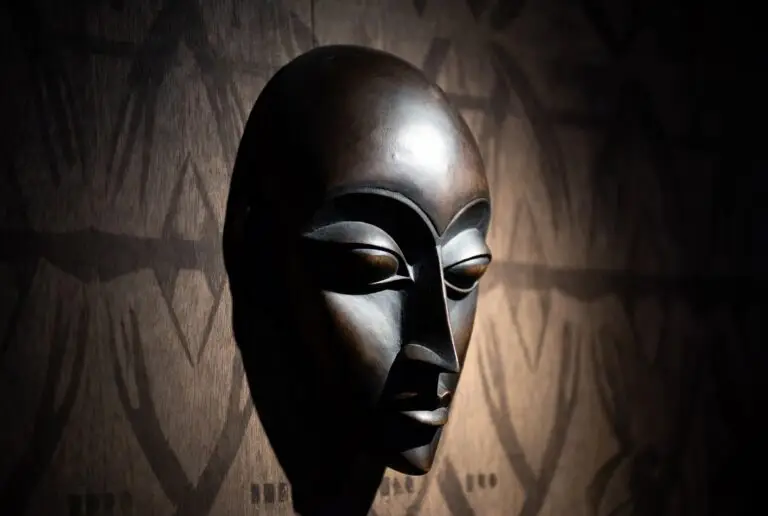
Search “African mask” right now and you will get the same photograph forty times over. A dark wooden face. A caption calling it tribal art. Nothing about who carved it, why, or what actually happened the day someone wore it.
That gap is the real problem with how this subject gets covered online, and it is the reason I am writing this page.
A mask, in its real setting, is not wall decoration. It is one part of an event, something a whole community built around it. A dance. A drum. A reason. A result. Strip all of that away and you are left with a face and nothing else.
This page puts the rest back.
What Does An African Mask Symbolize?
Here is the honest answer nobody wants to hear. It depends. It depends on the mask, the people who carved it, and the day it gets worn. There is no single African mask symbolism, the same way there is no single meaning behind European sculpture as a whole. Different peoples made different masks for different reasons.
One idea does hold across most of these traditions. The mask is not a disguise. It is a vessel.
When a dancer puts on a mask inside a real masquerade, the belief in many West and Central African traditions is not that he is pretending. The belief is that something else, an ancestor, a spirit, a force older than the dancer, is now using his body. For as long as the mask stays on, the man underneath is secondary.
That single idea is what separates a genuine ceremonial mask from a decorative one carved for a shop shelf. The carving can look identical. The meaning behind it is not.
The History Of Traditional African Tribal Masks
Most masking traditions in West and Central Africa were never written down. They were carried by apprenticeship, one carver teaching the next, one initiation society passing its knowledge on. That makes individual pieces hard to date. It does not make the history any less real.
Two examples are well documented. The Poro society, run by men, and the Sande society, sometimes called Bundu, run by women, both use masking to teach young people what adulthood actually requires of them. The Fang Ngil society of Gabon is another. Its members wore a distinctive white masked figure to enforce order and root out suspected wrongdoing inside Fang communities.
Here is the history most people actually know instead. In the early twentieth century, French colonial expansion pulled huge numbers of African masks and carvings out of the continent. Some left through trade. Many left through outright looting. They ended up in European museums, the Trocadéro in Paris among them.
Pablo Picasso visited that museum. Historians agree the masks he saw there fed directly into Les Demoiselles d’Avignon in 1907, a painting credited with helping start Cubism.
That is a real story, and it is worth knowing. It is the story of what Africa’s masks did for European art. It is not the story of what those same masks meant to the people who carved them. Hold on to both. Do not let one replace the other.
Why Are African Masks Worn? Ritual, Not Decoration
Traditional masks were worn for specific, working reasons, not for display.
Initiation. A mask marks a young person’s passage into adulthood, sometimes across years of training inside a society like Poro or Sande.
Speaking to ancestors. The Yoruba Egungun masquerade exists to honor and address ancestral spirits directly. Each masked dancer stands in for a named ancestor during the festival.
Enforcing order. The Fang Ngil mask functioned closer to a badge than an artwork. Its wearer had real authority to investigate wrongdoing.
Marking the harvest. Farming communities across West Africa use masking to open planting season or celebrate a good yield.
Burial. Masks appear in funeral rites across many traditions, guiding the dead and marking a community’s grief.
None of these five reasons require a mask to look pretty. Some are built to look frightening on purpose, because their job is to project power, not to match your living room.
What Do The Colors On An African Mask Mean?
Color does carry real meaning in African masking traditions. Treat what follows as a pattern, not a rulebook, because it shifts by region.
White, often made from kaolin clay, tends to point toward spirits, ancestors, and the world of the dead. The Fang Ngil mask’s pale face is the clearest known example.
Black tends to point toward night, mystery, and, in some traditions, the wisdom that comes with age.
Red tends to signal life force, danger, or power, often used as an accent rather than covering the whole face.
That is as far as the pattern reliably goes. The color language of a Kwele mask from the Congo Basin is not automatically the color language of a Yoruba mask from Nigeria. Ask which tradition you are looking at before you assume you know what a color means.
Traditional African Art Masks Versus Tourist Reproductions
Most masks you can actually buy today, including well made ones, were carved for the market, not for a ceremony. Say that plainly and nobody should be offended, because it is simply true.
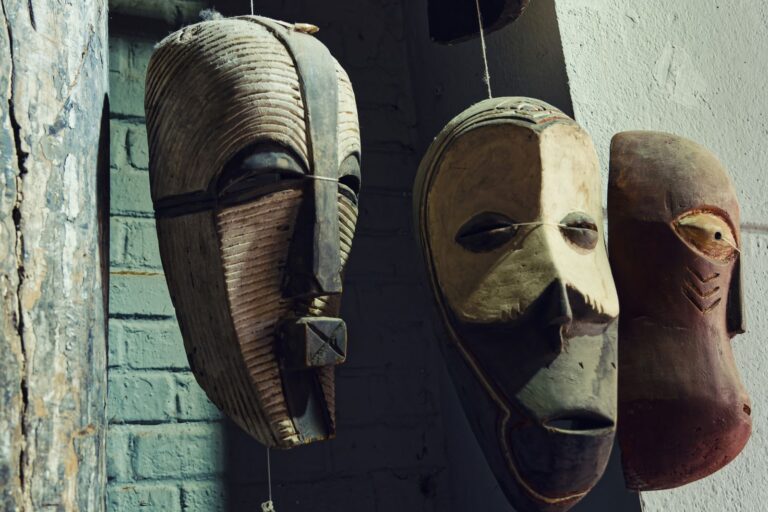
A few things tell the two apart. Wear. A mask that was actually danced in shows it: smoothed edges around the eyes and mouth, marks from cordage, real grime from use. Individuality. A market carving is often one of several identical siblings. A ceremonial mask is not. Materials. Genuine ceremonial pieces sometimes carry raffia, fiber, or pigment tied to specific requirements of a tradition, not generic decoration meant to look African. Provenance. This is the one that matters most. A documented history beats every visual clue above it.
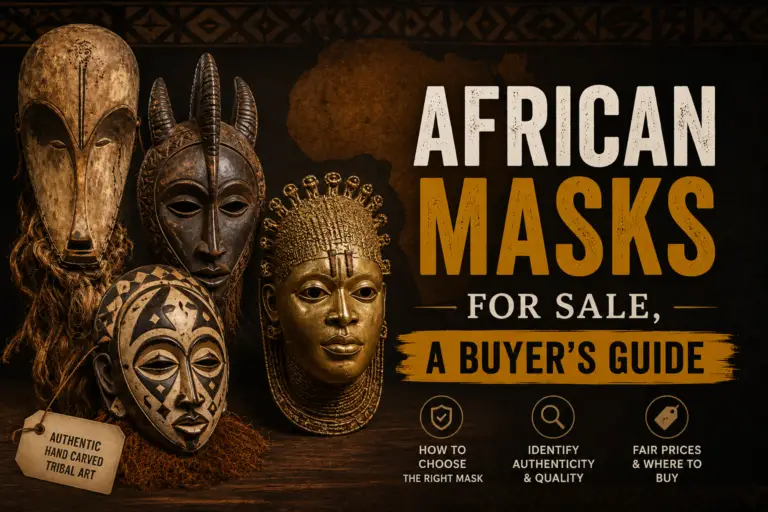
If you are shopping for one, read the buyer’s guide before you spend anything: African Masks For Sale, A Buyer’s Guide.
Types Of Traditional African Masks By Purpose
Organize the enormous variety of African masks by what they were built to do, and the whole subject gets easier to hold in your head.
Initiation masks, used in rites of passage. Funerary masks, used in mourning and burial. Harvest masks, tied to the farming calendar. Authority masks, like the Fang Ngil, used to enforce order. Masquerade masks, used in public festival and performance, sometimes serious, sometimes satirical.
For the same purposes broken down by actual region and people, Ghana, the Congo Basin, and further afield, read African Masks By Region And Tribe.
Frequently Asked Questions
Are African masks cursed?
No. That is a horror movie idea, not a cultural one. These masks are treated as spiritually significant. Significant and cursed are different words for different things.
What is the oldest African mask?
Most old masks survive today because a museum or private collection kept them dry. Many date to the nineteenth or early twentieth century.
What are African masks called?
There is no single name. Gelede and Egungun for the Yoruba. Kifwebe for the Luba and Songye. Ngil for the Fang. Learn the real name.
Go deeper into the stories behind the masks you just read about. Within Carved Lines uncovers the history, symbolism, and ritual meaning of Africa’s traditional masks — now fully revised in its second edition.
Get Your Copy