Sowei Mask of the Mende: The Only African Mask Tradition Owned by Women
New: the 2nd edition of Within Carved Lines: The Secret Meanings of African Masks is out now. Get the book →
Almost every well-known African masking tradition is controlled by men. The Sowei mask, worn by the Mende, Temne, Vai, and Gola peoples of Sierra Leone, Liberia, and Guinea, is the exception that reorders the whole picture: it is carved for women, owned by women, and worn only by senior women. No comparable tradition anywhere else on the continent gives women this level of exclusive control over a masking practice.
Who Are the Mende?
The Mende are the largest ethnic group in Sierra Leone, concentrated in the southern and eastern regions of the country, with related Sande-practicing communities among the Temne, Vai, and Gola further along the coast. Mende society has historically balanced two parallel institutions: the Poro society, which governs male initiation and civic authority, and the Sande society (also called Bundu in some areas), which governs female initiation, health knowledge, and moral authority. The Sowei mask belongs entirely to the second of these.
The Sande Society
Sande is one of the most powerful women’s institutions in West Africa. It oversees the initiation of girls into adulthood, a process that historically included instruction in domestic skills, reproductive health, community law, and the responsibilities of marriage and motherhood, delivered during a period of seclusion known as the “bush school.” The society’s senior leaders, called sowei or majo, hold real social and political authority within Mende communities — they can be consulted on disputes, they influence marriage negotiations, and their judgment carries civic weight far beyond the initiation season.
The sowei mask is the visible expression of that authority. It is danced only by senior initiated women, and it is the sowei leaders themselves — not male carvers acting alone, in most accounts — who commission the mask and direct its symbolism, even though the physical carving is often done by a male specialist. The performance is a public demonstration that Sande’s authority is complete: intellectual, spiritual, and artistic.
Mask Style: The Black, Serene Face
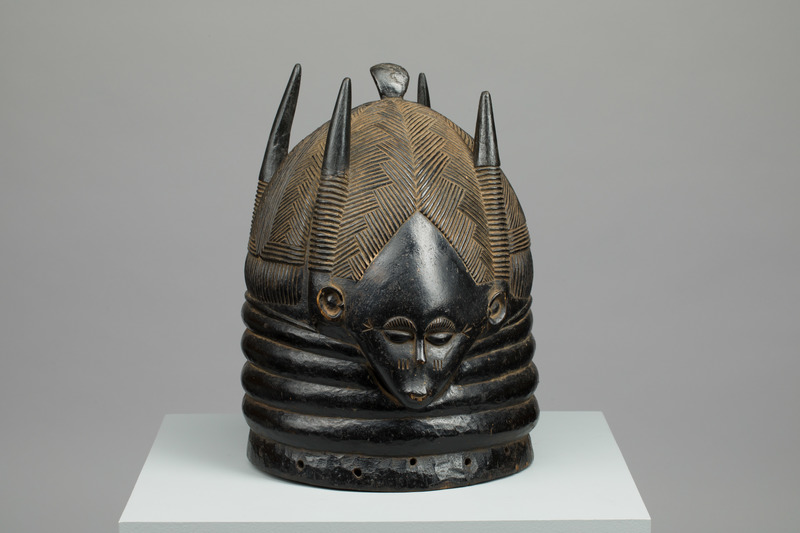
Sowei masks are helmet masks, meaning the carved wooden form fits over the entire head rather than resting in front of the face like most West African masks. The surface is carved and polished to a deep, glossy black — a finish associated with health, moral seriousness, and the ideal of composed feminine beauty. The facial features are small and understated: a narrow nose, a closed or slightly parted mouth, downcast or half-closed eyes suggesting calm and self-possession rather than display.
Around the neck, most Sowei masks carry stacked rolls often described as rings of fat, a traditional marker of prosperity, fertility, and good health in Mende aesthetics. The elaborate coiffure carved above the face — sometimes structured, sometimes topped with a small bird or horn motif — signals status and often references specific spiritual or ancestral associations tied to the individual sowei who commissioned it. When danced, the mask is paired with a full-body costume of blackened raffia fiber that conceals the wearer completely, reinforcing the sense that a spirit, not an individual woman, is present.
What the Sowei Teaches
The core performances built around the Sowei mask happen at the opening and closing of the Sande initiation cycle. At its most basic level, the appearance of the masked sowei announces that initiation is underway and marks the seriousness of the transition the initiates are undergoing. At the close of initiation, the masquerade celebrates the girls’ successful transformation and their readmission to the community as women ready for adult responsibility.
Because Sande remains an active institution across large parts of Sierra Leone and neighboring countries today, the Sowei mask is one of the relatively rare African masking traditions where the ritual context has not been broken by colonial suppression or conversion in the way many other traditions were. It is still commissioned, still worn, and still carries real institutional authority in the communities that practice it — worth remembering the next time someone assumes every African mask is a relic of a vanished past. See our piece on why African masks are not home décor for more on that distinction.
Sowei Masks in the World
Sowei masks entered Western museum collections in significant numbers during the colonial period, and today they sit in institutions including the Brooklyn Museum, the British Museum, and numerous university collections, usually catalogued under Sande, Bundu, or Bondo society material. Because the tradition is still living, there is an unusually direct line between museum holdings and an active, ongoing practice — a contrast worth sitting with next to masks from traditions that have gone dormant. For more on how women’s authority runs through African masking more broadly, see secrets of African masks: women and rituals.
Frequently Asked Questions
Who is allowed to wear a Sowei mask?
Only initiated, senior women of the Sande society. It is one of the only African masking traditions where the wearer is always a woman, not a man performing a female character.
What does the black color of the Sowei mask mean?
Deep, polished black is associated in Mende aesthetics with health, moral seriousness, and ideal feminine beauty — it is a deliberate aesthetic and symbolic choice, not simply the natural color of the wood.
Is the Sowei mask still used today?
Yes. Sande remains an active institution in parts of Sierra Leone, Liberia, and Guinea, and the Sowei masquerade continues to appear at initiation ceremonies.
How is Sowei different from most other African masks?
Most African masking traditions are controlled by men’s societies, even when the mask represents a female spirit or ancestor. Sowei is unusual in being owned, directed, and worn by women themselves.
See also: Every Traditional African Mask You Should Know · African Masks by Region and Tribe · Secrets of African Masks: Women and Rituals · Why African Masks Are Not Home Décor