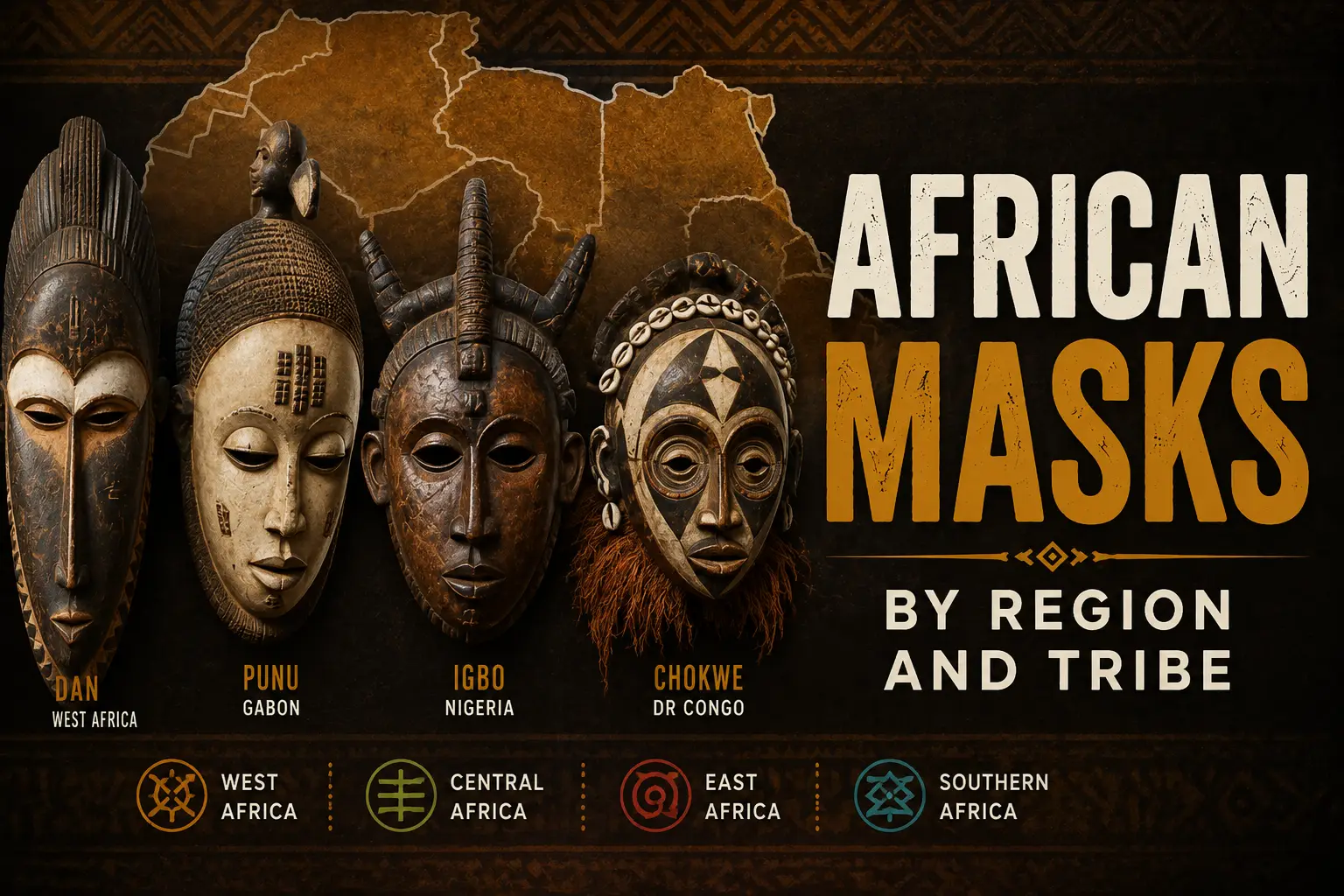
African Masks By Region And Tribe
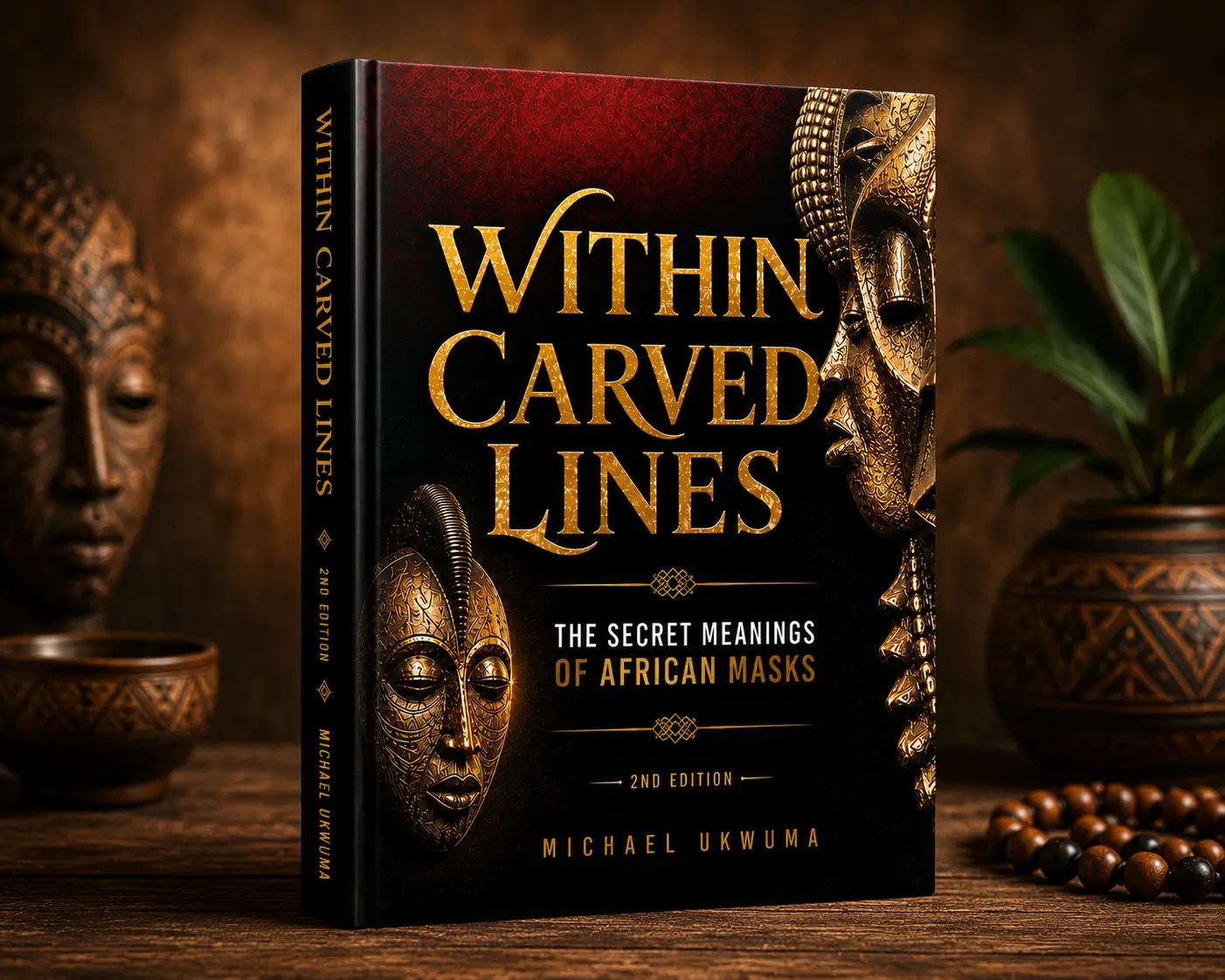
New: the 2nd edition of Within Carved Lines: The Secret Meanings of African Masks is out now. Get the book →
“African mask” is not one tradition. It is thousands of them, spread across fifty four countries, and most of those countries never carved a ceremonial wooden mask in their entire history.
I want to say that clearly at the start, because almost nothing else written on this subject says it. This page goes region by region. Ghana. The Congo Basin. Southern Africa. Kenya. And it tells you honestly where a real masking tradition exists and where it does not.
African Masks From Ghana, Ashanti And Akan Traditions
Ghana’s most famous carving is not a mask at all. It is the Akuaba, a wooden fertility figure tied to the Akan peoples, which includes the Ashanti. Women have carried Akuaba figures for generations, hoping for a healthy pregnancy. Because the Akuaba has a flat, disc shaped head, search engines and casual shoppers lump it in with masks constantly. It is not one.
Real masking traditions do exist among Akan and neighboring groups, mostly tied to festival, funeral, and chieftaincy occasions rather than the initiation society structure found further along the coast among the Mende or the Dan. If a seller calls something an Ashanti mask, ask them directly whether they mean a real ceremonial mask or an Akuaba style figure marketed loosely under the same search term. The two get mixed up constantly in online listings.
Congo Basin Masks: Kwele, Lulua And Fang
The Congo Basin, spread across the Republic of the Congo, the Democratic Republic of the Congo, and Gabon, holds some of the richest and most distinct masking traditions on the continent. Four names are worth knowing.
The Kwele mask, from the Republic of the Congo, is instantly recognizable. A pale, heart shaped face. Downturned or closed eyes. An expression closer to meditation than emotion. It was used in the beete ceremony, built to restore harmony after conflict.
The Fang Ngil mask, from Gabon, is elongated and white faced, tied to a secret society responsible for enforcing justice inside Fang communities. These are also among the rarest masks on earth. One of them sold for $4.4 million at auction. I tell that whole story here: The Mask That Sold For $4.4 Million.
The Lulua mask, from the Democratic Republic of the Congo, carries detailed scarification patterns carved directly into the wood, mirroring real body marking traditions of the Lulua people.
The Pende mask, also from the Democratic Republic of the Congo, spans several distinct types used across initiation, entertainment, and status roles. We break down each type in Pende Mask of the Congo: Types, Meanings, and Ceremonial Use.
Three traditions. One region. Three completely different faces. That alone should tell you how little “Congo Basin mask” actually explains.
Further into the same region, the Kifwebe mask of the Songye and Luba peoples adds a fifth face entirely: a striated, geometric surface where color and crest height signal gender, temperament, and judicial authority, worn by a men’s society that functioned closer to a court than a masquerade.
Nigeria’s Kingdom Of Benin, A Bronze Tradition Rather Than Wood
Nigeria deserves its own note, because its most famous masking tradition is not wood at all. The historic Kingdom of Benin, in what is now Edo State, is renowned for cast bronze court art, including ceremonial masks like the famous Queen Idia mask. It is a different material tradition from the wood carving discussed above, but every bit as real. We cover it in depth in Kingdom of Benin: Bronze Masks, Court Art, and a Civilisation Ahead of Its Time.
Zulu And Southern African Regalia, A Different Tradition Entirely
Here is something most pages on this topic will not tell you straight. Zulu culture is not known for carved wooden masks. Southern African traditions in general are not.
What Zulu material culture is genuinely known for is different: cowhide shields, beadwork, ceremonial headdress, regalia built for dance. That is its own rich tradition. It simply is not a masking tradition, and pretending otherwise does not honor it.
If you come across something sold as a Zulu mask, look closer at what is actually being described. It may be a beaded headdress marketed loosely as a mask because that search term gets more traffic. That is not an insult to Zulu culture. It is just accuracy.
What Is Actually Sold As An African Mask Kenya
I will say this plainly, because almost nobody else selling to this search term will. Kenya does not have a strong indigenous wood mask carving tradition on the scale of West or Central Africa. The Kikuyu, the Luo, the Maasai, none of Kenya’s major ethnic groups are historically known for ceremonial wooden masking the way the Yoruba or the Fang are.
What gets sold in Kenyan curio markets as an African mask is usually a generalized carving made for tourists, not tied to any specific Kenyan tradition. Much of that carving style traces back to the Makonde, a people from southeastern Tanzania and northern Mozambique known for a distinct, elongated, often abstract style that spread across East African markets through trade, not through shared ethnicity.
None of that makes these pieces fake or badly made. Plenty are genuinely skilled decorative carving. It only means a Kenyan mask should be sold and understood as East African decorative art, not as an artifact of a specific Kenyan ceremonial tradition. That is a more honest answer than most of what shows up when you search this term, and honesty is the entire point of this page.
Juju Masks, The Meaning And The Misconception
Juju is a real word. It comes out of Yoruba and Igbo speaking regions of West Africa, and it refers broadly to a charm, a spiritual object, or a supernatural force. Depending on context it can shade toward witchcraft or magic in a general sense.
Western pop culture took that word and bent it into something darker and vaguer, closer to a horror movie trope than anything Yoruba or Igbo speakers actually mean by it. A juju mask, in the internet search sense most people use, usually just means a mask marketed with a whiff of the occult rather than a real named tradition.
If you are researching or buying, skip the word juju and ask instead which specific people made the piece. That question gets you a real answer. Juju does not.
Comparing Yoruba, Dan, Fang, Kwele And Ashanti Traditions
The Yoruba, in Nigeria and Benin, made masks for ancestor veneration and social commentary. Look for elaborate superstructures and painted color, as seen in Gelede and Egungun masks.
The Dan, in the Ivory Coast and Liberia, made masks for entertainment, social roles, and ideals of beauty. Look for smooth, rounded, natural faces. Our full guide, The Dan Mask of West Africa, covers the regional variations in detail.
The Fang, in Gabon, made the Ngil mask for judicial and social authority. Look for an elongated white face. See Fang Reliquary Mask (Ngil): Guardians of Ancestral Bones in Gabon for the full story.
The Kwele, in the Republic of the Congo, made masks to restore social harmony through the beete ceremony. Look for a pale, heart shaped face with downturned eyes.
The Ashanti and wider Akan peoples of Ghana are better known for the Akuaba figure than for masks, though real masking traditions exist there too, tied to festival and chieftaincy. Read more in Ashanti Gold Mask: History, Symbolism, and Royal Significance in Ghana.
The Baule, in central Ivory Coast, built the Goli masquerade around a full day-long sequence of paired masks rather than one type. Read the sequence in Goli Mask of the Baule: The Masquerade Cycle of the Ivory Coast.
The Mende, in Sierra Leone, made the Sowei mask — the one major African masking tradition carved, owned, and worn entirely by women, through the Sande society. See Sowei Mask of the Mende: The Only African Mask Tradition Owned by Women.
The Dogon, in Mali, made the Kanaga mask, its double-barred cross superstructure danced at the dama funerary rites. See Kanaga Mask of the Dogon: The Cross-Shaped Mask of Mali’s Funeral Rites.
This is a starting map, not an exhaustive one. Within each of these peoples there are further sub styles and regional variation. If you are buying or researching a specific piece, naming the actual tradition, rather than defaulting to tribal mask, is the single most useful and most respectful thing you can do.
Frequently Asked Questions
What are African masks called in different tribes?
There is no shared word across cultures. Gelede and Egungun for the Yoruba. Ngil for the Fang. Kifwebe for the Luba and Songye. Learn the specific name.
Does Kenya have a real mask carving tradition?
Not like West or Central Africa does. Most Kenyan masks on the market are East African decorative carving made for tourists, not artifacts of an indigenous Kenyan tradition.
Do you own a mask like this?
Not sure what it is, where it comes from, or whether it was ever danced? Start with our free Mask Identifier.
If you want the full story, I offer an in depth reading of your mask. Readings start at around sixty dollars, and every one is quoted before anything begins.
Go deeper into the stories behind the masks you just read about. Within Carved Lines uncovers the history, symbolism, and ritual meaning of Africa’s traditional masks — now fully revised in its second edition.
Get Your Copy