Goli Mask of the Baule: The Masquerade Cycle of the Ivory Coast
New: the 2nd edition of Within Carved Lines: The Secret Meanings of African Masks is out now. Get the book →
Most African masking traditions center on a single dominant mask type. Goli, performed by the Baule people of central Ivory Coast, is built differently: it is a sequence of paired masks, performed in order across a single day, that moves the audience from energy and abstraction toward calm and refinement. Understanding Goli means understanding it as a structure, not an object.
Who Are the Baule?
The Baule are one of the largest ethnic groups in Ivory Coast, with roots tracing to an eastward migration from the Akan region of what is now Ghana in the eighteenth century, led according to Baule oral history by Queen Abla Pokou. Baule communities are known across West African art history for a refined, naturalistic sculptural style, visible not only in Goli but in figure carving and the portrait-style Mblo masquerade — a related but separate Baule tradition that deserves its own telling.
Baule social life historically combined village chieftaincy with a strong emphasis on individual achievement and craftsmanship, reflected in the widespread Baule practice of commissioning small spirit-spouse figures for private devotion. Masking, by contrast, is a public, communal art form — and Goli is its most spectacular expression.
Goli: A Masquerade, Not a Single Mask
Unlike initiation-based traditions performed only for insiders, Goli is a public entertainment and honor masquerade, staged at funerals of important people, at the reception of distinguished visitors, and at major community celebrations. It is open to Baule and non-Baule spectators alike, which has made it one of the most widely documented and widely photographed African masquerade traditions.
A full Goli performance unfolds as a sequence of paired masks — male and female versions of each type — that appear across the course of a single day in a fixed order, typically moving from the most energetic and least human-featured masks in the morning toward the calmest, most serene, most human-featured masks by the end of the day. The sequence is often read as a kind of theatrical arc: from raw, animal-associated force toward composed human wisdom.
Mask Styles Across the Sequence
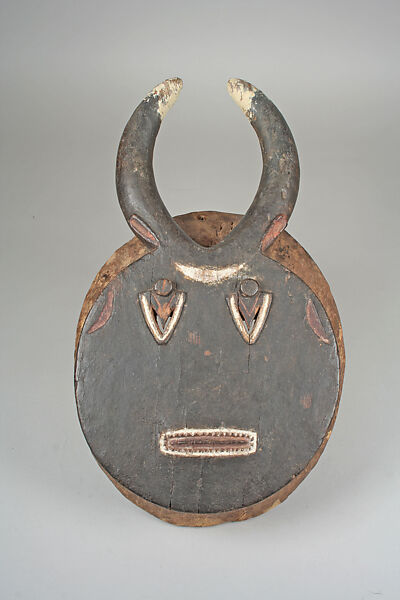
The masks that open a Goli performance, known as kple kple, are flat, circular or disc-shaped, painted boldly in red, black, and white, and fitted with a pair of horns. Their geometric abstraction and rapid, energetic dancing style associate them with speed and untamed force rather than individual human character. As the sequence progresses, later mask pairs introduce more three-dimensional carving and increasingly human, composed facial features, arriving at masks that emphasize serenity and refinement — a deliberate visual and choreographic contrast with the kple kple that opened the day.
This progression is the reason Goli is often singled out in West African art scholarship: few masking traditions build an entire day’s performance around a visible, danced argument about the movement from wildness to composure.
A Borrowed Tradition, Fully Adopted
Goli is unusual among major African masquerade traditions in having a documented, relatively recent adoption history. Baule oral history and subsequent scholarship place its arrival among the Baule in the early twentieth century, borrowed from neighboring peoples to the north and west and then reshaped into a distinctly Baule form. Far from diminishing its authenticity, this history is often cited as an example of how masking traditions travel, adapt, and take on new meaning within their new communities — a useful corrective to the assumption that “authentic” African traditions must be static or ancient to be legitimate.
Goli Masks in the World
Because Goli performances were extensively documented by anthropologists and photographers through the twentieth century, and because kple kple masks in particular were produced in significant numbers for community use, examples are held in major collections including the Metropolitan Museum of Art and the Barbier-Mueller Museum, typically alongside Baule figure sculpture and Mblo masks. Kple kple masks are also among the more frequently reproduced Baule forms in the tourist and decorative art market, which makes provenance and quality of carving especially relevant for anyone buying rather than simply studying one — see our African masks buying guide for what to look for.
Frequently Asked Questions
What does the word Goli refer to?
Goli names the full masquerade cycle — the sequence of paired masks and the day-long performance — rather than a single mask type. Kple kple is the specific name for the masks that open the sequence.
Is Goli a secret or a public masquerade?
Public. Unlike initiation masks tied to closed societies, Goli is performed as entertainment and honor at funerals and community celebrations, and it can be watched by outsiders.
Is Goli an ancient Baule tradition?
Not in the way many assume. Baule oral history and scholarly research place its adoption in the early twentieth century, borrowed from neighboring peoples and adapted into Baule form — a reminder that masking traditions evolve.
How can I tell a genuine Goli kple kple mask from a tourist reproduction?
Look at the quality and depth of the carving, wear patterns consistent with actual dance use, and documented provenance. Our buying guide covers this in more depth.
See also: Every Traditional African Mask You Should Know · African Masks by Region and Tribe · I Decoded African Masks and Their Color Symbolism · African Masks for Sale: A Buying Guide