Ejagham Masks: The Skin-Covered Faces of the Ngbe Leopard Society
New: the 2nd edition of Within Carved Lines: The Secret Meanings of African Masks is out now. Get the book →
Most African helmet masks are carved, painted, and left as wood. Ejagham carvers, working in the Cross River region straddling southeastern Nigeria and Cameroon, took an additional and genuinely unusual step: they stretched real skin, taken first from slaves and later from antelope, over the carved wooden form beneath, then stained it with pigments made from leaves and bark until it read as living tissue rather than sculpture. The result, in the plain assessment of specialists who have surveyed masking traditions across the continent, is unique in Africa. Nothing else looks quite like it.
That single technical choice is the throughline worth carrying through this piece. A skin-covered mask is not just a stylistic variation on a wooden one. It changes what the object is claiming to be. A carved wooden face represents an ancestor or a spirit. A face built from an actual stretched skin, aged and stained until it looks organic, is doing something closer to reanimation, and the Ejagham built an entire secret society, a river trade network, and a two-format masking system around that difference.
Who Are the Ejagham?
The Ejagham are one of several related ethnicities living in the Cross River region of southeastern Nigeria, extending into Cameroon, alongside the Anyang, Boki, Keaka, and Yako, all of whom speak related Ekoi languages and share much of the same masking tradition. Farm labor traditionally fell to women, with the exception of clearing new forest land, which freed Ejagham men to concentrate on hunting and the arts of war, and, not incidentally, gave them the leisure to invest heavily in art. Both men and women wove raffia cloth on upright looms and gave equal, careful attention to coiffure, body paint, and dress, a shared aesthetic culture that extended well beyond the masks themselves. Political organization stayed local. No institution unified the Cross River’s many scattered village communities into a single polity, and that gap is exactly what Ngbe was built to fill.
Ngbe: The Leopard Society That Ran the River
Ngbe, whose name means simply “leopard” in the Ejagham language, is likely the oldest secret society documented in the Cross River region, and it was open only to men. Its unifying effect on the area’s fragmented communities was substantial and largely commercial: Ngbe gave otherwise disconnected villages a shared institution through which to conduct commercial, ritual, and social exchange, effectively substituting for the centralized political authority the region never developed on its own. A leopard-based society claiming that kind of coordinating role fits a wider West and Central African pattern, seen also among the Kwele’s own leopard-linked beete ritual against witchcraft documented elsewhere on this site, in which the region’s most feared predator becomes the emblem of the institution best positioned to keep order.
A Mask Covered in Real Skin
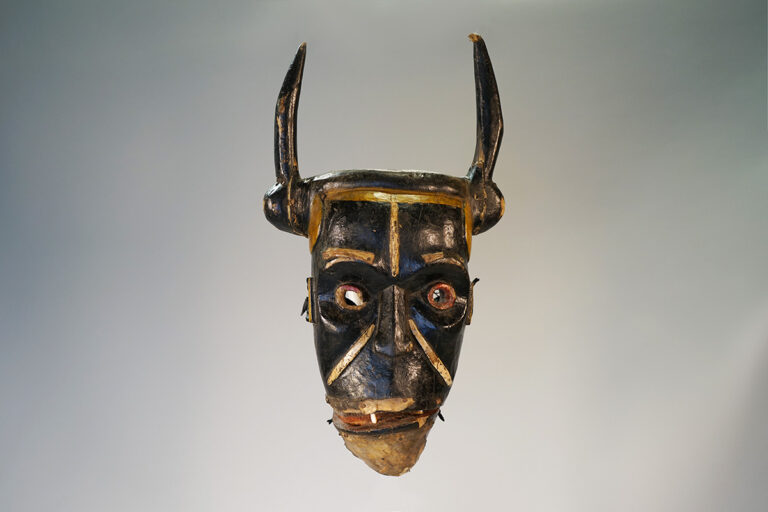
The signature Ejagham object is the skin-covered helmet mask: a form carved first in soft wood, then covered with fresh animal skin (in earlier periods, the skin of slaves) stretched tightly over the carving and tacked in place. Once the skin dried, it was stained with pigments drawn from leaves and bark, a finishing step that pushed the object further away from looking like carved wood and further toward looking like an actual face. Metal teeth, inlaid eyes, and pegs representing hair, sometimes replaced by elaborate carved coils, added to the effect, along with feathers, quills, and human hair worked into the finished hairdo. The assumption embedded in the record is that all of these masks represented ancestors, though animal and skull forms exist alongside the human-headed ones, and the animal and grotesque types in particular were built to read as fierce and frightening rather than benign. The skin covering was not treated as a cosmetic flourish. It functioned as a magical agent in its own right, understood to invoke ancestral spirits and to erode the barrier between the living participants in a ritual and the dead ones the mask was calling forward.
Helmet and Crest: Two Formats, One Technique
Ejagham masking worked in two distinct physical formats. The helmet mask covers the wearer’s entire head down to the shoulders, built directly onto the skin-covered wooden form described above. The crest mask is a lighter, smaller alternative that does not cover the head at all, instead sitting on top of it, attached to a basketry cap the wearer secures in place. Both formats could carry the full range of decoration, metal teeth, inlaid eyes, hair pegs or coils, and both appeared in the same broad category of performance: dances by accomplished, specially trained performers, staged at funerals, at the initiation of new society members, and at agricultural and other communal events. The choice between a full helmet and a lighter crest was a practical one as much as a symbolic one, trading full concealment and dramatic presence against a lighter, more maneuverable object for a dancer who needed greater freedom of movement.
Selling the Right to Perform, Not Just the Mask
One detail about Ejagham and wider Ekoi masking is easy to pass over and worth pulling out on its own: the elaborate trading network that ran along the Cross River did not just move goods. It moved the rights to perform specific masquerades. A group holding the rights to a particular Ngbe or other society masquerade could sell those rights to a buyer group in another village, travel there to perform the masquerade once as proof of transmission, and then return home, deliberately leaving their own masks and costumes behind for the new owners to keep and use going forward. Repeated across a broad river network over generations, this practice spread related art forms and performance traditions widely across a diverse population, while also guaranteeing that no two copies stayed identical for long: local carvers reproducing a purchased masquerade inevitably introduced their own changes in both form and meaning as they made it their own. A single masquerade type, traced across the region, could therefore look meaningfully different from village to village, not because of failed transmission but because the trade itself was designed to let local ownership reshape what had been bought.
The Standing Stones of Ikom
Ejagham territory contains one further body of art worth noting even though it stands entirely apart from the masking tradition: in the northern Ejagham area around Ikom, large carved stone monoliths called akwanshi, ranging from one to six feet high, represent human figures in low relief. They are thought to date to no earlier than the sixteenth century, which places them well within the same broad historical window as the masking and trading culture described above, even though stone monoliths and skin-covered wooden masks are, on the surface, about as different as two art forms from the same people can be.
Frequently Asked Questions
What makes an Ejagham mask different from other African masks?
Ejagham carvers stretched real animal skin (in earlier periods, skin taken from slaves) over a carved wooden form and stained it with pigments from leaves and bark, producing a genuinely skin-covered mask, a technique specialists describe as unique in Africa.
What is the Ngbe society?
Ngbe, meaning “leopard,” is likely the oldest secret society in the Cross River region and was open only to men. It gave scattered Cross River villages a shared institution for commercial, ritual, and social exchange in the absence of any centralized political authority.
What is the difference between an Ejagham helmet mask and a crest mask?
A helmet mask covers the wearer’s entire head down to the shoulders and is built onto the skin-covered wooden form. A crest mask is lighter and sits on top of the head, attached to a basketry cap, rather than covering it.
Why do similar masquerades look different from village to village in this region?
Because the Cross River trading network sold the rights to perform a masquerade rather than only the physical mask. Local carvers who acquired those rights reproduced the masquerade in their own style, introducing gradual changes in form and meaning across the region.
See also: African Masks by Region and Tribe · West African Mask Styles: A Visual Guide to Regional Differences · Ekuk and Gon Masks of the Kwele: The Beete Ritual Against Witchcraft · Every Traditional African Mask You Should Know

Brooklyn Museum. Licensed CC BY 3.0. Source: Wikimedia Commons