What Is an African Mask? A Beginner’s Guide to Meaning and History
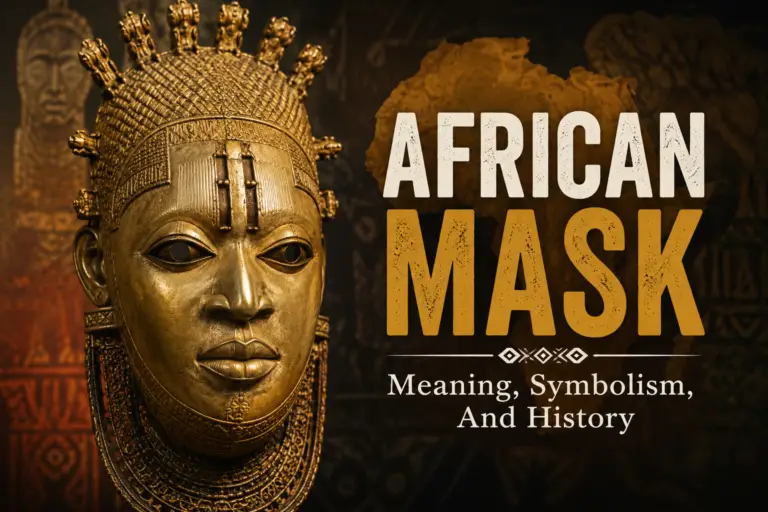
What is an African mask? People ask this question more often than you would think, and most of the answers they find online are thin. A single photo. A caption that says “tribal mask.” Nothing about who carved it, who wore it, or what it was for. That is the gap this piece is here to close. An African mask is not one thing. It is a carved or constructed face, worn or displayed, that carries meaning given to it by a specific people, in a specific place, for a specific purpose. Strip away the purpose and the people, and you are left with a curio. Put them back, and you are looking at one of the most serious art forms the continent has produced.
Watch on the SEVICS Africa channel: The African Mask: Is It More Than Just Art?
What Is an African Mask, Really?
Start with the basics. A traditional African mask is rarely just a face covering. It is usually part of a larger costume, sometimes covering the whole body in cloth, raffia, or fiber, so that the wearer disappears entirely and something else takes their place. That something else might be an ancestor, a bush spirit, a deity, or a moral idea given a face, like justice or fertility. The mask is the visible part of a much bigger event. It moves with drumming, chanting, and dance. Take away the performance and the mask on a shelf is only half itself.
This matters because most people encounter masks the wrong way first, in a museum case or a souvenir shop, standing still and silent. That silence is not how masks were meant to live.
What African Masks Are Made Of, and Who Makes Them
Wood is the most common material, carved from a single log with adzes and knives, then finished with pigment, kaolin, charcoal, or plant dyes. But wood is only the start. Depending on the people and the purpose, a mask might carry cowrie shells, woven raffia collars, brass or copper sheeting, animal hide, human hair, feathers, or cloth. Some masks, like certain Yoruba and Igbo helmet forms, cover the entire head and rest on the shoulders rather than the face.
The maker’s role is bigger than “artist” in the sense the West usually means it. In many traditions, mask carving is a specialized craft passed down within a family or a guild, and the carver often works within rules about which forms are permitted, which colors carry which meaning, and which masks belong to which society or age grade. Among several West African peoples, mask ownership and mask knowledge are tied to closed associations, so the carver is not making decorative art on request. He is producing an object that will be judged by elders, activated in ceremony, and treated with the same seriousness as a title or an office.
Why Masks Are Made: Ritual, Initiation, and Storytelling
Ask why African masks are made and you get a long list, because the honest answer is that no single reason covers it.
Among the Dogon of Mali, the kanaga mask appears at the dama, the ceremony that sends a dead person’s spirit into the world of the ancestors. Its flat wooden crosspiece above the face is read as a symbol connecting earth and sky. It is a funerary mask, built for grief and transition, not entertainment.
Among the Yoruba of southwestern Nigeria, gelede masks and their accompanying dances honor the spiritual power attributed to elder women, the “mothers,” and are performed to keep that power benevolent rather than destructive. The masks are often painted, sometimes topped with carved scenes of daily life, and the performance itself is public, communal, and full of humor alongside reverence.
Among the Chokwe of Angola and the Democratic Republic of Congo, masks like the mukishi figures appear during mukanda, the initiation process that moves boys into manhood. The mask teaches as much as it performs. It disciplines, instructs, and marks a passage that cannot be undone.
Among the Dan of Liberia and Ivory Coast, masks serve social functions that shift by context, sometimes appearing at entertainment dances, sometimes acting as a form of community judgment, carrying authority that a human face alone would not be given.
Notice what just happened across those four examples. Grief. Reverence for women’s spiritual authority. Initiation into adulthood. Social judgment and entertainment. Four different peoples, four different purposes, four different masks. That is the point.
Meaning and History Are Not One Story
This is where the beginner’s question “what is an African mask” needs a correction built into it. There is no single African mask tradition, the same way there is no single European painting tradition. A Dogon funerary mask and a Yoruba gelede mask were not made by the same people, for the same reason, using the same rules. Treating them as interchangeable examples of “African art” erases exactly the information that makes each one meaningful, which people made it, what ceremony it belongs to, and what it is not allowed to be used for outside that context.
How Colonial Collecting Distorted Mask History
Here is where the history gets uncomfortable, and it needs to be said plainly. During the colonial period, European soldiers, missionaries, and administrators removed enormous numbers of masks and ritual objects from the communities that made them, often by force, often from sacred storage that was never meant to be seen by outsiders. Once in Europe, these objects were relabeled. A mask built for a specific ceremony, owned by a specific society, became “tribal art” or “primitive art,” displayed for its shape rather than its function, admired the way you might admire a strange rock rather than understood the way you would understand a courtroom or a church.
That relabeling did real damage. It taught generations of Western viewers that African masks were curiosities from static, timeless “tribes” rather than working objects made by specific societies with specific histories, societies that were changing, trading, and creating new forms constantly, exactly like everywhere else. Museums are slowly correcting this now, restoring names, origins, and ceremonial context to pieces that were stripped of all three. But the correction is recent, and the old framing still shapes how a lot of people are introduced to this subject for the first time.
Why This History Still Matters
Knowing what an African mask actually is protects you from two mistakes at once. It stops you from treating the mask as decoration with no weight behind it, and it stops you from flattening dozens of distinct peoples into one imagined “African” tradition. Neither mistake is harmless. Both erase the specific communities, the Dogon, the Yoruba, the Chokwe, the Dan, and hundreds of others, who built these forms and who, in many cases, are still building them.
If this is your first time reading about masks in any depth, you are exactly who this was written for. For a deeper look at how to read a specific mask, its materials, and its markings, read our full guide, Understand Your African Mask Today. If you want to keep learning about the cultural history behind these objects, our Education section is the right place to start, beginning with Prioritizing Education. And if you would rather see this history than read it, the SEVICS Africa YouTube channel walks through many of these masks and traditions on camera, mask in hand, story attached.