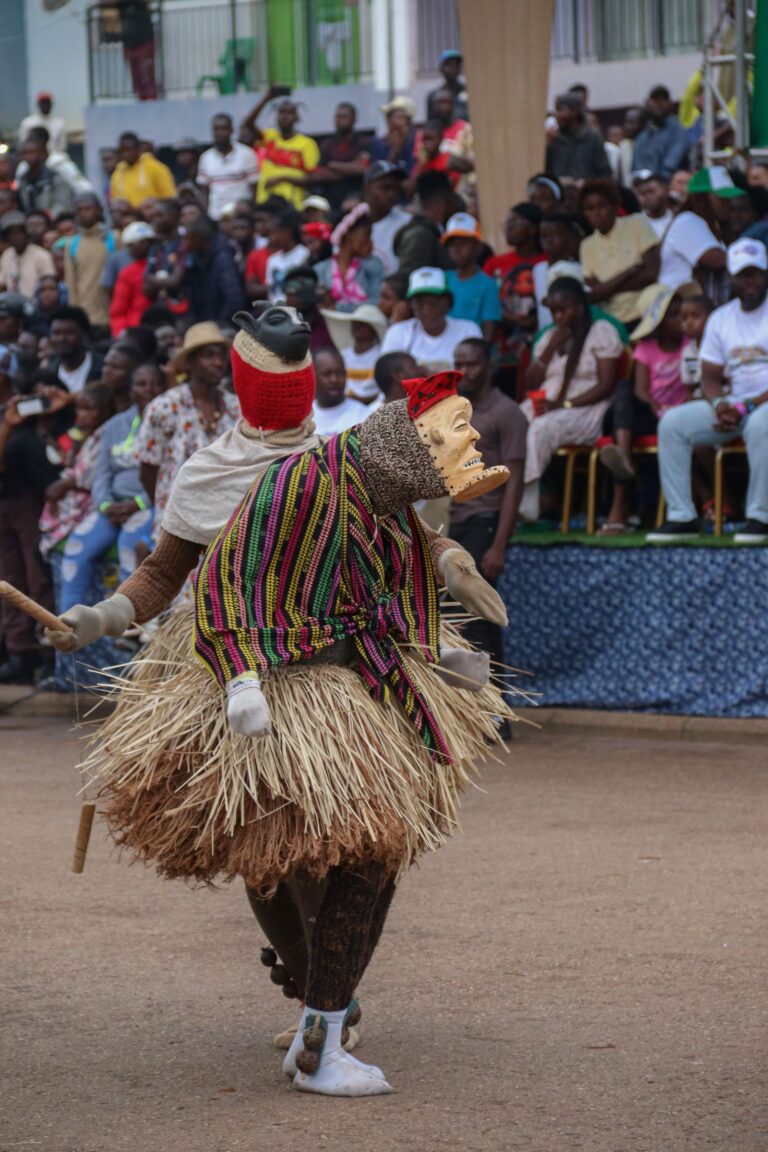
Bete Masks: The Grimacing Face That Made War, Then Kept the Peace
New: the 2nd edition of Within Carved Lines: The Secret Meanings of African Masks is out now. Get the book →
Most masks documented in this book serve either war or peace, aggression or reconciliation, rarely both at once. The Bete of Côte d’Ivoire, roughly 600,000 people living between the Akan groups to the east and the Guro to the north, built a single mask type that did both jobs in sequence: worn to instill fear and terror in enemies before and during armed conflict, then brought out again to preside over the ceremony that restored peace once the fighting was over. That single object serving both ends of the same conflict, weaponized dread followed by ceremonial resolution, is the throughline worth carrying through this piece. It turns the gre or nyabwa mask into something closer to a piece of civic infrastructure than a simple war mask: the community’s tool for managing conflict from its most violent opening to its formal close.

Who Are the Bete?
The Bete live in the southwestern part of Côte d’Ivoire, an agricultural people numbering around 600,000, organized patrilineally into small “headless” villages that operate under the authority of the ancestors rather than a central chief. Historically hunters, the Bete now farm as well, growing what is needed for a subsistence economy while also linking into the broader market economy through the cultivation of cacao and coffee, a combination that places them within a wider regional pattern of communities balancing older subsistence practices against newer cash-crop agriculture.
A Religion Built Around Ancestors, Not a Distant God
Religion is omnipresent in Bete life, aimed at maintaining a harmonious relationship between nature and the ancestors responsible for the tribe’s welfare. The vast majority of Bete still follow their traditional African religion today, believing in a creator god named Lago whom they neither pray to nor worship directly. Instead, they seek help from many lesser spirits believed to hold supernatural power, spirits of the ancestors, and spirits inhabiting trees, rivers, and rocks, observing numerous customs and taboos and making sacrifices of eggs, chickens, and cattle. Each ritual focuses on maintaining good relations with the world of the ancestors, and it is this religious system, oriented toward the dead and the natural world rather than toward a remote creator, that gives rise to the mask performances at the center of Bete ritual life, performances in which music plays a fundamental role and in which men form dedicated dance societies that young apprentices work to join.
Gre and Nyabwa: A Face Built to Frighten
Bete carvers are renowned for one particular face mask, called gre or nyabwa, built around exaggerated, grimacing, distorted features: a large protruding mouth, facial protuberances, a bulging forehead, an elongated nose with nostrils sometimes extending to each side of the face, and globular or bulging slit eyes set beneath a high-domed forehead carved with a medium ridge. Every element of the design points toward the same effect, a face constructed specifically to be frightening rather than beautiful, aggressive rather than composed.
From the Battlefield to the Peace Table
In earlier days, the gre or nyabwa mask presided over the ceremony held when peace was restored after armed conflicts, and it also took part in sessions of customary justice, giving it a formal role in both ending violence and resolving disputes through recognized legal process. The same mask was worn to prepare men for war, offering magical protection by instilling fear and terror in potential enemies before or during the fighting itself. That dual role, present at the outbreak of conflict and again at its formal resolution, is unusual among the masks documented in this book, most of which are tied to a single side of the ledger. Today the mask is worn for a variety of ceremonies, including entertainment dances, a considerably softened continuation of a role that once spanned the full arc of war and peace.
Statues Carved Under the Guro’s Influence
Beyond the mask tradition, the Bete carved elegant statues, stylistically influenced by their Guro neighbors. These figures were usually carved as standing forms with set-apart legs, an elongated torso with square shoulders, a columnar neck supporting an oblong head with a pointed chin, an incised mouth, and a high-domed, smooth forehead beneath a helmet-like coiffure, hand positions that remain difficult to interpret, and touches of white pigment. Displayed in shelters or shrines, male and female figures represented the founders of the community, incarnating an ideal of spiritual perfection and moral strength tied directly to physical beauty. Smaller statuettes, inspired by a tradition borrowed from the Baule, may have been carved to represent spouses from the other world.
Frequently Asked Questions
What is the gre or nyabwa mask used for?
It served two opposite functions across a single conflict: worn to prepare men for war and terrify enemies through its grimacing, aggressive design, then brought out again to preside over the ceremony restoring peace and to take part in sessions of customary justice.
What does a gre mask look like?
It has exaggerated, grimacing features: a large protruding mouth, facial protuberances, a bulging forehead, an elongated nose, and globular or bulging slit eyes beneath a high-domed, ridged forehead.
Who do the Bete worship?
They believe in a creator god named Lago, whom they neither pray to nor worship directly, instead seeking help from ancestral spirits and spirits inhabiting trees, rivers, and rocks through sacrifice and ritual observance.
Whose influence shaped Bete statues?
Bete statues show clear stylistic influence from their Guro neighbors, while smaller spirit-spouse statuettes draw on a tradition borrowed from the Baule.
See also: African Masks by Region and Tribe · Guro Masks: The Zamble, and a Style Forged Between the Baule and the Dan · Yohure Masks: Dangerous Spirits Worn to Steady the Living After a Death · Every Traditional African Mask You Should Know