Lulua Masks: Faces From an Ethnic Crossroads in the Congo
New: the 2nd edition of Within Carved Lines: The Secret Meanings of African Masks is out now. Get the book →
“Lulua” is not really the name of one people. It is an umbrella term for a large number of heterogeneous groups who settled near the Lulua River, between the Kasai and Sankuru rivers in the southern Democratic Republic of the Congo. That heterogeneity is not a footnote to their art. It is the reason their art looks the way it does.
Keep that one fact in view as the throughline for this whole piece: where most masking traditions on this site belong to a single people with a single origin story, Lulua masks are the visible result of several different peoples living, marrying, and carving in the same river valley over centuries. That is why, as we’ll see, even specialists sometimes struggle to say with confidence exactly which Lulua mask came from which of the group’s constituent communities.
Who Are the Lulua?
Around 300,000 Lulua people live in small regional chiefdoms scattered across a landscape of farmland and forest along the Lulua River, each chiefdom with its own village chief responsible for judicial, political, and social cohesion, electing a common leader only in times of crisis. In the late nineteenth century, the Lulua king Kalambam introduced new social and religious regulations that ended traditional palm wine drinking and hemp smoking, a reminder that Lulua culture has undergone real, dated, internal reform rather than staying static across centuries. Their economy runs on agriculture, hunting, trade, and locally sourced salt, sold to neighboring groups.
A People Formed by Migration, Not a Single Origin
The Lulua migrated from western Africa during the eighteenth century and settled in what was then the southern Congo Free State region, later Zaire, now the Democratic Republic of the Congo. That migration history, arriving as multiple groups into a shared territory rather than expanding outward from one point of origin, is the direct explanation for why Lulua art historians describe as an ethnic crossroads rather than a single tradition.
Why Lulua Figures Are Covered in Scarification
Before turning to masks, it’s worth understanding the statuary that sits alongside them, because the same logic runs through both. Lulua statues are remarkable for the degree of scarification carved into them, a deliberate expression of a wish to be socially differentiated from neighboring peoples. Male figures depict warrior chiefs holding a ceremonial sword, shield, or cup. The most famous statuettes, the mbulenga, are female charm figures, while chibola maternity figures were worn on the belt to stand watch over childbirth, protecting a newborn or a baby still to come.
Other Lulua carvings served specific, practical ritual functions: crouching statuettes with receptacles on their heads were used by hunters as hemp boxes, spoken to and credited with bringing luck on the return from a hunt; other figures protected against sorcerers, thieves, and lightning, or were used in divination sessions. The scale of the head, often a full quarter of a figure’s total height, and details like a pointed hairdo, a horn symbolizing power, and concentric circles around the navel symbolizing life, all reflect a consistent visual vocabulary that carries into the mask tradition as well.
Two Families of Lulua Mask
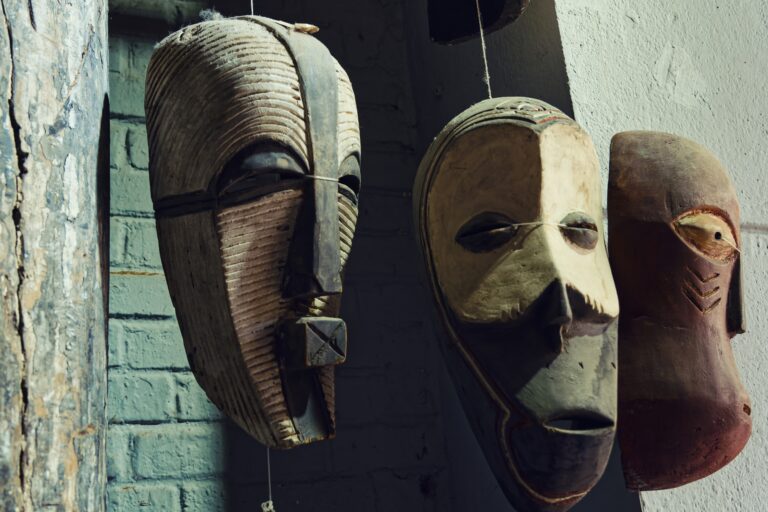
Because the Lulua occupy such a wide, ethnically mixed territory, their masks show real stylistic overlap with neighboring peoples, and confirming a given mask’s precise origin is often genuinely difficult even for specialists. Within that variation, at least two broad categories of wooden Lulua mask can be distinguished.
The first is a face mask with concave eye sockets and intricate, geometric painted patterns. The second is a face mask that also has concave eye sockets, but with simpler patterns and a distinctive plank shaped crest rising from the top. Masks from both categories share a pointed nose and deep set eyes, and were most likely used during circumcision ceremonies and funerals, the two occasions where masked performance across this region tends to concentrate.
Why “Crossroads” Is the Right Word
It is worth being direct about what makes Lulua masking different from almost everything else covered on this site. A Kwele mask can be traced to a specific ritual, beete, performed by a specific people in a specific forest region. A Lulua mask often cannot be pinned down with that same confidence, not because the tradition is any less real or any less rich, but because the Lulua themselves were never one people carving in isolation. They were several peoples, arriving over generations, settling into the same river valley, marrying across group lines, and carving in styles that borrowed from and blended into each other. A Lulua mask, in that sense, is not a weaker or vaguer version of a “purer” single tribe tradition. It is direct physical evidence of exactly how culture actually moves and mixes along a river shared by many different peoples, which is arguably more historically honest than a single, tidy origin story would be.
Frequently Asked Questions
Why is “Lulua” described as an umbrella term rather than one ethnic group?
Because it refers to a large number of heterogeneous peoples who migrated into the same river region during the eighteenth century, rather than a single group that expanded from one origin point.
What are the two main types of Lulua mask?
One type has concave eye sockets with intricate geometric painted patterns. The other also has concave eye sockets but with simpler patterns and a plank shaped crest. Both share a pointed nose and deep eye sockets.
What were Lulua masks used for?
They were most likely used during circumcision ceremonies and funerals, the occasions where masked performance concentrates across much of this region of the Congo.
Why are Lulua statues so heavily scarified?
The scarification on Lulua figures expresses a deliberate wish to be socially differentiated from neighboring peoples, a visual marker of identity within a region shared by many related but distinct groups.
See also: African Masks by Region and Tribe · Kifwebe Mask of the Songye and Luba: Striped Faces of Power and Judgment · Pende Mask of the Congo: Types, Meanings, and Ceremonial Use · Every Traditional African Mask You Should Know
%20used%20in%20circumcision%20ritual%20(mukanda)%20-%20Lulua%20-%20Royal%20Museum%20for%20Central%20Africa%20-%20DSC06276.JPG)
Photo by Daderot, Royal Museum for Central Africa, Tervuren. Public domain (CC0).