How African Kings Led the Resistance: Leadership Lessons From Colonization
When people talk about how African kings led the resistance against colonization, they usually go straight to the battles. The guns, the sieges, the defeats. But the real story is what happened before the first shot was fired. It is the alliances built in secret. The armies rebuilt after loss. The decision to negotiate instead of fight, and the decision to fight instead of negotiate. That is leadership, not history trivia. And it still has something to teach anyone building something today, in a boardroom, a church, a community, or a classroom.
We covered how several African kingdoms eventually fell during colonization in an earlier piece. This one looks at the same period from a different angle. Not why kingdoms fell, but how their rulers led while everything around them was on fire.
What Leadership Looked Like When Empires Came Knocking
By the late 1800s, European powers were not knocking gently. They came with treaties written in languages the other party could not read, with guns that outmatched spears, and with promises that rarely survived contact with reality. African rulers who resisted were not choosing between winning and losing. Most of them knew the odds. They were choosing how their people would be remembered, and how much they could preserve before the terms were dictated to them.
That distinction matters. Leadership in that era was rarely about a single dramatic stand. It was about sustained decisions made under pressure, with incomplete information, against opponents who had industrial weapons and endless soldiers to spend. The rulers who are still remembered today were not remembered because they always won. They are remembered because of how they led.
How African Kings Led the Resistance: Four Rulers, Four Strategies
There is no single template for resisting an empire. Each of these rulers read their situation and built a strategy suited to it. That is the first lesson before we even get to the details: leadership is not one fixed style copied from a textbook. It is a response to the specific ground you are standing on.
Queen Nzinga and the Discipline of Alliance Building
Nzinga ruled Ndongo and later Matamba, in what is now Angola, through most of the 1600s. She spent decades resisting Portuguese expansion, and she did it by refusing to fight alone. She negotiated with the Dutch when it served her interests, absorbed escaped enslaved people and warrior groups into her forces, and shifted her diplomatic posture repeatedly as circumstances changed, including a period presenting herself within a Christian political framework to gain leverage with European powers. None of this was inconsistency. It was a ruler treating alliances as a resource to be managed carefully, not a loyalty test to be passed once and forgotten. She led into her sixties and seventies, which in itself says something about endurance as a leadership trait.
Samori Toure and the Habit of Adapting Faster Than the Threat
Samori Toure built the Wassoulou Empire in West Africa and fought the French for close to two decades. What set him apart was not raw bravery. It was his refusal to keep fighting the same war twice. He reorganized his army along more modern lines, built local workshops to repair and produce firearms rather than depending entirely on outside supply, and when the French pressed one region too hard, he was willing to relocate his base rather than defend ground that had become a losing bet. That is a hard decision for any leader. Abandoning a position, even a symbolic one, to protect the people and the mission for another day.
Menelik II and the Long Game of Diplomacy
Menelik II of Ethiopia is remembered for the victory at the Battle of Adwa in 1896, where Ethiopian forces defeated an Italian invasion. But the battle was the visible part of a much longer strategy. In the years before Adwa, Menelik worked multiple European powers against each other diplomatically, securing modern weapons and training even while some of those same powers had colonial ambitions in the region. He understood that resistance does not start on the battlefield. It starts years earlier, in the quiet, unglamorous work of building capacity before you need it. Ethiopia’s independence through that period remains one of the clearest examples of preparation outlasting aggression.
Yaa Asantewaa and the Power of Morale When Others Hesitate
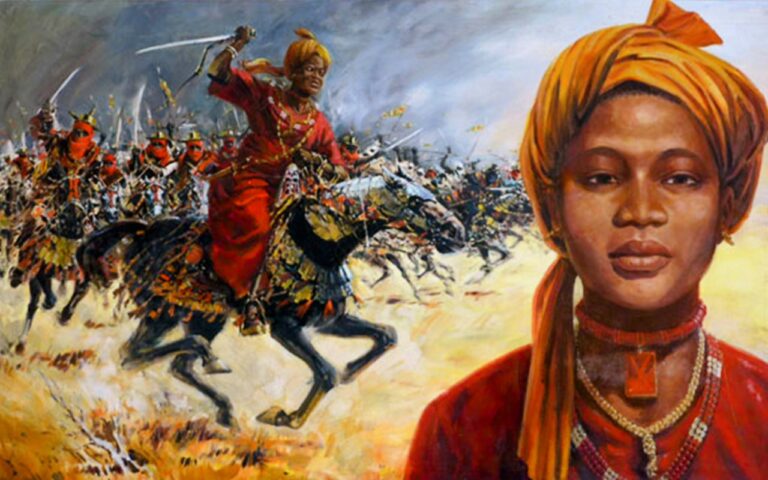
Yaa Asantewaa was a queen mother of Ejisu within the Ashanti Empire, in what is now Ghana. In 1900, when British demands escalated, including over the Golden Stool, a symbol of Ashanti sovereignty, accounts passed down describe a moment when the male chiefs were divided and reluctant to fight. Yaa Asantewaa is remembered for pushing them to act when their resolve was wavering, and for leading what became known as the War of the Golden Stool. Whatever the exact details lost to time, the pattern that survives is clear and instructive: sometimes the most important leadership act is refusing to let a room full of hesitant people talk themselves into inaction.
The Leadership Lessons Behind the Battles
Put these four rulers side by side and a pattern emerges that has nothing to do with weapons. Nzinga shows the discipline of building alliances even with unlikely partners. Samori Toure shows the value of rebuilding your capacity instead of clinging to a failing plan. Menelik II shows what patient, unglamorous preparation can secure before a crisis ever hits. Yaa Asantewaa shows that morale is a leadership function, not a side effect, and that someone in the room has to hold the line when others waver.
None of these lessons require a colonial invasion to matter. They apply to a business owner deciding whether to restructure before the market forces it on them. They apply to a community leader trying to hold a coalition together when funding gets tight. They apply to anyone whose team is losing heart and needs someone to speak first.
Why This Still Matters for African Leadership Today
This is the connection SEVICS Africa keeps coming back to. African history is not a museum piece. It is a leadership curriculum that has been sitting in plain sight, waiting for people to read it that way. The kings and queens who resisted colonization were not perfect, and their stories deserve honesty, not decoration. But the strategic instincts they carried, adaptability, alliance building, preparation, and morale, are the same instincts we try to build in leaders today.
If you want the fuller picture of how these kingdoms eventually fell despite this leadership, read our companion piece on how African kingdoms fell during colonization. It fills in the context this article assumes.
And if leadership drawn from African history is something you want to keep learning from, visit the Leadership section on SEVICS Africa for more pieces in this line. We also unpack these histories and their lessons in video form on the SEVICS Africa YouTube channel, so if you would rather watch this history than read it, that is where to find us.