Bobo Masks: How the Bobo-Fing Cleanse a Village’s Mistakes With a Mask Called Dwo
New: the 2nd edition of Within Carved Lines: The Secret Meanings of African Masks is out now. Get the book →
Among the Bobo, a mask is not primarily a portrait, a costume, or even a spirit’s dwelling place. It is closer to an instrument of debt repayment. The Bobo believe that human beings are always, inevitably, making errors against the natural order, and that it falls to the community, regularly and deliberately, to make amends. Masks are the mechanism built to do exactly that: to erase evil and to restore the god-given balance between sun, earth, and rain that human mistakes keep throwing out of alignment.
That is the throughline worth carrying into everything below. Almost every other masking tradition on this site is organized around commemorating something, an ancestor, a chief, a rite of passage. Bobo masking is organized around correcting something, an ongoing, recurring need to reconcile a farming community with the forces its own errors have offended, and that corrective purpose shapes everything from who is allowed to wear a mask to what animals the masks are carved to represent.
Who Are the Bobo?
Around 130,000 Bobo, often labeled Bobo-Fing in the art-historical literature though they call themselves simply Bobo, live in eastern Burkina Faso and in neighboring Mali, farming sorghum, millet, yams, and maize as staple crops alongside cotton and peanuts grown for cash. Bobo society is governed by a council of elders rather than a chief; the very idea of a single ruler is treated as foreign and, in the community’s own framing, dangerous, an attack on the order of things as the god established it. That is not an incidental detail. It sits at the center of Bobo belief and helps explain why masking, rather than chiefly authority, became the community’s primary tool for managing its relationship with the forces that govern the natural world.
Wuro, Dwo, and a Debt Owed to the Gods
The Bobo creator god, Wuro, formed the world out of a ball of mud and made the first man a blacksmith, a detail that immediately linked the blacksmith caste to divine creation itself. Wuro’s son, Dwo, was given the job of helping humankind directly, and the Bobo blacksmiths became, in turn, the priests of Dwo worship, the caste responsible for maintaining the relationship between ordinary people and this intermediary deity. Living in a region of dry savanna where every harvest depends on rainfall the community cannot control, the Bobo built a whole calendar of purification rituals meant to reconcile themselves with nature, on the premise that it is human beings, not the natural world, who are responsible when that relationship goes wrong.
What a Mask Is Actually For, Among the Bobo
Set against that backdrop, the purpose of a Bobo mask becomes specific and almost procedural: masks exist to erase evil and to reinstate the god-given balance between sun, earth, and rain, disturbed by ongoing human error. Their meaning is revealed to young boys only during initiation, which keeps the corrective machinery itself, and not merely its performance, restricted to those who have been formally brought into the tradition. Purification ceremonies cluster at the end of the dry season, immediately before the work of cultivation begins, a moment when reconciling the community with nature carries obvious agricultural stakes, though the masks also appear at ceremonies tied to new crops, initiations, and funerals across the wider ritual calendar.
A Bestiary of Purification
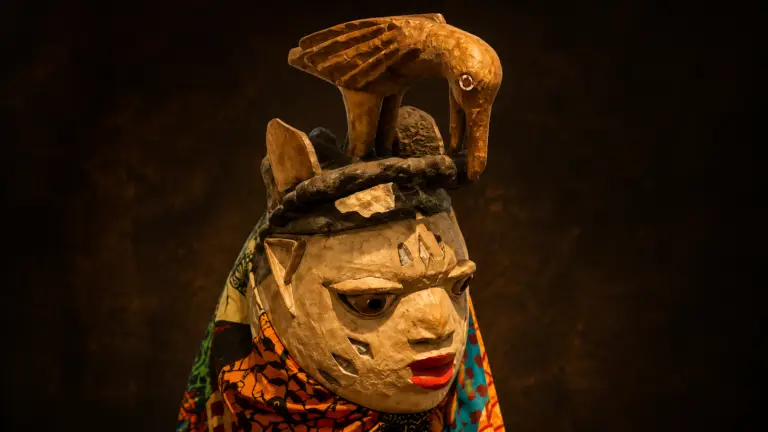
Bobo purification masks are built from leaves, fiber, and wood, and they represent Dwo himself or a defined set of protective spirits given animal form: warthog, male buffalo with flat horns, a rooster with its crest standing perpendicular to its face, toucan, fish, antelope, serpent, and hawk. Every one of these forms is understood to incarnate the forces of fertility, fecundity, and growth, which is precisely the register the masks need to operate in if their job is to restore agricultural and cosmic balance rather than simply frighten or entertain. The range of animals is wide, but the underlying logic is consistent: each creature lends the mask a specific facet of the natural vitality the community needs restored.
Erasing the Self to Become the Mask
The single most distinctive belief documented in Bobo masking concerns the wearer rather than the object. Among the Bobo, the sacredness of a mask comes from the conviction that the divinity is genuinely present inside it and acts through it, not merely alongside the person wearing it. To “be” a mask, in this framework, a man had to erase himself: to stop being himself, in a real and deliberate sense, and to let the mask’s identity take full precedence over his own. That is a stronger claim than the more common idea, found across many African masking traditions, that a wearer channels or represents a spirit while dancing. Here, the human being is asked to actively step aside so the divinity, working through the mask, can be the one truly present and truly acting.
Bobo, Bobo-Fing, and Bobo-Oule: A Name Worth Untangling
One naming detail is worth resolving directly, because it is a near-perfect setup for confusion. The neighboring Bwa people, whose own plank masks are documented elsewhere on this site, are recorded under the alternate names Bobo-Oule and Bobo-Ule, names built from the very same root as Bobo itself. The Bobo documented in this article are, correspondingly, often labeled Bobo-Fing in the literature. Two distinct peoples, sharing a common root name, both carving masks, both working in the same general Burkina Faso and Mali region, is exactly the kind of overlap that leads museum labels and casual descriptions astray. The underlying belief systems are genuinely different: the Bwa’s plank masks are organized around a different set of spirit and insect imagery, while Bobo masking is built entirely around Dwo, purification, and the self-erasing wearer described above. If you encounter a mask labeled simply “Bobo” or “Bwa” without further detail, it is worth checking which of these two related but distinct traditions it actually belongs to.
Frequently Asked Questions
What is the purpose of a Bobo mask?
Bobo masks exist to erase human error and restore the god-given balance between sun, earth, and rain, a balance the Bobo believe ordinary human mistakes are constantly disturbing.
Who is Dwo?
Dwo is the son of the Bobo creator god Wuro, given the role of helping humankind. Bobo blacksmiths serve as the priests of Dwo worship, and many purification masks represent Dwo directly.
Are Bobo and Bwa masks the same thing?
No, though the names are easy to confuse. The Bwa are recorded under the names Bobo-Oule and Bobo-Ule, sharing a root with Bobo, but the two peoples carve different mask forms tied to distinct belief systems.
What does it mean that a Bobo mask wearer “erases himself”?
The Bobo believe the divinity is genuinely present and acting through the mask itself, not simply represented by the wearer. To properly “be” the mask, the wearer is expected to set aside his own identity entirely while performing.
See also: African Masks by Region and Tribe · Bwa Plank Mask of Burkina Faso: Insects, Spirits, and Geometric Art · African Mask Meaning, Symbolism, And History · Every Traditional African Mask You Should Know
.jpg)
Photo by Ji-Elle. Licensed CC BY-SA 4.0. Source: Wikimedia Commons