Lwalwa Masks: Four Faces of a Hunting Ritual in the Congo
New: the 2nd edition of Within Carved Lines: The Secret Meanings of African Masks is out now. Get the book →
Most masking traditions on this site are built around one recurring event: an initiation, a funeral, an installation of a chief. Lwalwa masking is built around a recurring failure. When hunters came home from the forest with nothing, the Lwalwa did not treat that as bad luck to be shrugged off. They treated it as a rupture serious enough to require a dance, and they built four distinct, geometrically severe mask types to help stage it.
That is the throughline worth carrying into everything below. The four Lwalwa mask types, nkaki, shifoola, mvondo, and mushika, are often displayed as if they were simply four regional styles or four artistic variations on a theme. They are better understood as four characters built to work inside the same single ceremony, the bangongo hunting ritual, each doing a slightly different job within it.
Who Are the Lwalwa?
Around 20,000 Lwalwa people live in the triangle of land formed by the Kasai River and its tributary the Lweta, in what was once the southwestern Kasai province of the Democratic Republic of the Congo, with a larger population living across the border in Angola. It is fertile, well watered country, and the Lwalwa built an agricultural economy on it: women handle nearly all of the planting, weeding, and harvesting, growing crops for both household use and local trade, while men contribute mainly at harvest time and through hunting, which supplies only occasional meat but carries social weight far beyond its calories. The Lwalwa are close relatives of the Lulua, their neighbors to the north along the same river system, and the two peoples’ art has often been discussed together for exactly that reason. Political organization is deliberately light. Each village has its own chief, male or female, but that chief’s authority is checked by a separate, powerful institution: the bangongo society.
A Society Kept in Check by a Mask Cult
Bangongo is the institution that gives Lwalwa masking its reason for existing. It oversees two things at once: the secret rituals of male initiation and circumcision, and the public ceremony that follows an unsuccessful hunt. That second role is the less common one among the masking traditions covered on this site, and it is worth sitting with for a moment. Most initiation-linked masking marks a fixed, expected life passage. Bangongo’s hunting ceremony marks an unplanned failure, called into being only when the community actually needs it, which means a Lwalwa mask dance could happen on short notice, whenever hunters came back empty-handed and the ancestors needed appeasing.
The sculptor who carved these masks held a genuinely privileged position in Lwalwa society. His profession was hereditary, and success at it brought real wealth, wealth substantial enough that a sculptor could become village chief in his own right, specifically in charge of organizing the masked dances his own craft made possible. Art and authority, in other words, ran through the same hands.
Four Masks, One Nose Shape Each
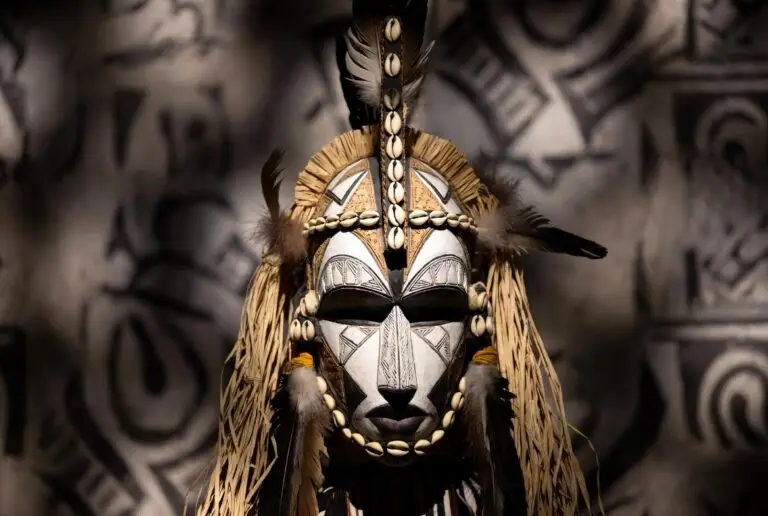
Lwalwa masks share a family resemblance that makes them instantly recognizable even to people who have never seen one before: a balanced, almost architectural composition, slanted eyes set beneath a deep, heavy forehead, a protruding mouth, and, above all, a dramatically enlarged, geometric nose. That nose is also exactly where the four types split apart from each other, each one modeled loosely after the shape of a different bird’s beak.
Nkaki is the man’s mask, built around a wide, triangular nose panel that can extend all the way up to the forehead, the largest and most architecturally bold of the four. Shifoola carries a short, sharply hooked nose, more compact and angular than nkaki’s broad triangle. Mvondo’s nose echoes nkaki’s shape but at a noticeably smaller scale, a kind of quieter cousin to the male mask. Mushika, sometimes called kashika, is the one mask of the four built to represent a woman, distinguished by a frontal crest rather than the exaggerated nose that defines the other three. Across all four, the lips stay narrow but thick and protruding, the eyes are cut as horizontal slits, and raised tattoo-like protuberances mark the temples, a shared vocabulary of detail laid over four very different silhouettes.
What the Masks Were Actually For
The bangongo dance had a specific job: when hunters returned without game, the community staged a masked performance intended to appease the ancestors and persuade them to intervene on the next hunt. The choreography was demanding and precise, built around the idea that the right combination of movement and appearance could actually compel a response from the spirit world, not merely gesture toward one. The same four mask types also appeared in the more secret side of bangongo’s work, the initiation and circumcision of young men, where their appearance carried a different, more restricted weight than it did in the public hunting ceremony.
Lwalwa statuary sits in a clearly secondary position to the masks, which is itself a useful data point about where Lwalwa artistic energy was concentrated. Figures were carved for fertility ritual and ancestor cult purposes, but their features were visibly borrowed from the mask tradition rather than developed as their own independent visual language, cruder in execution and clearly downstream of what the mask carvers had already established.
Carving as a Path to Power
It is worth returning to the sculptor’s position one more time, because it says something distinctive about Lwalwa society compared to many of its neighbors. In several nearby masking cultures, ritual authority and carving skill belong to separate people entirely, a chief or elder commissions the work, and a craftsman, often lower in social standing, executes it. Among the Lwalwa, those two roles could converge in a single person. A gifted carver did not simply serve the bangongo hierarchy from below. He could rise to lead it, becoming the village chief responsible for the very masked dances his hands had made possible. That convergence is part of why Lwalwa masks carry the confident, almost architectural precision they do: they were frequently made by the same men who understood, better than anyone else in the village, exactly what effect the finished object needed to have on the people watching it.
From Ritual to Performance
Lwalwa masks have not disappeared from village life, but their center of gravity has shifted. The masked dances still take place, and they still draw on the same nkaki, shifoola, mvondo, and mushika forms carved for generations. What has changed is the occasion. Today, mask dances are increasingly performed for payment, staged as entertainment for audiences rather than as a direct, urgent appeal to appease frustrated ancestors after a failed hunt. The magic that once justified the dance has, in large part, given way to spectacle. That shift, from urgent ritual to paid performance, is one that shows up again and again across Central African masking traditions once government administration, cash economies, and tourism reshape what a village dance is actually for, and Lwalwa masking is a particularly clear example of it because the change is so openly acknowledged rather than quietly assumed.
Frequently Asked Questions
What are the four types of Lwalwa mask?
Nkaki, a man’s mask with a wide triangular nose; shifoola, with a short hooked nose; mvondo, a smaller version of nkaki’s shape; and mushika, the female mask, identified by a frontal crest rather than an exaggerated nose.
What was the bangongo ritual for?
Bangongo governed both male initiation and circumcision and a separate public ceremony held after an unsuccessful hunt, in which masked dancers worked to appease the ancestors and secure better luck.
How are the Lwalwa related to the Lulua?
The Lwalwa are close relatives of the Lulua, their northern neighbors along the same river system, and the two peoples’ art is often studied together, though Lwalwa masking developed its own distinct four-type system.
Why did Lwalwa sculptors hold unusually high status?
Carving was a hereditary, well paid profession, and a successful sculptor could become village chief, giving him direct authority over the same masked dances his craft made possible.
See also: African Masks by Region and Tribe · Lulua Masks: Faces From an Ethnic Crossroads in the Congo · Every Traditional African Mask You Should Know · African Masks for Sale: A Buyer’s Guide

MAS – Museum aan de Stroom, Antwerp. Public domain (CC0). Source: Wikimedia Commons