Scarification vs Tattoos: How African Body Marking Traditions Differ in Meaning
Picture two photographs side by side. In one, a Nuer man from South Sudan stands with his forehead raised in rows of small ridges, thick enough to trace with a fingertip in the dark. In the other, a Berber woman from the Atlas Mountains carries a fine blue tattoo down her chin, thin as a hair, drawn long ago in soot and ink. A stranger might call both the same thing. But ask the man and the woman what happened to their skin, and they will not describe the same event. That is the real story behind scarification vs tattoos in African tradition. Two different processes. Two different meanings. Two different ways a body carries memory.
What Scarification Actually Is
Scarification is not a tattoo that went wrong. It is its own craft, built on cutting or raising the skin so it heals into a permanent pattern. Sometimes ash or charcoal is rubbed into the fresh wound so the scar rises higher, becoming a small ridge you can feel with your hand long after the skin has healed. This is why people sometimes call it cicatrization. The word points at what the practice is really doing. It is not painting the skin. It is reshaping it.
Among the Dinka and Nuer peoples of South Sudan, forehead scarification has long marked a young man’s passage into a recognized age set. The lines across the brow are not private. Everyone who looks at that man knows roughly where he stands in the order of his community, what generation he belongs to, what he has already survived to earn those marks.
The Tiv of central Nigeria carry a similar logic, though their patterns and placement differ. Scarification among the Tiv has served as a marker of beauty and readiness, something a young woman or man carries into courtship and marriage as a visible sign of maturity. It says, without a single word, that this person has been through something and come out the other side.
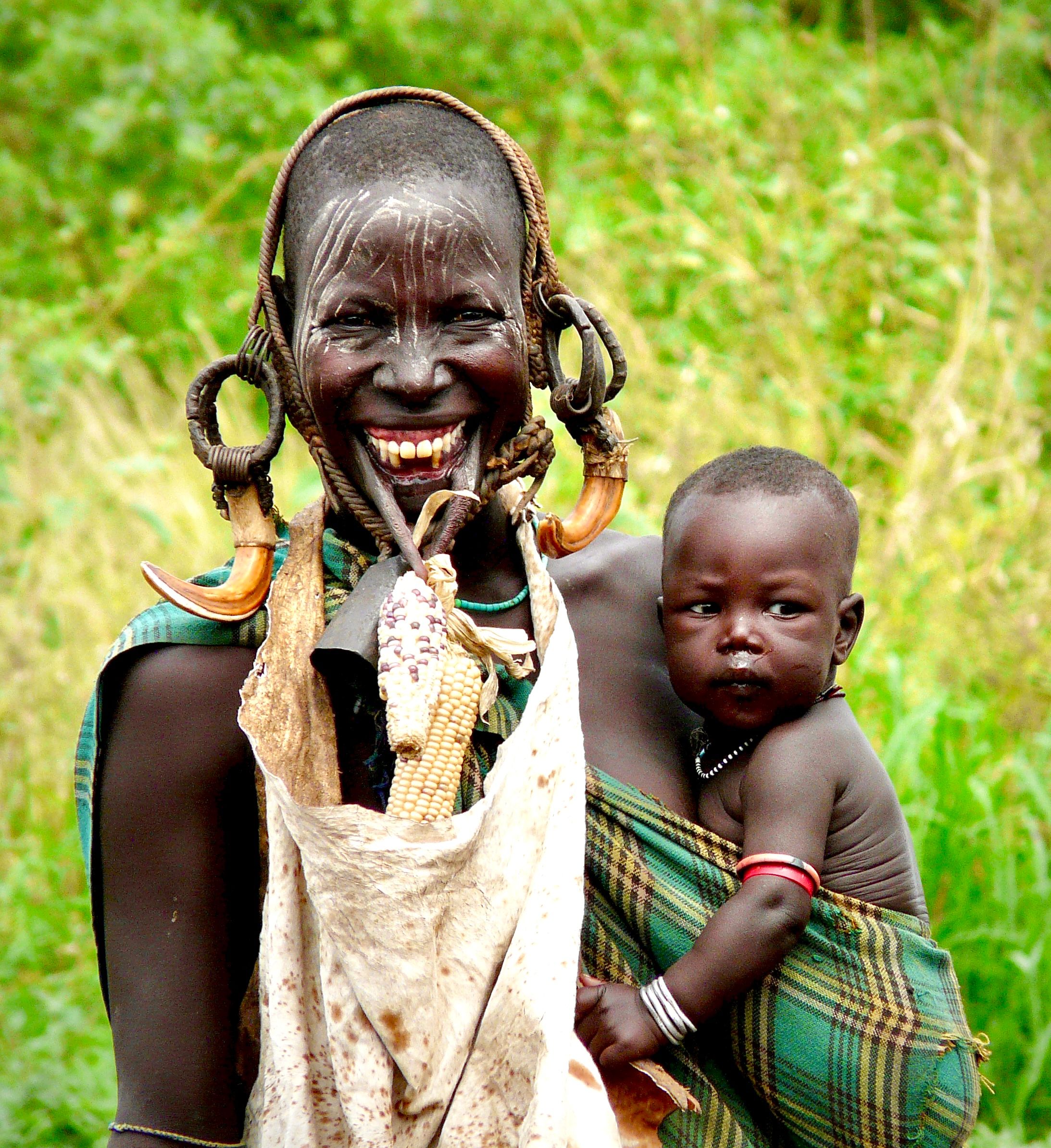
Among the Karo and Surma peoples of the Omo Valley in Ethiopia, scarification often extends across the torso and arms, sometimes tied to beauty, sometimes to bravery, sometimes to marking an achievement within the community. The specifics shift from group to group, even village to village. What stays constant is the function. The scar is a record.
Pain as Part of the Message
Here is the part that outsiders often miss. The pain is not incidental to scarification. It is frequently part of the meaning itself. A young person who endures the cutting without flinching, without crying out, without pulling away, is showing the community something real about their character. Courage. Self control. Readiness for adult responsibility. The elders who perform the cutting are not being cruel. They are administering a test that the whole community has agreed matters. You do not get to skip the pain and still claim the meaning.
What Tattooing Actually Is
Tattooing works on a different principle entirely. Instead of cutting the skin into a raised scar, tattooing inserts pigment, often soot, ash, or plant based dye, under the surface of the skin using a needle, thorn, or similar tool. The mark stays flat. It sits in the skin rather than rising out of it.
The Amazigh people of North Africa, often called Berber, carried an old tradition of facial and hand tattooing, done mostly by women, for women. These tattoos were not simply decorative, even though they were often beautiful. They carried protective meaning, warding off harm or the evil eye. Some were believed to carry medicinal value, placed near joints or areas of the body associated with pain, similar to tattoo traditions found in other ancient cultures around the world. Others marked fertility, marital status, or spiritual protection during pregnancy and childbirth.
Nubian tattoo traditions from Sudan and Egypt reach back a very long way, with markings on the hands, arms, and torso serving protective and spiritual functions alongside decorative ones. In these traditions, the tattoo was never just an image. It was a working object, doing something for the person who wore it.
Scarification vs Tattoos: Different Tools, Different Readings
This is where the comparison sharpens. Scarification raises or removes tissue. Tattooing inserts pigment into tissue that stays intact. That difference in technique produces a difference in how the mark is read.
A raised scar can be felt. On dark skin, where fine ink lines are not always easy to see from a distance or in low light, a scar’s texture carries information regardless of how much light falls on the skin. You can read a scar with your hand in the dark, in a crowded gathering, in a handshake or an embrace. A tattoo, especially a fine one, depends more on sight, on proximity, on the viewer being close enough and the light being good enough.
This is not a small technical footnote. It shapes what each practice is good at communicating. Scarification, tied so often to public ritual and life transitions such as coming of age, marriage readiness, or clan identity, benefits from being something the whole community can register through sight and touch over a person’s lifetime. Tattooing, carrying protective or spiritual functions in traditions like the Amazigh and Nubian ones, did not always need the same public, tactile permanence. It needed to work quietly, close to the body, sometimes hidden under clothing.
Neither Practice Is Simple Decoration
Here is where you need to be careful, because both traditions get flattened by people who do not know better. Scarification is not a primitive stage that tattooing improved on. Tattooing is not merely cosmetic where scarification is deep. Both practices carry real cultural weight. Both were performed by specific people trusted with the knowledge, following specific rules, for specific reasons. A scar on a Surma man’s arm and a tattoo on a Nubian woman’s hand are both doing serious work, just through different technical means.
The two traditions do overlap in some societies, and a person can carry both scarification and tattoo work on their body across a lifetime. But overlap does not mean sameness. Knowing the difference between raising a scar and inserting pigment tells you something true about how each culture chose to write on the body.
What the Body Remembers
A mark on the skin outlives the moment it was made. That is the whole point. Whether raised in scar tissue or drawn in soot and ink, these markings were never meant to fade quietly into the background of a life. They were meant to be read, by the community, by the ancestors, by the person carrying them every single day.
If this kind of detail interests you, there is more waiting for you in our full piece on the deeper history and significance of scarification across African cultures. And if you want to keep exploring the wider world of masks, marking, and ancestral memory, spend some time in our African heritage collection, where these traditions are given the space and respect they deserve. You can also find more of this work in video form on the SEVICS Africa YouTube channel, where these stories are brought to life beyond the page.