How to Identify African Masks: A Region by Region Guide for Beginners
Walk into any curio shop in Lagos or Nairobi and you will hear one word used for everything on the shelf. Tribal. That single word covers a Yoruba Gelede mask standing next to a Congolese Kifwebe mask standing next to a rough plank carved last month for the tourist trade. The seller often does not know the difference. Many buyers never ask.
You should ask. A mask is not a generic object. It comes from a people, a purpose, a specific hand that carved it for a specific reason. Learning how to identify African masks starts with one simple shift in thinking. Stop asking “is this African.” Start asking “which people made this, and why.”
This guide will not turn you into an appraiser overnight. Nobody becomes one from a single article. What it will give you is visual literacy, the ability to look at a mask and recognize the family it likely belongs to, region by region, tradition by tradition.
Watch on the SEVICS Africa channel: How to Decode Your Traditional African Mask
Why Region Matters More Than the Word Africa
Nigeria alone has over two hundred ethnic groups, and many of them carve masks. Add Mali, Gabon, Angola, the Democratic Republic of Congo, Guinea, Sierra Leone, Ivory Coast. Each tradition has its own rules about shape, material, and function. A mask made for a Poro society initiation in Guinea has nothing in common with a mask made for an Igbo Mmanwu performance except that both are wood and both are worn.
So the first rule of identification is simple. Look for the region first. The style will follow.
West African Wood Masks: Mande and Guinea Coast Traditions
Across Mali, Guinea, Sierra Leone, and Liberia, the Mande speaking peoples and their neighbors along the Guinea Coast carved some of the most recognized masks on the continent. Two names come up constantly here. Poro and Sande.
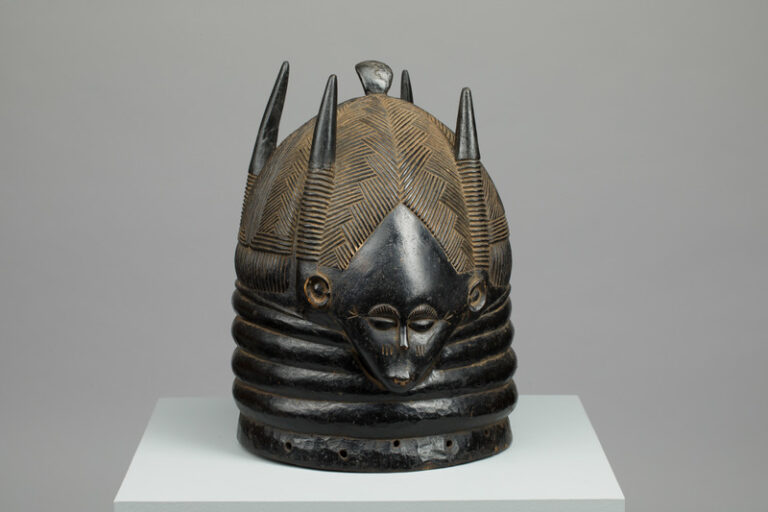
Poro society masks, worn by men, tend to be helmet shaped, covering the whole head rather than sitting flat on the face. Sande society masks, by contrast, are famous for being among the only masking traditions historically controlled and worn by women. Sande masks show a small, calm face, a high forehead, and an elaborate carved hairstyle, all in dark polished wood. The surface is usually smooth, almost glossy, from years of oiling and handling.
If you see a helmet form mask with a serene, composed expression and a dark, almost black finish, you are likely looking at something from this Mande and Guinea Coast family.
Yoruba Masks: Gelede and Egungun
Move to southwestern Nigeria and the visual language changes completely. Yoruba Gelede masks are built to be seen from a distance, at a festival, in daylight, moving. They carry elaborate superstructures on top of the face, sometimes showing everyday scenes, animals, or symbols of power, all painted in bright color. Gelede honors women, especially older women, and the performance itself is public and communal.
Egungun masks and costumes work differently. Egungun is less about a carved face and more about a full body covering, layers of cloth, sometimes dozens of panels, meant to represent ancestral spirits returning to the community. When you see a mask tradition where the cloth matters as much as the wood, you are likely looking at Egungun.
Bright paint, layered cloth, and a sense of theater are the clues here. Yoruba masking is rarely quiet.
How to Identify African Masks From Nigeria Specifically
Nigeria alone gives you at least two distinct visual worlds. Southwest Yoruba work is colorful and theatrical. Southeast Igbo work is different again.
Igbo Mmanwu: Masquerade as Performance
Among the Igbo, the masking tradition is called Mmanwu, sometimes Mmuo. This is not a static object meant for a shelf. Mmanwu exists to move, to run, to chase, to perform. Some Mmanwu masks are carved wood with sharp, exaggerated features. Others incorporate raffia, cloth, and found materials built around a wooden core.
Mmanwu spirits appear at funerals, festivals, and title taking ceremonies. Some are gentle and comic. Others are fierce and are kept at a distance by young men who know to run rather than stand and stare. A mask alone, sitting in a museum case, tells you almost nothing about Mmanwu. You have to understand that the object was built to be inhabited and to move through a crowd.
Dogon Masks From Mali: The Vertical Form
Few masking traditions are as visually distinct as the Dogon of Mali. The Kanaga mask is the clearest example. It rises tall and vertical, topped with a double barred cross shape that can reach well above the head of the wearer. Dogon masks are used in funerary rites, particularly the Dama ceremony, which marks the end of a mourning period and sends the spirit of the dead into the world of the ancestors.
If a mask looks architectural, almost like a structure rather than a face, tall, geometric, and clearly built for a funeral context, think Dogon before anything else.
Central African Kifwebe Masks: Luba and Songye
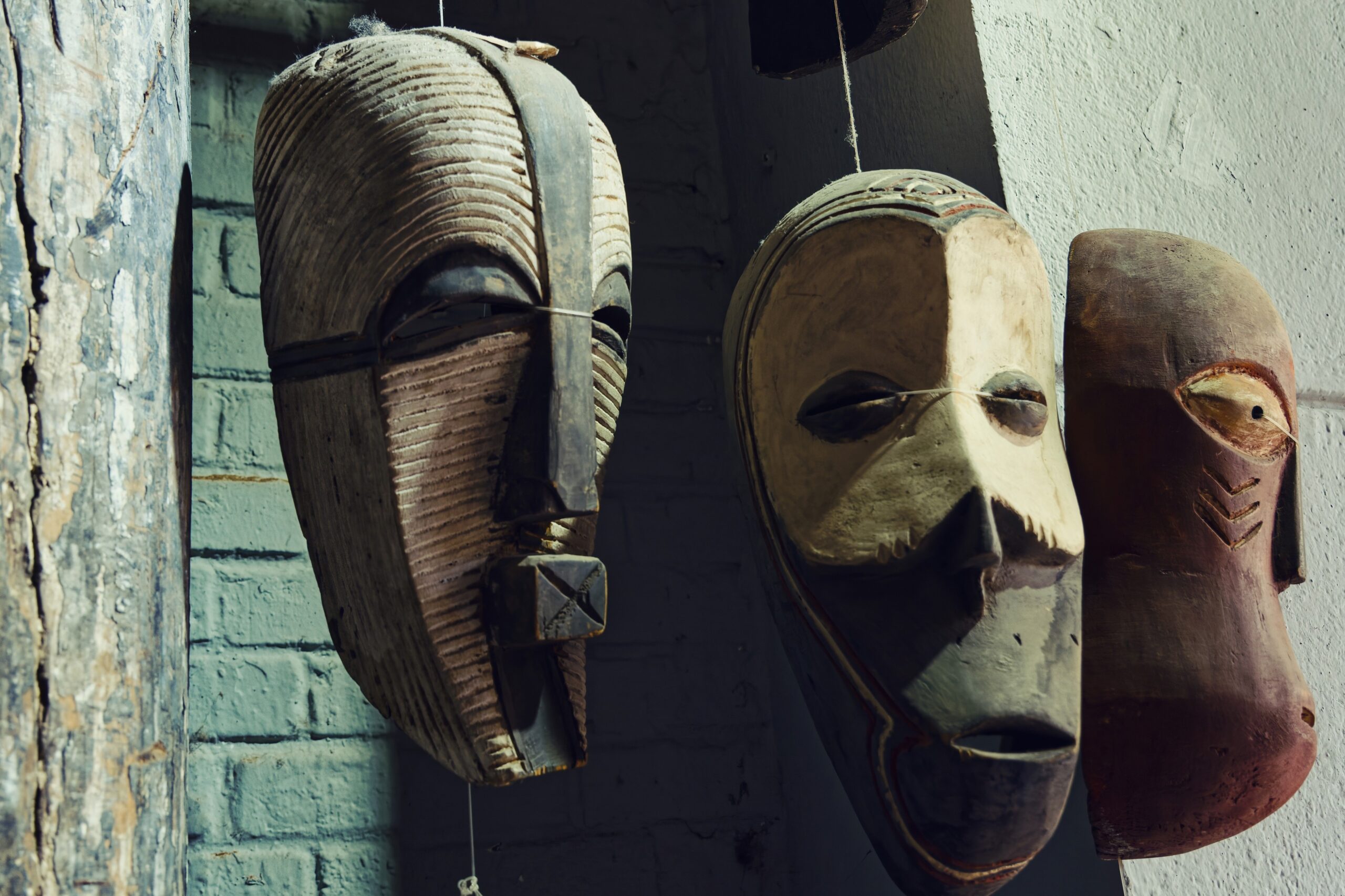
Travel to the Luba and Songye peoples of the Democratic Republic of Congo and you find the Kifwebe tradition. These masks are covered in carved striations, ridges running across the surface in tight geometric patterning, often painted in white, black, and reddish tones. The lines are not decoration for its own sake. Among the Songye especially, Kifwebe masks carried real social weight, associated with authority, control, and sometimes with maintaining order within the community.
The carved striations are the single clearest identifying feature here. Nothing else on this list looks quite like it.
Fang Masks From Gabon: The Pale, Heart Shaped Face
Fang masks from Gabon are quieter in form but historically enormous in influence. The face is often pale, coated in kaolin or white chalk, shaped almost like a heart, with a narrow chin and a calm, elongated expression. Early twentieth century European modern artists encountered masks like these and were deeply affected by the abstraction of the form. That influence is well documented in the history of modern art, even when the credit given to the original carvers was not.
Pale surface, heart shaped face, restrained expression. That combination points toward Fang and related Gabonese traditions.
Chokwe Masks From Angola and DRC: Hairstyle as Status
Among the Chokwe of Angola and the Democratic Republic of Congo, masks are known for elaborate carved hairstyles and headdresses that signal rank and status. The Mwana Pwo mask, representing an idealized young woman, shows fine facial features alongside an intricately carved coiffure. Status here is worn on the head, quite literally.
Practical Cues: Shape, Material, Surface, Function
Once you move past region, four questions will serve you every time.
Shape. Is the face naturalistic, close to a real human face, or is it abstract and geometric, broken into planes and patterns?
Material. Is it carved wood, the most common choice, or does it include brass, ivory, raffia, or cloth additions? Each material choice narrows the field.
Surface treatment. Is there paint, kaolin or chalk white, or a deep patina built up from years of ritual handling and touch? Patina especially tells you a mask was used, not just made.
Function. Was this built for initiation, for funerary rites, for agricultural ceremony, or for judicial and justice purposes within a community? Function shapes form more than almost anything else.
Be Honest About the Limits of This Guide
Here is the truth nobody selling masks wants to tell you. Identifying a mask’s exact origin with real certainty usually requires expert study, careful provenance research, and often physical access to comparable documented pieces. This guide gives you visual literacy. It does not give you authentication. If you are buying, inheriting, or researching a mask you believe has real age or ritual history, consult people who specialize in this field before you make claims you cannot support.
What this guide gives you is a starting eye. A way to look at a mask and ask better questions instead of reaching for one flattening word.
That is worth something. A mask is a record of a people’s relationship with the unseen, with ancestors, with order, with the land. Learning to see the difference between a Dogon Kanaga and a Songye Kifwebe is a small act of respect toward the hands that made them and the communities that still carry these traditions forward.
If this kind of cultural literacy matters to you, keep going. Read more about prioritizing education around African heritage, and look through our companion piece on every traditional African mask you should know for a deeper catalogue of specific traditions. You can also find more of this work in video form on the SEVICS Africa YouTube channel, where these masks and the cultures behind them get room to breathe beyond a single article.
Do you own a mask like this?
Not sure what it is, where it comes from, or whether it was ever danced? Start with our free Mask Identifier.
If you want the full story, I offer an in depth reading of your mask. Readings start at around sixty dollars, and every one is quoted before anything begins.