Yoruba Gelede Mask: Meaning, Ceremony, and Cultural Significance
New: the 2nd edition of Within Carved Lines: The Secret Meanings of African Masks is out now. Get the book →
Among the many masquerade traditions of West Africa, few are as visually spectacular or as spiritually significant as the Gelede of the Yoruba people. Performed across Nigeria, the Republic of Benin, and Togo, Gelede masquerades are a celebration, a prayer, and a negotiation — a way of honouring the immense spiritual power of women and asking for their blessing on the community.
Who Are the Yoruba?
The Yoruba are one of the largest ethnic groups in Africa, numbering over 40 million people and concentrated primarily in southwestern Nigeria, southern Benin, and Togo. They have one of the richest artistic traditions on the continent, encompassing bronze casting, beadwork, weaving, and above all, masquerade performance. Yoruba cities like Ife, Oyo, and Benin City were sophisticated urban centres with complex governance and artistic production centuries before European contact.
What Is Gelede?
Gelede is a masquerade tradition performed to honour Iyami Osoronga — the great mothers, a category of female spiritual power that encompasses elderly women, female ancestors, and certain female deities. In Yoruba cosmology, these great mothers possess an extraordinary and potentially dangerous spiritual force known as ase. When pleased and honoured, they bestow fertility, health, and prosperity. When neglected or offended, they can withdraw their blessing, causing illness, infertility, and communal suffering.
The Gelede masquerade is therefore fundamentally an act of collective respect and appeasement. By performing beautifully, by dancing with skill and discipline, and by presenting masks that celebrate women, the community demonstrates its regard for the great mothers and invites their continued support.
The Masks Themselves
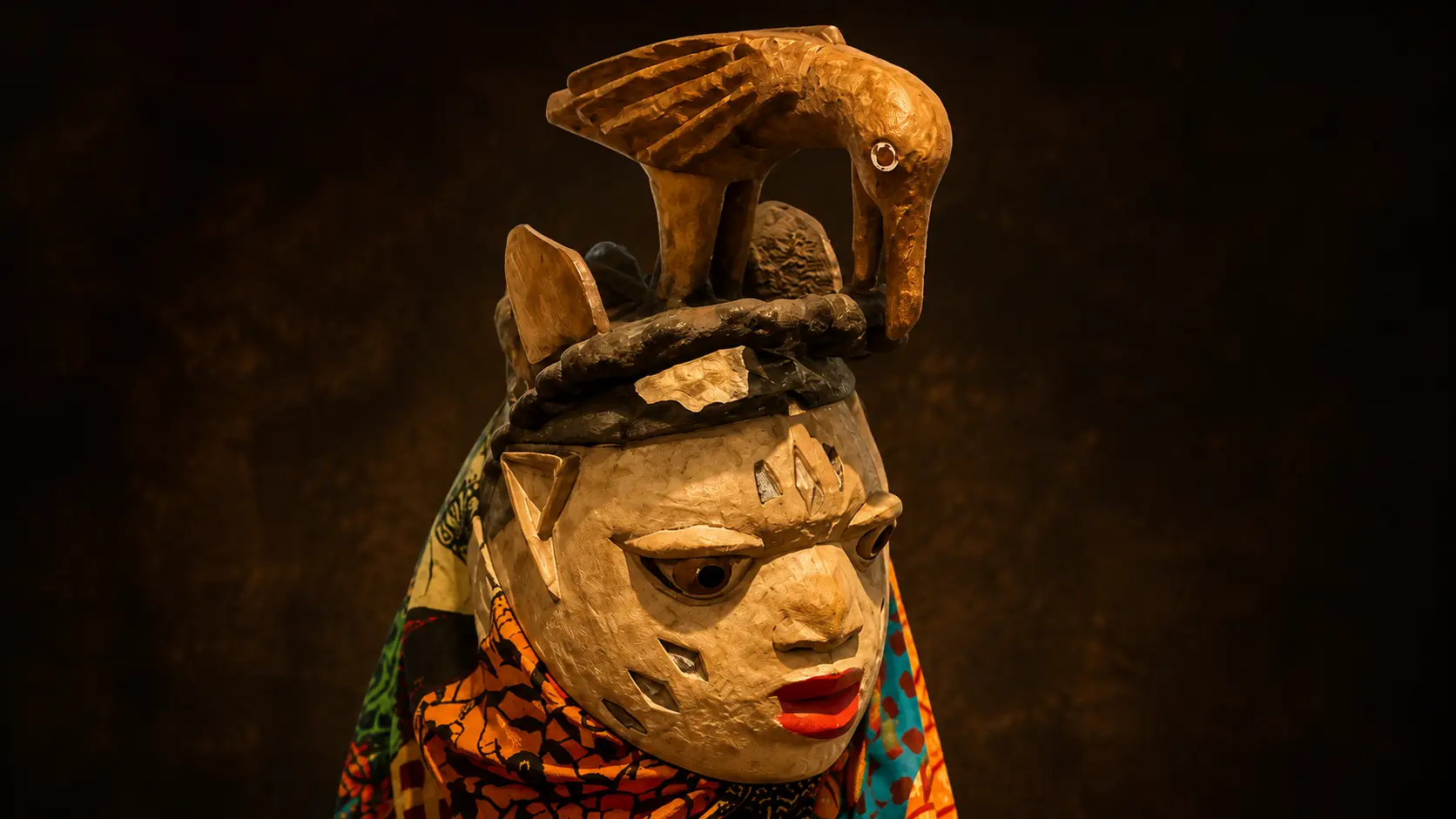
Gelede masks are helmet masks worn on top of the head rather than over the face. The lower portion of the helmet fits over the dancer’s head, while the upper portion — which is what observers see — is an elaborate carved superstructure. This superstructure is where the mask carver’s artistry is most fully expressed.
The superstructure can represent almost anything: a market scene with miniature figures, a colonial officer on horseback, a woman carrying a child, animals in elaborate arrangements, or abstract geometric forms. The variety is intentional — Gelede performances are in part a form of social commentary, and the superstructures satirise, celebrate, warn, and entertain in equal measure. A mask representing a figure associated with wealth and excess, for instance, may be gently mocking the excesses of that type of person while entertaining the crowd.
The face portion of most Gelede masks is relatively standardised: oval, with almond-shaped eyes, a carefully shaped nose, and a calm, balanced expression. This ideally proportioned face represents the composed, dignified quality — known in Yoruba aesthetics as iwa pele — that the tradition seeks to cultivate and celebrate.
The Performance
Gelede performances typically take place at night and in the early morning, times associated with the spiritual activity of the great mothers. Performances are held for a range of occasions: funerals, community crises, planting and harvest seasons, and annual festivals.
The masquerade is performed in pairs — male and female — representing complementarity and balance. The male mask, Efe, performs at night and is associated with humour, satire, and entertainment. The female mask, Gelede, performs at dawn and is associated with grace, beauty, and community well-being. Both performances involve elaborate costuming: the dancer’s entire body below the mask is wrapped in cloth so that no skin is visible, creating the illusion of a complete supernatural being rather than a human in costume.
The dancing in Gelede is famous for its footwork. Unlike many African masquerades that emphasise the upper body or the mask itself, Gelede requires the performer to execute complex rhythmic patterns with the feet and ankles, accompanied by iron ankle rattles called aro. The sound of the rattles and the rhythm of the feet are as important as the visual spectacle of the mask.
UNESCO Recognition
In 2001, UNESCO proclaimed the Gelede masquerade of the Yoruba-Nago communities of Benin, Nigeria, and Togo a Masterpiece of the Oral and Intangible Heritage of Humanity. It was incorporated into the Representative List of UNESCO’s Intangible Cultural Heritage in 2008. This recognition acknowledged not only the aesthetic beauty of the tradition but its social function: Gelede is a living system of values, ethics, and community governance expressed through performance.
Gelede Today
The Gelede tradition continues to be performed in Yoruba communities, though the contexts have shifted. Where the masquerade was once exclusively a ritual matter, it now also appears in cultural festivals, tourism events, and arts showcases. This expansion has brought new audiences to the tradition but has also raised questions about the sacred dimensions of the performance and how they are maintained when the audience is composed of tourists rather than community members seeking spiritual intercession.
Master carvers of Gelede masks are still active, and the tradition of passing mask-making knowledge from master to apprentice continues. The masks themselves — both old examples and contemporary works — are collected widely, and some of the finest historical examples can be seen in the British Museum, the Metropolitan Museum of Art, and the Musée du quai Branly in Paris, among other institutions.
Go deeper into the stories behind the masks you just read about. Within Carved Lines uncovers the history, symbolism, and ritual meaning of Africa’s traditional masks — now fully revised in its second edition.
Get Your Copy