Mambila Masks: Justice, Hidden from Women, Kept in a Hut on Stilts
New: the 2nd edition of Within Carved Lines: The Secret Meanings of African Masks is out now. Get the book →
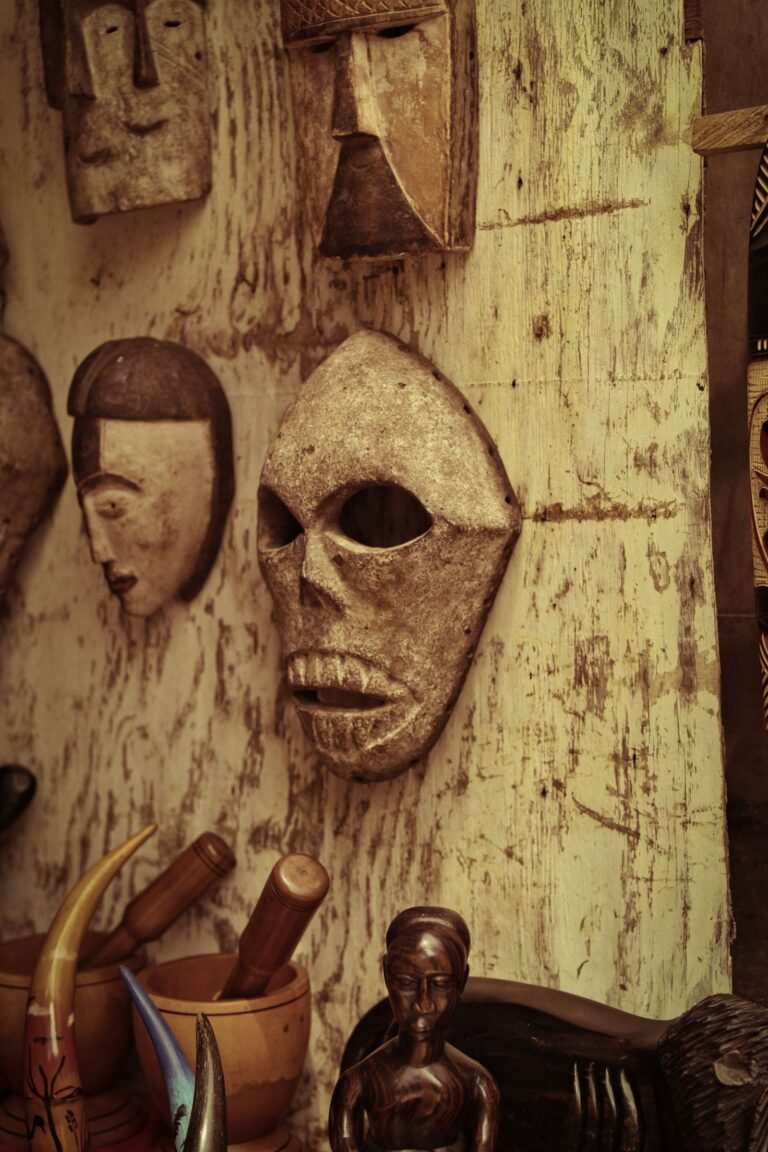
Several masking traditions documented in this book tie their objects to ancestors, initiation, or entertainment. The Mambila, farmers and stockbreeders straddling the Cameroon–Nigeria border, built theirs around something more specific: an association called suaga, concerned primarily with justice and supernatural cleansing within the community. The masks and figures that gave suaga its physical form were not simply private, they were actively hidden, kept in a net hung inside a hut raised on stilts, guarded by the head of the family and kept out of women’s sight entirely. That deliberate concealment, justice made physically inaccessible to half the community, is the throughline worth carrying through this piece. It turns Mambila masking into a system where authority and secrecy reinforce each other directly, the hut itself functioning almost like a courtroom nobody but initiated men were allowed to enter.

Who Are the Mambila?
The 25,000 Mambila occupy the region bordering Cameroon and Nigeria, north of the Grassland, where land is distributed by each group’s chief and passed through family lines. Sorghum, rice, and millet form the core of their agriculture, supplemented by bananas, yams, maize, manioc, peppers, peanuts, sweet potatoes, and tobacco, with cattle-milking practices borrowed from the neighboring Fulani. A society of mutual assistance called the kurum helps clear land, bring in harvests, and build houses, doubling as a social structure that knits celebrations and dances into the community’s working life. The Mambila practice ancestor worship limited strictly to family ancestors, and chiefs of the lineage were buried in granaries, likened directly to grains of millet as symbols of prosperity and continuing life.
Suaga: An Association Built Around Justice
Mambila art centers on suaga, an association primarily concerned with justice and supernatural cleansing within the community, a mandate that sets it apart from many neighboring associations built more narrowly around initiation or ancestor veneration alone. The figures the Mambila produced in large numbers for this purpose are recognizable by a heart-shaped face, often painted with pigments applied after carving, embodying ancestors believed responsible for the clan’s accumulated wealth. Their legs are bent, their heads enlarged and outlined in wooden pegs, a silhouette distinct enough to identify a Mambila figure at a glance.
Heart-Shaped Figures and a Hut on Stilts
Alongside the figures, the Mambila carved highly stylized animal masks, and both masks and statues shared the same fate when not in use: kept hidden from the eyes of women in a net hung inside a hut built on stilts, guarded by the head of the family. The hut’s front wall carried its own symbolic program, two figures, male on the right and female on the left, crowned by a rainbow and framed by the sun and the moon, turning the storage space itself into a miniature cosmology standing guard over the objects inside.
Cephalomorphic Helmets and the Agricultural Cycle
Dancers marking the beginning and end of the agricultural cycle were led by a tribesman wearing a cephalomorphic helmet mask, followed by a retinue of assistants in secondary masks shaped like stylized animal heads, usually a dog’s or a crow’s. Women were excluded from these masquerades both as performers and as spectators, though they staged their own separate version, dressed in rags and vegetation, at a different time and place, a parallel tradition that mirrored the men’s masquerade without ever overlapping it.
Frequently Asked Questions
What is the Mambila suaga association?
Suaga is the association at the center of Mambila masking art, concerned primarily with justice and supernatural cleansing within the community.
Why were Mambila masks and figures hidden from women?
They were kept in a net inside a hut raised on stilts, guarded by the head of the family, and women were excluded from viewing them or from participating in the masquerades built around them.
What do Mambila figures look like?
They have a distinctive heart-shaped face, bent legs, and an enlarged head outlined in wooden pegs, and they are believed to embody ancestors responsible for the clan’s wealth.
Who leads the Mambila agricultural cycle dances?
A tribesman wearing a cephalomorphic helmet mask leads the dancers, followed by assistants wearing secondary masks shaped like stylized dog or crow heads.
See also: African Masks by Region and Tribe · Chamba Masks: A Skull-Shaped Helmet and the Girl Who Was Really a Buffalo · Every Traditional African Mask You Should Know · African Coming-of-Age Ceremonies: How Different Cultures Mark the Transition to Adulthood