Nigerian Masks: The Masquerade Traditions Almost Nobody Can Name
Ask a room full of people to name a Nigerian mask and you will get silence, or you will get the Idia mask, which is not a mask you wear on your face at all. That gap is the whole problem. Nigeria has more distinct masquerade traditions than most continents, and outside a handful of academic departments, almost nobody can name five of them.
So here are the Nigerian masks that matter, what they do, and who they belong to. Not a museum list. A working one.
Igbo mmanwu, the spirit that is not a costume
In the southeast, the word is mmanwu. It comes closest to spirit made visible. The Igbo did not build one masquerade tradition. They built hundreds, village by village, and they are not interchangeable.
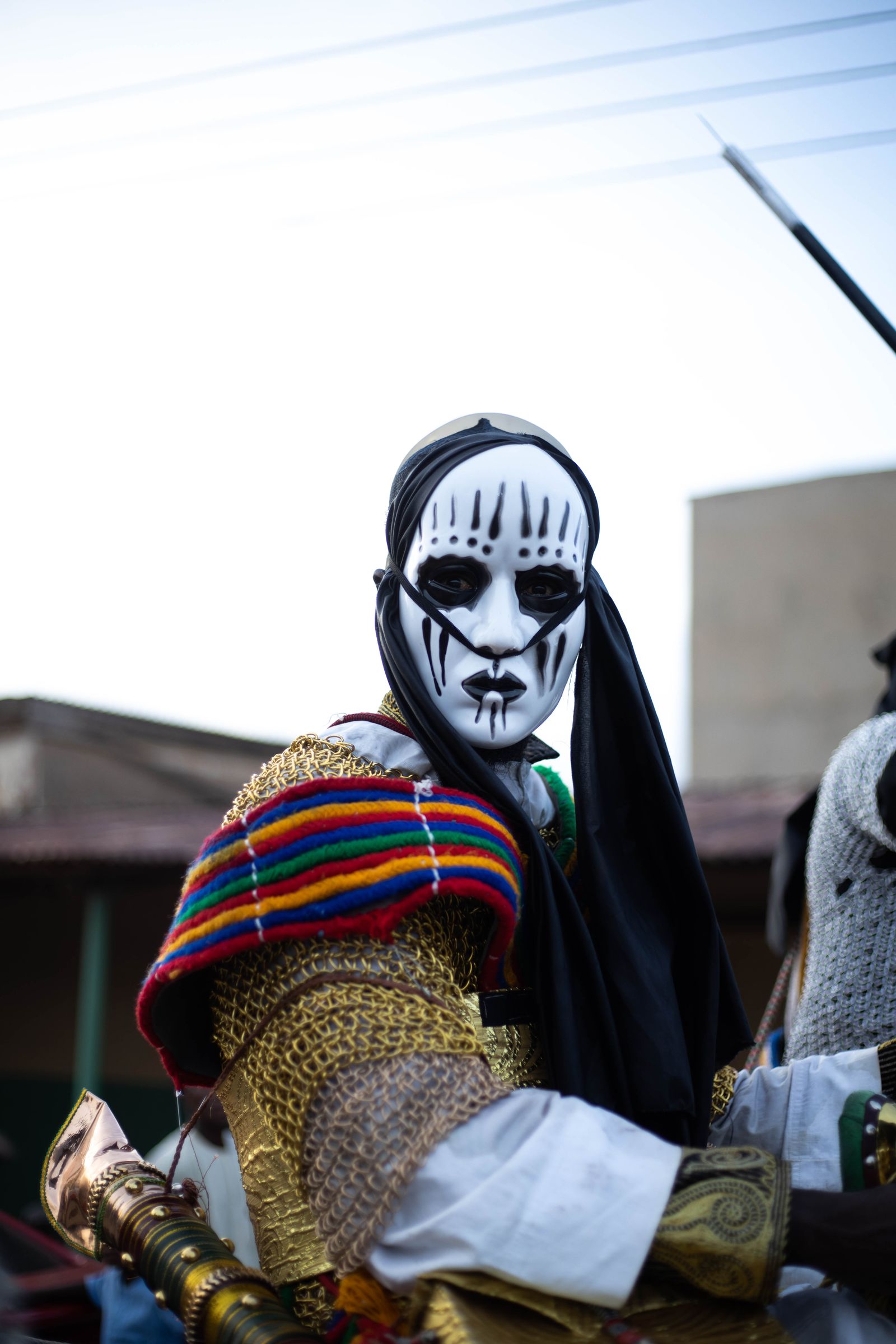
Agbogho Mmuo is the maiden spirit. A white faced mask with a delicate nose, small pursed mouth, and an elaborate crested coiffure built up in black. It represents a girl who died before marriage, returning with her beauty perfected. The dancer is a man. The gait is deliberately light, almost floating, because a spirit does not walk the way a farmer walks. We have written a full piece on the Agbogho Mmuo and what its beauty is actually arguing.
Set against her is Mgbedike, which translates roughly to the time of the brave. Huge, dark, horned, teeth bared, built to be ugly on purpose. Mgbedike and Agbogho Mmuo often perform in the same season because the tradition is making a point about opposites. Beauty and force. Restraint and appetite. The village needs both.
Then there is Ijele. Ijele is not a face mask. It is a structure, sometimes over three metres tall and weighing enough that a team of men supports the dancer, covered in mirrors, coloured cloth, and dozens of small modelled figures showing everyday life. Leopards, colonial officers, women pounding yam, priests. It is a kingdom on a frame. Ijele is inscribed on the UNESCO Representative List of the Intangible Cultural Heritage of Humanity. It appears for the death of an important elder and for very few other occasions. Most Igbo people will see it perhaps twice in a lifetime.
Further east, among the Izzi and the Afikpo communities, Ogbodo Enyi is the elephant spirit. A helmet mask with a blunt trunk form and a heavy blocky face, whitened with kaolin, worn on top of the head rather than over it. It belongs to an age grade and it enforces. When Ogbodo Enyi comes out, the young men who owe the community something hear about it in public.
Yoruba masking, where the dead come to visit
In the southwest, the logic changes. Yoruba masquerade is less about spirit intrusion and more about relationship. The dead are still family. They are simply somewhere else.
Egungun is the ancestral masquerade. A great layered assemblage of cloth, often imported velvets and damasks stitched into panels that fly open when the dancer spins, so that the cloth becomes a moving wall. The face is usually hidden behind netting rather than carved wood, though many Egungun carry a carved headpiece. Egungun comes to greet the lineage, settle a matter, receive praise, and bless. A family that has stopped bringing out its Egungun is a family that has let something lapse.
Gelede is the other direction entirely. Gelede masks sit on top of the head, carved as a calm human face with an elaborate superstructure above it showing whatever the carver wants to comment on. A trader, a motorcycle, a pair of birds, a rival. Gelede is performed to honour awon iya wa, our mothers, and the spiritual power carried by women, which the tradition treats as real, considerable, and worth placating. It is also very funny. Satire is built into it. Gelede was inscribed by UNESCO in 2001.
Epa masks from the northeast Yoruba towns are the heavy ones. A helmet carved from a single block with a superstructure above that can carry an equestrian warrior or a seated mother with children. They are danced by young men as a test of strength during festivals that mark the agricultural year and the passage into adulthood.
The delta, the cross river, and the middle belt
Among the Ijo of the Niger Delta, masks are water spirit headdresses. They are worn horizontally, projecting forward above the head like a canoe, and they combine human features with fish, crocodile, and hippopotamus forms. The Ekine society performs them. The spirits being honoured are owuamapu, water people, who in Ijo thought lived among humans before birth and remain interested afterwards.
Move east to the Cross River and the material changes completely. The Ejagham and their neighbours made skin covered headdresses, carving the wooden form and then stretching antelope hide over it while wet so it dried tight. The result is unnervingly lifelike. These belong to the Ekpe and Ekpo societies, which governed. The same region produced nsibidi, an indigenous graphic script, and some of it is carved directly onto the objects.
In the middle belt, the Mumuye of Taraba worked in a style so abstract that when their sculpture reached Europe in the late nineteen fifties it was mistaken for modernist work. Elongated bodies, ear discs, limbs reduced to ribbons. They also made the va bong masks, which combine a buffalo form with a human face.
Why Nigerian masks are so hard to see clearly
Three reasons. The first is that the 1897 sack of Benin City and the collecting boom that followed emptied a great deal of southern Nigeria into European institutions, so the best documented pieces are eight thousand kilometres from the people who made them. The second is that a century of missionary pressure taught Nigerians themselves to be embarrassed by masquerade. The third is that we have not done a good job of writing our own catalogue.
The third one is fixable. That is the entire reason this site exists. If you want the wider map, our guide to African masks by region and tribe places Nigerian traditions in continental context, and our overview of the traditional African masks worth knowing is the starting point for anyone building from zero.
Where to go next
We film these traditions one people at a time on the SEVICS Africa channel on YouTube, because a masquerade is a moving thing and a photograph flattens it.
If you run a school, a museum programme, or a company with a cultural budget, the documentation work behind these articles is fundable, and our corporate support page sets out how partnerships are structured. Nigeria has the masks. What it needs is the record.