African Scarification: A Complete Introduction to Body Marking Traditions
New: the 2nd edition of Within Carved Lines: The Secret Meanings of African Masks is out now. Get the book →
Scarification — the deliberate creation of permanent marks on the skin through cutting, burning, or abrasion — is one of the oldest and most widespread forms of human body art. While it is practised in various forms across the world, Africa has developed some of its most culturally elaborate and spiritually significant traditions of skin marking. For many African communities, the marked body is a text: a record of identity, status, belonging, and spiritual protection written directly on the flesh.
What Is Scarification?
Scarification refers to any technique that creates permanent marks on the skin by working with the skin’s own healing processes. Three main techniques are used across Africa. The first is incision scarification, in which cuts are made with a blade, thorn, or other sharp instrument. The depth and pattern of the cuts determine the shape of the resulting scar. The second is branding, in which a heated implement is applied to the skin, creating a burn scar. The third is abrasion scarification, in which the skin is repeatedly irritated — sometimes by rubbing ash or charcoal into cuts — to produce raised scars known as keloids. People with darker skin tones tend to form more prominent keloid scars, which is one reason scarification developed with particular elaborateness in sub-Saharan African communities.
Why Do Communities Practise Scarification?
The reasons for scarification are as varied as the cultures that practise it, but several broad categories recur across the continent. Identity and group belonging is perhaps the most common function: the marks on a person’s body identify them as a member of a particular group, clan, or people. In the past, this had practical importance — in times of conflict, a person’s markings could mean the difference between being treated as a member of one’s own community and being treated as an outsider.
Rites of passage are another major context. In many communities, scarification is performed at the transition from childhood to adulthood, marking the young person’s entry into a new social role. The pain of the process is itself significant: enduring it with composure is a demonstration of the courage and self-discipline expected of an adult. The scars that result are permanent testimony to having passed through this threshold.
Spiritual protection is a third function. In some traditions, certain marks are believed to provide protection against evil, illness, or bad fortune. These protective marks may be made at birth, at times of vulnerability, or as specific responses to divination that has identified a spiritual danger.
Beauty and social attractiveness also play a role in many traditions. Among communities where scarification is the norm, marked skin is considered beautiful, and the absence of marks may make a person appear socially incomplete or even suspect. The aesthetics of scarification — the precision of the pattern, the quality of the healed scar, the creativity of the design — are appreciated and discussed in the same way that other societies discuss clothing or jewellery.
Major Scarification Traditions Across Africa
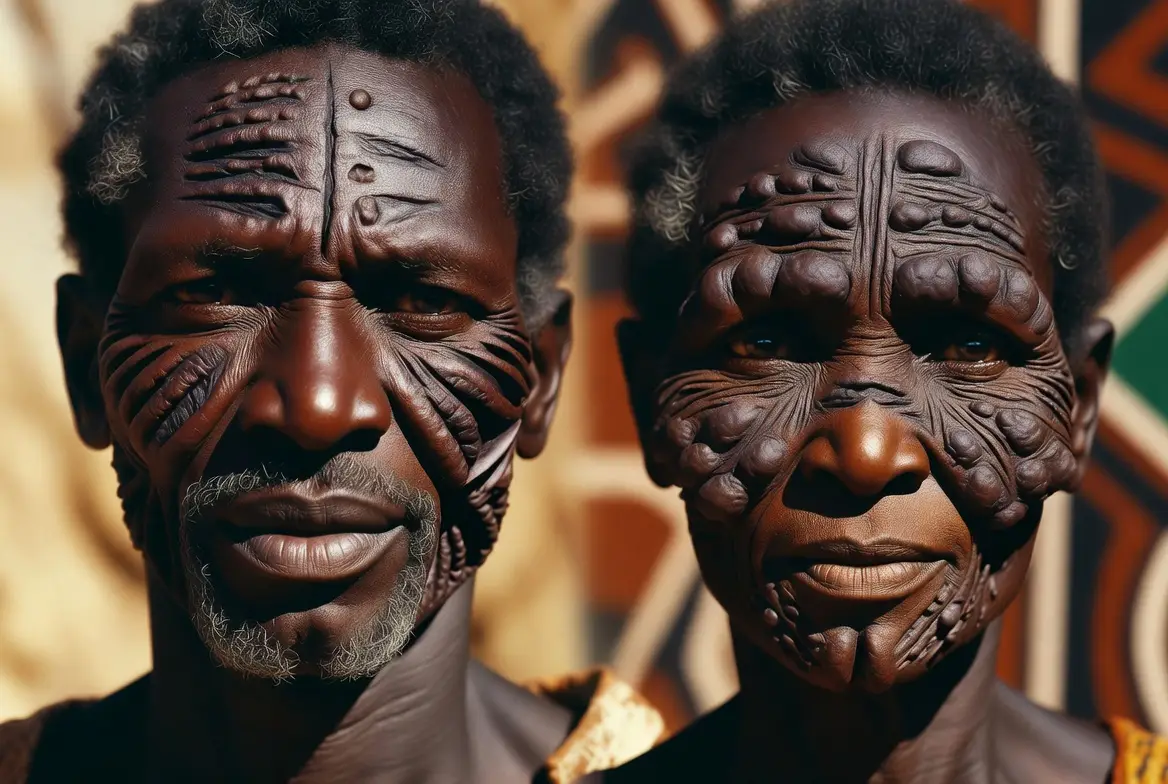
In West Africa, the Bini (Edo) and Igbo peoples of Nigeria have historically used facial and body marks to identify clan membership and spiritual affiliation. Among the Dinka and Nuer of South Sudan, men receive dramatic forehead scarification — parallel lines cut across the forehead — as part of male initiation. These marks are seen as a sign of bravery and are a source of considerable pride. The Bodi, Mursi, and Surma peoples of southwestern Ethiopia use scarification alongside other body modification practices as markers of beauty and social status.
Among the Tiv people of central Nigeria, a complex system of body marks known as ichahoho covers large portions of the body, with different patterns having different social and spiritual meanings. In Côte d’Ivoire and Ghana, facial marks historically identified individuals’ ethnic affiliation — allowing people to identify one another across long distances and through the disruption of the slave trade era, which scattered communities across the continent and the Atlantic world.
Scarification and the Modern World
Like many traditional body practices, scarification has declined in many urban African communities over the twentieth and twenty-first centuries. Colonial administrations often discouraged or actively prohibited the practice. Christian and Islamic missions framed it as pagan and primitive. Medical concerns about infection and hygiene, while sometimes valid, were also used as justifications for cultural suppression.
In rural areas and among communities that have maintained strong connections to traditional practice, scarification continues. And in many urban communities, there has been a revival of interest in traditional marking as a form of cultural reaffirmation and pride. Young people who grew up without marks sometimes choose to receive them as adults, as a deliberate reconnection with heritage.
It is also worth noting that Western body modification culture has, in recent decades, adopted scarification as an aesthetic practice, largely disconnected from any cultural context. The use of scarification techniques in Western tattoo studios has opened conversations — not always comfortable ones — about the relationship between cultural borrowing and cultural appreciation.
Understanding Scarification With Respect
For those approaching African scarification as outsiders — whether through travel, museum visits, or cultural research — the most important thing is to approach it as a fully developed cultural system rather than an exotic practice. The marks on a person’s body are personal and communal, spiritual and aesthetic. They are not curiosities or spectacles, but communications — ones that deserve to be read with care.
Go deeper into the stories behind the masks you just read about. Within Carved Lines uncovers the history, symbolism, and ritual meaning of Africa’s traditional masks — now fully revised in its second edition.
Get Your Copy