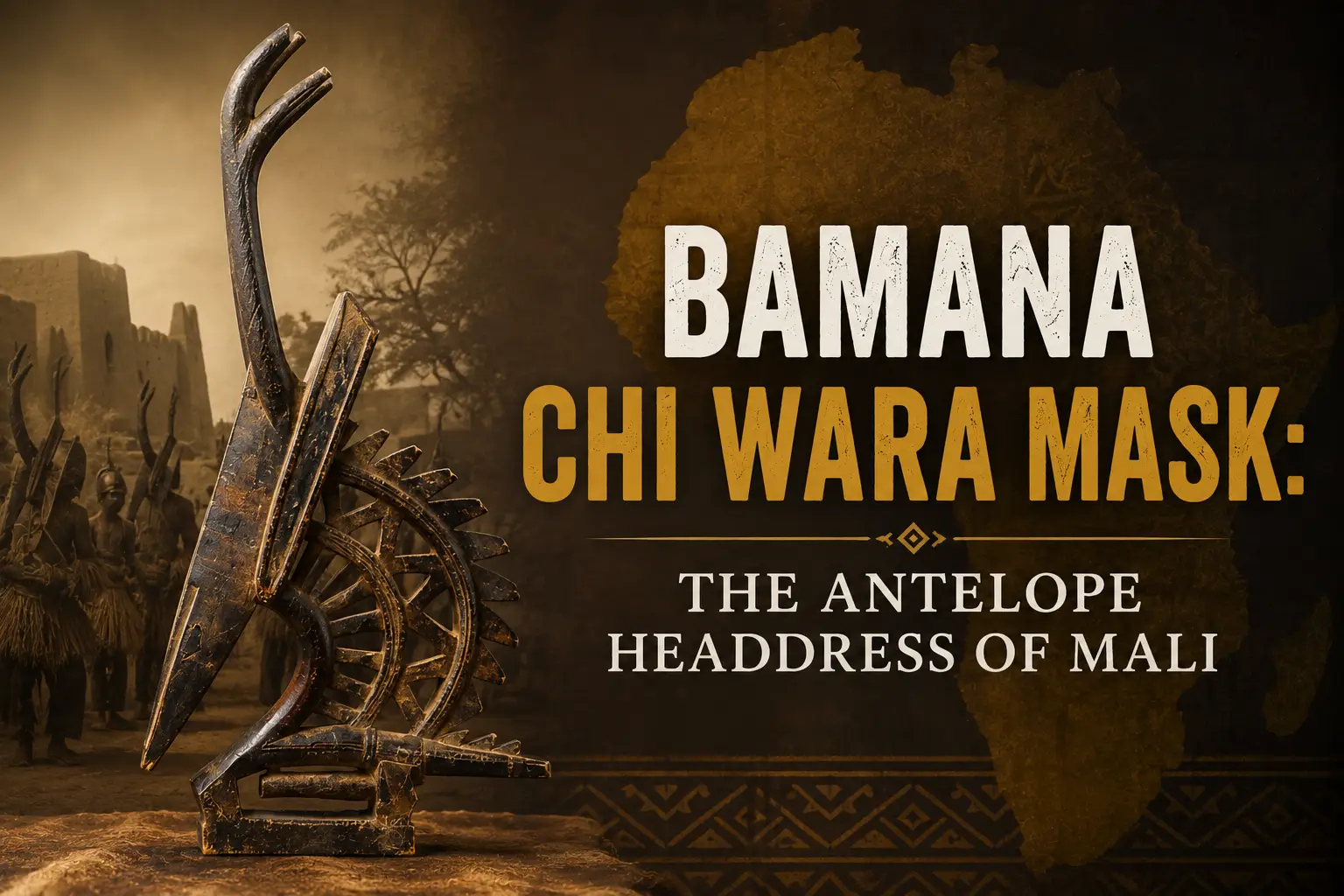
Bamana Chi Wara Mask: The Antelope Headdress of Mali
New: the 2nd edition of Within Carved Lines: The Secret Meanings of African Masks is out now. Get the book →
On the wide savanna and along the inland delta of the Niger River in Mali, the Bamana people have created one of West Africa’s most celebrated masquerade traditions — the Chi Wara, an antelope headdress that is carried on the back rather than worn on the face, and that honours the spirit credited with teaching human beings how to farm. In a region where agriculture is the foundation of survival, this is a tradition with profound stakes.
Who Are the Bamana?
The Bamana — also called Bambara — are one of the largest Mande-speaking peoples, numbering over five million and concentrated in Mali, with smaller communities in Burkina Faso, Senegal, Guinea, and Côte d’Ivoire. Historically they organised themselves into a powerful state system, the Bamana Empire of Ségou, which dominated the western Sudan from the seventeenth to the nineteenth century. Their artistic traditions — particularly their masquerades, their bogolan (mud cloth), and their iron-forging practices — are among the most celebrated in West Africa.
Chi Wara: The Mythological Background
The word Chi Wara combines “chi” (work or agriculture) and “wara” (wild animal), giving a rough meaning of “the farming animal” or “the animal that cultivates.” According to Bamana mythology, Chi Wara was a supernatural being — half-animal, half-human — who came to earth and taught the first humans to cultivate crops. He demonstrated the techniques of ploughing, planting, and harvesting, and then disappeared into the earth, becoming the spirit of agricultural fertility who must be honoured if the rains are to come and the harvest to be good.
The Chi Wara masquerade is therefore fundamentally a thanksgiving and a prayer. It takes place at the beginning of the planting season, asking Chi Wara’s spirit to bless the coming agricultural cycle, and at harvest time, giving thanks for the food that has been produced. The performance involves the best farmers in the community — those who have worked hardest and produced the most — competing in hoeing demonstrations, with the masked figures dancing among them to encourage their efforts.
The Headdress
The Chi Wara headdress is one of the most instantly recognisable forms in African art. It is a carved wooden sculpture representing an antelope — specifically a roan antelope, which is among the largest and most powerful antelope species of the West African savanna — in an upright, stylised pose. The carving combines animal features with agricultural symbolism: the antelope’s neck extends into a geometric zigzag pattern that represents the movements of the sun across the sky, the movements of the farmer’s body during cultivation, and the serpentine path of the Niger River.
Chi Wara headdresses are performed in male-female pairs, representing the complementarity of the genders in agricultural work and in life. The male figure (with vertical horns pointing straight up) is associated with the sun, with yang energy, and with the activity of planting. The female figure (with curved horns and often a fawn attached beneath her) represents the earth, the rains, and the nurturing of growth. Together they create a complete picture of the forces that produce a successful harvest.
The headdress is attached to a basketwork cap that fits over the performer’s head, and the performer’s body is entirely concealed by a raffia costume. The performer moves bent at the waist, mimicking the movement of an antelope, and the headdress appears to dance and leap above the crowd. The physical demands of the performance are considerable — the headdresses can be heavy, and the bent-over running movement requires considerable strength and endurance.
Regional Styles
Chi Wara headdresses vary significantly in style across different Bamana communities. Northern styles tend to be more horizontal and recumbent, while southern styles tend to be more vertical with high, dramatically curved horns. Segou-area headdresses are often extremely large and elaborate. The diversity of styles reflects the regional variations within Bamana artistic practice and the latitude given to individual carvers to express their own vision within the traditional form.
Chi Wara in the Contemporary World
The Chi Wara headdress became internationally known in the twentieth century and is now one of the most widely reproduced symbols of African art. It appears on the logo of the Economic Community of West African States (ECOWAS), Mali’s national airline, and numerous other contexts where a symbol of West African cultural identity is required. The image of the leaping antelope headdress has entered global visual culture as a shorthand for African artistic achievement — though this visibility comes with the risk of decontextualisation, reducing a living spiritual tradition to a logo.
In Mali, Chi Wara performances continue in farming communities, though urbanisation and agricultural change have affected the contexts in which the masquerade takes place. The tradition is maintained by the Ciwara society, a men’s association that continues to transmit the knowledge and performance traditions from generation to generation.
Go deeper into the stories behind the masks you just read about. Within Carved Lines uncovers the history, symbolism, and ritual meaning of Africa’s traditional masks — now fully revised in its second edition.
Get Your Copy