Landuman Masks: One Mask, Three Guesses at What Animal It Is
New: the 2nd edition of Within Carved Lines: The Secret Meanings of African Masks is out now. Get the book →
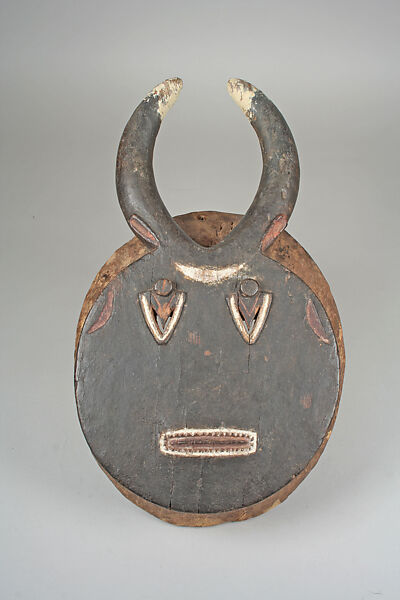
Most masking traditions documented in this book maintain a whole wardrobe of mask types, each built for a distinct spirit, rite, or society. The Landuman of Guinea are known to use exactly one: the numbe, a horizontal, horned, animal-headed mask whose abstract form has been read as a buffalo, a narwhal, and a dolphin in different accounts, without the sources ever settling on which. A single mask, and still no consensus on what it depicts. That narrowness, one mask type carrying three competing identifications, is the throughline worth carrying through this piece. It makes the numbe function almost like a Rorschach test built in wood: an object precise enough in its carving to demand an answer, and abstract enough that no single answer has stuck.

Who Are the Landuman?
The 25,000 Landuman are settled in Guinea and Guinea-Bissau. They are farmers who cultivate corn, millet, rice, and peanuts, organized under a supreme chief who holds authority over individual village chiefs. Inheritance passes through the matrilineal line, tying property and status to maternal descent rather than paternal lineage. The initiation of young people remains a tightly guarded secret, and the Landuman worship the spirits of the dead, a belief system that runs through both of the tribe’s most notable carved forms.
The Numbe: An Animal Mask Nobody Can Fully Identify
The numbe is horizontal in orientation and comprised of three elements: an ovoid head, an elongated snout, and a set of horns on top of the skull. This abstract, stylized composition suggests a buffalo, but it has also been said to represent a narwhal or a dolphin, three very different animals united only by the mask’s ambiguous, pared-down geometry. According to one source, its function would be to protect an enclosure, a practical, almost architectural role rather than a performative one built around dance or possession. The numbe is the only mask the Landuman are known to use, making it carry the entire weight of the tribe’s masking tradition on its own.
A Python Statue Tied to Fertility
Alongside the numbe, Landuman carving includes a statue in the shape of a python, a form that is probably connected to the snake cult found among several regional traditions and usually associated with fertility. Where the numbe protects a physical space, the python statue reaches toward a different register entirely, tying the Landuman’s carved output to concerns about continuity and generation rather than to defense or initiation. Together, the two objects, one mask and one statue, represent the near-complete record of Landuman sculptural art documented in this book.
Frequently Asked Questions
What is the numbe mask?
The numbe is the only mask the Landuman are known to use. It is a horizontal, abstract animal-head mask combining an ovoid head, an elongated snout, and horns, variously identified as a buffalo, a narwhal, or a dolphin.
What was the numbe mask used for?
According to one source, its function was to protect an enclosure, a role tied to guarding a physical space rather than to performance or possession.
What does the Landuman python statue represent?
It is probably connected to the snake cult and usually associated with fertility, distinct from the numbe’s protective function.
How does Landuman inheritance work?
Inheritance passes through the matrilineal line, and a supreme chief holds authority over individual village chiefs.
See also: African Masks by Region and Tribe · Chamba Masks: A Skull-Shaped Helmet and the Girl Who Was Really a Buffalo · Every Traditional African Mask You Should Know · African Funeral Traditions: How Different Cultures Honour the Dead