Sukuma Masks: A Chief Who Is Also a Sorcerer, Checked by Secret Societies
New: the 2nd edition of Within Carved Lines: The Secret Meanings of African Masks is out now. Get the book →
Several traditions documented in this book separate political authority from spiritual or occult power, assigning them to different offices entirely. The Sukuma of northern Tanzania collapse the two into a single person: each village chief is also a sorcerer, and his power is deliberately counterbalanced by secret societies rather than left unchecked. Authority and the supernatural aren’t kept in separate hands here, they’re held by the same one, with an institutional brake built in to stop it from concentrating too far. That fusion, one office carrying both political and occult power, restrained by a second institution rather than a rival chief, is the throughline worth carrying through this piece. It sets up the dry-season ceremonies where Sukuma masks and jointed figures perform side by side, art forms that answer to the same layered structure of power.

Who Are the Sukuma?
The Sukuma number approximately one million people, living in small villages in the northern part of Tanzania. Each village is headed by a chief who is also a sorcerer, and whose power is counterbalanced by secret societies, a structure that distributes authority even as it concentrates political and spiritual roles in a single figure.
A Chief-Sorcerer Balanced by Secret Societies
The dual role of chief and sorcerer means Sukuma village leadership carries both civil and occult weight at once. Rather than leaving that combined authority unchecked, the presence of secret societies functions as a structural counterweight, distributing real influence across the community instead of letting it rest entirely with one office. This layered arrangement, a single leader with doubled power and an institutional check on it, sits behind the art produced for the community’s most significant seasonal ceremonies.
Amaleba: Jointed Figures for Dancers and Musicians
Sukuma carvers are associated with large, rough-looking, standing figures, some made with articulated limbs and others carved without any arms and legs at all. Their bold, rounded heads usually have eyes inset with beads. Figures carved with articulated limbs, known as amaleba, are used by musicians and dancers during ceremonies held in the dry season, following the harvest, putting a moving, jointed sculptural form directly into performance. Another type of tall carved figure, to which fetish material is attached, is thought to represent an ancestor, extending the same carving tradition toward commemoration rather than performance.
Fearful Masks for the Dry Season
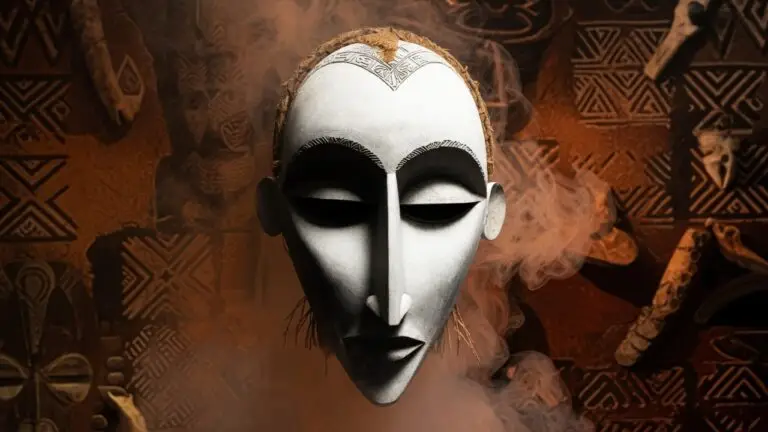
Sukuma masks carry a fearful expression, with exaggerated features including applied eyebrows, a beard, and a moustache. In common with the amaleba figures, Sukuma masks were also employed during dance ceremonies held in the dry season, placing masks and jointed figures within the same seasonal performance calendar. Sukuma craftsmen additionally produced terracotta figures with a small head and hands resting on their hips, along with ivory necklaces, extending Sukuma material culture beyond wood into fired clay and carved ivory.
Frequently Asked Questions
What does it mean that a Sukuma chief is also a sorcerer?
Each Sukuma village chief holds both civil and occult authority in the same role, and this combined power is counterbalanced by secret societies within the community.
What are amaleba?
Amaleba are Sukuma carved figures with articulated limbs, used by musicians and dancers during dry-season ceremonies held after the harvest.
What do Sukuma masks look like?
They carry a fearful expression, with exaggerated features including applied eyebrows, a beard, and a moustache.
What other objects did Sukuma craftsmen produce?
Terracotta figures with a small head and hands resting on the hips, and ivory necklaces, alongside the wooden figures and masks.
See also: African Masks by Region and Tribe · Every Traditional African Mask You Should Know · African Funeral Traditions: How Different Cultures Honour the Dead