Mbala Masks: A People Named After Their Own Red Pigment
New: the 2nd edition of Within Carved Lines: The Secret Meanings of African Masks is out now. Get the book →
Many peoples documented in this book take their names from a place, an ancestor, or an occupation. The Mbala of the southwestern Democratic Republic of the Congo take theirs from a color: tukula, the famous red pigment they produce, gives them their name, “the red people.” The material a craftsman applies to a finished object became, over generations, the identity of the people who made it. That reversal, a pigment naming a population rather than the other way around, is the throughline worth carrying through this piece. It runs directly into the Mbala’s most celebrated works, maternity figures carved with a deliberate, lifelike asymmetry that evokes not an abstract ideal but the specific, remembered force of the clan’s female founder.

Who Are the Mbala?
The 60,000 Mbala migrated from Angola during the 17th century and settled in the Kwango-Kwilu region in the southwestern Democratic Republic of the Congo. The region is a point of confluence for many ethnicities with whom the Mbala have become assimilated, including the Pelende, Suku, Pende, and Yaka. They are governed by regional village chiefs who regulate the economy: hunting, fishing, and manioc farming form its core.
Tukula: The Red Pigment That Named a People
The Mbala produce a famous red pigment called tukula, and it is from this pigment that their name, “the red people,” emanates. The pigment isn’t a minor craft detail, it is embedded directly in how the Mbala understand and name themselves, tying identity to a specific material practice rather than to territory or lineage alone.
Maternity Figures and Musician Statues in Pairs
The Mbala are famous for their maternity figures and their musician statues, drummers or players of the thumb piano (sanza) or xylophone, which appear in pairs: the male figure holds a musical instrument, the female holds a child. The figures come in three types, diamond-shaped, elongated, or trapezoidal, some carrying a figure on their shoulders, with features, especially the forehead and chin, projecting forcefully beneath a crest-like coiffure. Mbala standing and sitting mother-and-child figures are much more powerfully rigid in style than comparable figures elsewhere in the Congo region. In the matrilinear society of the Mbala, maternity was celebrated with particular specificity, a symbol of the chief’s authority and a central part of ancestor worship, inspiring a powerful evocation of the clan’s female founder as the true force of nature behind the lineage. Despite their sacred character, these statues remain very lifelike, often carved with a slight asymmetry that gives them a distinct spontaneity and personality rather than the static symmetry of a purely ceremonial object.
Fetish Figures, Rare Helmet Masks, and Ivory Objects
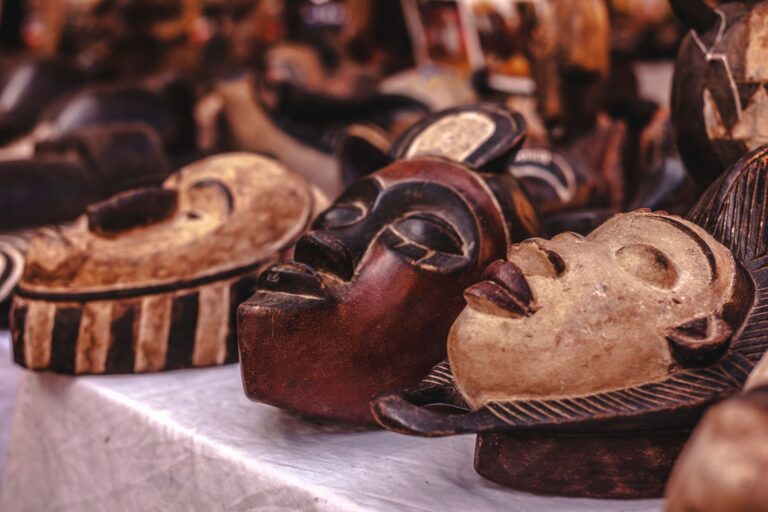
Fetish figures used for hunting and divination are often covered with added paraphernalia believed to enhance their powers. Mbala masks resemble those of the neighboring Yaka, while helmet masks are rare and their function is unknown, a gap in the record that stands out against the otherwise well-documented maternity tradition. Headrests supported on the arms of single and double figures also appear, alongside finely sculpted ivory objects: scepters, knives, cups, and neckrests, extending Mbala craftsmanship from monumental figures down to small, personal-use pieces.
Frequently Asked Questions
What is tukula?
Tukula is the famous red pigment produced by the Mbala, and it is the source of their name, “the red people.”
What are Mbala maternity figures known for?
They are known for a powerfully rigid style and a deliberate, lifelike asymmetry, evoking the clan’s female founder as part of ancestor worship in the Mbala’s matrilinear society.
How do Mbala musician statues typically appear?
They appear in pairs, with the male figure holding a musical instrument, such as a drum, thumb piano, or xylophone, and the female figure holding a child.
What is known about Mbala helmet masks?
They are rare, and unlike the maternity figures, their function is unknown.
See also: African Masks by Region and Tribe · Kakuunga and Kholuka: The Masks of Yaka Initiation in the Congo · Suku Masks: Royal Court Charms in the Southwestern Congo · Every Traditional African Mask You Should Know