Goma Masks: The Statue That Has No Body Between Its Head and Legs
New: the 2nd edition of Within Carved Lines: The Secret Meanings of African Masks is out now. Get the book →
Most carved figures documented in this book preserve, at minimum, the basic proportions of a body: head, torso, limbs, even when stylized heavily. The Goma of the northwestern end of Lake Tanganyika carved four-legged statues that skip the torso altogether, a very large head sitting directly above four legs with no body between them at all. The absence isn’t a stylization of the body, it’s the removal of it. That subtraction, a figure defined by what’s missing rather than by what’s exaggerated, is the throughline worth carrying through this piece. It repeats across the Goma’s carved output, from the masks’ concave, eye-dominated faces to a ceremonial headpiece that goes even further, replacing the legs with a hollow cap and leaving only a two-faced head behind.
Who Are the Goma?
The Goma occupy a small area at the northwestern end of Lake Tanganyika in the Democratic Republic of the Congo. Most objects of Goma art strongly resemble the neighboring Buyu and Bemba traditions, placing Goma carving within a shared regional visual language rather than an entirely isolated style.
Masks and Shields Built Around the Eyes
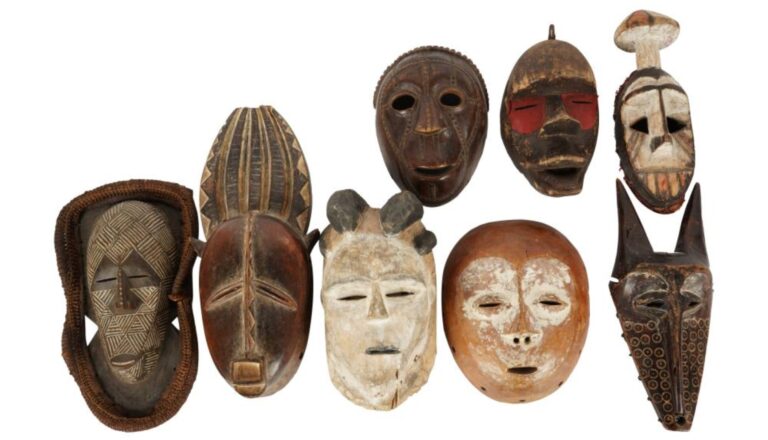
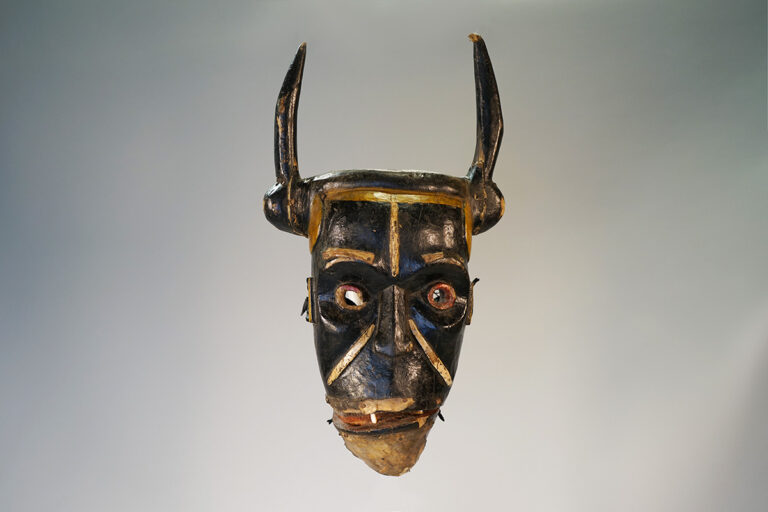
The Goma produce masks and shield-like carvings remarkable for their abstract design, with great emphasis placed on the eyes and a protrusion standing in for the mouth. The face is reduced to a small set of dominant features rather than rendered as a full naturalistic likeness, a graphic economy that carries through the rest of Goma’s carved figures.
The Statue With No Body
Goma four-legged statues have a very large head and a facial expression in the same style as the masks: two large concave surfaces with two round bulging eyes. Between the legs and the head, there is no body at all, an omission that makes the statue read as two separate carved elements, head and legs, joined directly without the connective torso a viewer would expect. The effect concentrates all visual attention on the head’s exaggerated features, since there is no intervening form to distract from it.
A Headpiece That Replaces the Legs Entirely
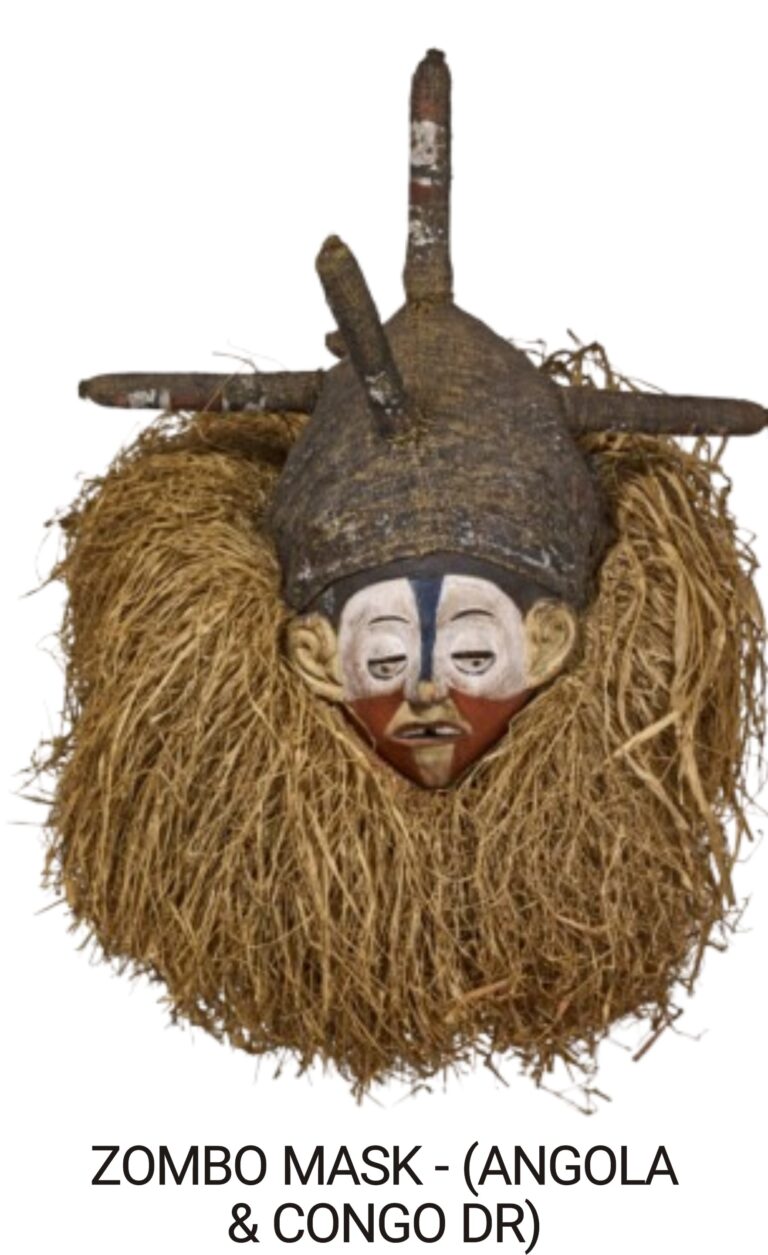
The same general structure reappears in a ceremonial headpiece, where the legs are replaced entirely by a hollowed-out hemispherical cap positioned below a two-faced head, often topped with feathers. Instead of recognizable facial features, the concave surface of the face is carved with an abstract cross design, pushing the object even further from representation than the masks or statues. Where the four-legged statue removes the body but keeps the legs, the headpiece removes the legs as well, leaving a structure built almost entirely from absence, punctuated only by the carved head and its abstract cross-marked face.
Frequently Asked Questions
What do Goma masks look like?
They are abstract, with great emphasis on the eyes and a protrusion for the mouth, carved as shield-like objects as well as face masks.
What is unusual about Goma four-legged statues?
There is no body between the legs and the very large head, which carries two large concave surfaces with two round bulging eyes in the same style as the masks.
What replaces the legs on the Goma ceremonial headpiece?
A hollowed-out hemispherical cap, positioned below a two-faced head often topped with feathers, with the face carved as an abstract cross design rather than recognizable features.
Which traditions does Goma art most resemble?
Most objects of Goma art strongly resemble the neighboring Buyu and Bemba art traditions.
See also: African Masks by Region and Tribe · Bemba Masks: The Honey Spirit’s Helmet, Hidden in a Cave and Forbidden to See · Every Traditional African Mask You Should Know