Ogoni Masks: Dances That Range From Pure Fun to Passing a Verdict
New: the 2nd edition of Within Carved Lines: The Secret Meanings of African Masks is out now. Get the book →
Most masking traditions documented in this book draw a fairly clean line around what a mask is for: initiation, or funerals, or entertainment, rarely all at once and rarely including anything as concrete as a legal ruling. The Ogoni, living east of the Niger delta in Nigeria, never drew that line. Their masquerades are regionally varied, partly homegrown and partly borrowed from neighbors like the Ibibio and the Ijo, and the resulting dances do everything from pure entertainment to funeral services, harvest festivals, and the implementation of judicial verdicts. That range, a single masking tradition stretched from party to courtroom, is the throughline worth carrying through this piece. It says something about how the Ogoni treat their masks less as objects tied to one sacred function and more as a flexible cultural toolkit, assembled from whatever neighboring traditions offered and then pointed at whatever the moment required.

Who Are the Ogoni?
The Ogoni live to the east of the Niger delta, in a fertile area rich in petroleum resources. Despite sustained efforts by Christian missionaries, they have retained a vital, regionally varied masquerading activity, one that survived pressure to abandon it in a way many neighboring traditions did not.
A Masquerading Tradition Built From Borrowed Parts
Ogoni masking is only partly homegrown. Much of it is adopted from neighboring ethnic groups such as the Ibibio or the Ijo, making Ogoni masquerade less a single unified style than a regional composite, shaped by whichever forms proved most useful or most compelling as they crossed into Ogoni territory. Rather than treating this borrowing as a dilution of tradition, Ogoni communities folded it directly into their own regionally varied practice.
From Entertainment to Verdict: What Ogoni Masks Actually Do
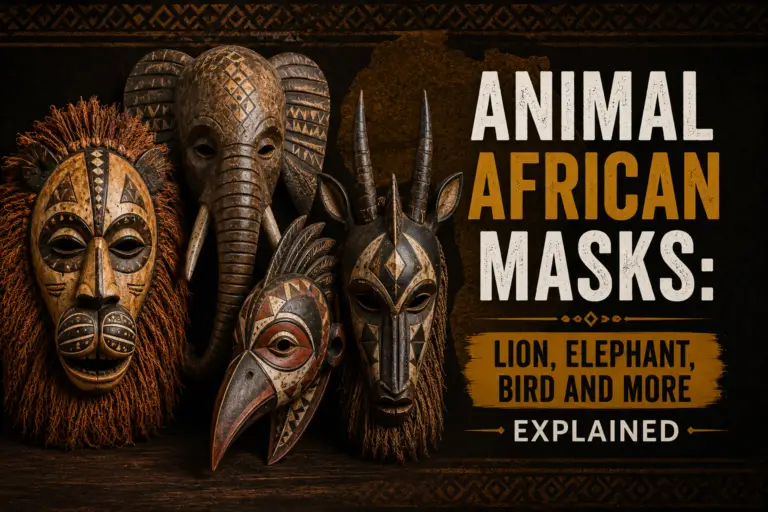
Ogoni mask dances serve a great variety of functions, and which function applies depends heavily on the region. At one end of the spectrum sits pure entertainment; at the other, participation in funeral services, harvest festivals, and the implementation of judicial verdicts, a use case rarely seen this explicitly elsewhere in this book. Masks of wild animals are danced acrobatically on the occasion of agrarian rituals, tying the performance directly to the agricultural calendar even as other masks in the same tradition are doing the work of settling disputes.
Frequently Asked Questions
What are Ogoni masks used for?
They serve a wide range of functions depending on the region: pure entertainment, funeral services, harvest festivals, and even the implementation of judicial verdicts.
Where does Ogoni masquerade tradition come from?
It is partly rooted in Ogoni’s own tradition and partly adopted from neighboring ethnic groups such as the Ibibio and the Ijo.
What kind of masks appear in Ogoni agrarian rituals?
Masks representing wild animals are danced acrobatically on the occasion of agrarian rituals.
Where do the Ogoni live?
The Ogoni live to the east of the Niger delta in Nigeria, in a fertile area rich in petroleum resources.
See also: African Masks by Region and Tribe · Ijo Masks: Water Spirits Who Lived Among Humans Before They Were Born · Every Traditional African Mask You Should Know