Buyu Ancestor Figures: A Shared Style Outliving the People Who Made It
New: the 2nd edition of Within Carved Lines: The Secret Meanings of African Masks is out now. Get the book →
Several traditions documented in this book belong unmistakably to one people, carved in a style found nowhere else. The Buyu, who occupy a small area between the Lualaba River and the northwestern end of Lake Tanganyika in the eastern Democratic Republic of the Congo, complicate that picture: their ancestor figures are stylistically so close to those of neighboring groups, the Holoholo, the Binji, and the Bangubangu, that it is sometimes difficult to tell the styles apart at all. That closeness, a visual language shared so completely across neighboring peoples that authorship blurs, is the throughline worth carrying through this piece. It matters more now than ever: the Buyu population is declining and their culture disintegrating as the neighboring Bembe have expanded into Buyu territory over the past 70 years, making the question of whose style this really is a genuinely open one.
Who Are the Buyu?
The Buyu occupy a small area between the Lualaba River and the northwestern end of Lake Tanganyika, in the eastern Democratic Republic of the Congo. This region has been overrun by innumerable shifts in population, and groups of diverse origins, the Lega, Bembe, Buyu, Bangubangu, and Binji, have coexisted in the same villages, their primary shared activity being the hunt. That proximity created constant cultural exchange and drove the mobility of the population across generations. The Buyu population is declining and their culture disintegrating due to the expansion of the Bembe over the past 70 years into Buyu territory.
Ancestor Figures for Chiefs Who Led Migrations
Among the six clans that form the Buyu ethnic group, three are known predominantly for their male and female ancestor figures. These figures honor venerated chiefs who led migrations, founded villages, or provided exceptional leadership to their people. The Buyu worship nature spirits alongside ancestors, and when bad luck arrives, they attempt to understand the will of the ancestors through dream interpretation or divination, immortalizing their chiefs and forebears in vigorous figures marked by a massive head, long cylindrical torso, square shoulders, and a bulging trunk.
A Style So Shared It Is Hard to Tell Apart
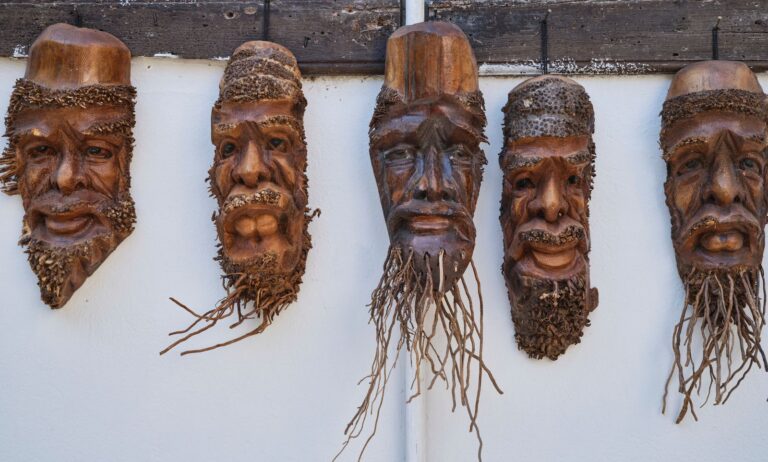
Buyu ancestor figures share a triangular face, a forehead marked by circularly arched eyebrows, coffee-bean-shaped eyes, a dominant jaw, an angular chin, and a hatched motif simulating a stylized beard. These figures are stylistically so close to those produced by neighboring ethnic groups on the western banks of the lake, especially the Holoholo, the Binji, and the Bangubangu, that specialists sometimes struggle to distinguish one style from another. The figures are kept in small huts and displayed in series of five to seven, carrying either a beneficial or malefic influence on everyday life that requires an ongoing cult and associated offerings; before a hunt, men rub their weapons with white clay at the shrine, and offer trophies upon a successful return. Bust figures were sometimes left outside the ancestor shrine as well, either in the village or in the forest.
Frequently Asked Questions
Who are the Buyu related to?
The Buyu share territory and cultural exchange with the Lega, Bembe, Bangubangu, and Binji, and their ancestor-figure style is stylistically very close to that of the Holoholo, Binji, and Bangubangu.
What do Buyu ancestor figures represent?
They honor venerated chiefs from three of the six Buyu clans who led migrations, founded villages, or provided exceptional leadership.
What is happening to Buyu culture today?
The Buyu population is declining and their culture disintegrating as the neighboring Bembe have expanded into Buyu territory over the past 70 years.
How are Buyu ancestor figures used?
They are kept in small huts, displayed in series of five to seven, and require ongoing offerings; men rub their weapons with white clay at the shrine before a hunt and offer trophies upon a successful return.
See also: African Masks by Region and Tribe · Lega Bwami Art: Objects You Have to Earn the Right to Own · Binji Masks: The Border Style Behind the Kuba Bwoom? · Every Traditional African Mask You Should Know