Understand Your Traditional African Mask: A Practical Guide for Owners and Collectors
So you own an African mask. Maybe it called out to you in a shop. Maybe you inherited it from a parent or an aunt who passed on, and now it sits on your wall, beautiful and silent, and you have no real connection to it. You do not know where it came from. You do not know what it means. You do not know if it is worth anything. And quietly, you wonder if it should even be in your home at all.
These are the right questions to ask. And they are the questions I get asked most often on my YouTube channel and in my emails.
Let us answer them properly.
First, Understand What You Are Looking At
Africa is a continent. I know this seems obvious, but it is the single most important thing to remember when you try to understand a mask. We are a continent of many nations, many languages, many tribes, and many spiritual traditions. Masks are indigenous to specific peoples. They are made for specific reasons. A mask from the Bini Kingdom does not mean what a Senufo mask means. A Yoruba Gelede mask does not perform the same function as a Dogon Kanaga.
There is no such thing as ‘a generic African mask’. The phrase itself is a problem. It collapses thousands of distinct traditions into one imagined object, and it is part of the reason so many masks end up misunderstood, mishandled, or mounted in the wrong rooms.
So when you ask, ‘what kind of mask do I have?’, you are really asking three different questions at the same time:
- What was this mask made for?
- Where does it come from?
- What does it carry?
Let us take them one by one.
What Was Your Mask Made For?
Across African cultures, masks fall broadly into three categories of purpose. Knowing which one you own changes everything else.
Decorative Masks
These are made to be beautiful. They are made to hang on a wall, to grace a hotel lobby, to sit in a collector’s display case. You can usually tell a decorative mask just by turning it over. Look at the back. If there are no eye slits, no breathing holes, no straps or rope marks where it could have been tied to a face, then it was never meant to be worn. Often there is a notch or a small hook so the mask can hang on a nail. That tells you everything. This kind of mask was made for the eye, not the body.
Decorative masks are not less valuable as art. Some of them are extraordinary craftsmanship. But spiritually they are quiet. They were never asked to do work, and they do not do any.
Performance and Ceremonial Masks
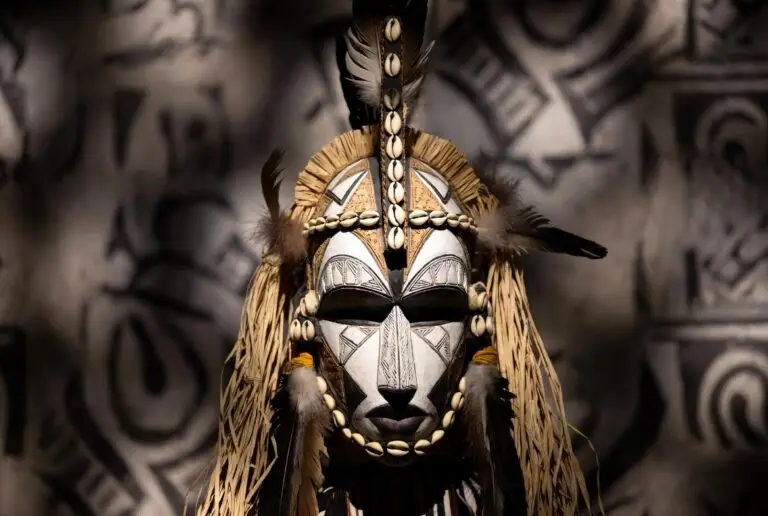
These are made to be worn during festivals, dances, funerals, initiations, and community celebrations. They have eye slits. They have ways to secure them to the head. Sometimes you can see the residue of cloth, raffia, or rope where a costume was attached at the rim. Their job is to embody a spirit, an ancestor, or a force during the performance, and then return to a resting state when the dance is over.
The Zaouli mask of the Guro people of Côte d’Ivoire is a famous example. So is the Gelede of the Yoruba, danced in pairs to honour the spiritual power of women and elders. So is the Egungun of Nigeria, which channels the presence of ancestors during community festivals. These masks live a double life. They are objects when they rest. They are presences when they dance.
Ritual Masks
These are different. These are masks that exist to do spiritual work. They live in shrines. They are kept by priests, diviners, and secret societies. They are used in rites that are not open to the public. A ritual mask is not an object. It is a tool. Sometimes it is a presence.
You will rarely find a true ritual mask on the open market. They are not supposed to be sold. When they do appear, it is usually because they were taken during colonial expeditions, looted, smuggled, or removed from a community that had no say in the matter. Many of the African masks now sitting in European and American museums fall into this category, which is part of the wider conversation about restitution.
Most of the masks that people inherit, buy at airports, or pick up from antique markets are decorative or, at best, retired performance masks. But not all of them. And the ones that are something more deserve to be treated with care.
Where Does Your Mask Come From?
A lot of masks come with tags or labels saying where they were made. If yours did, half the work is done for you. If it did not, you can still work it out.
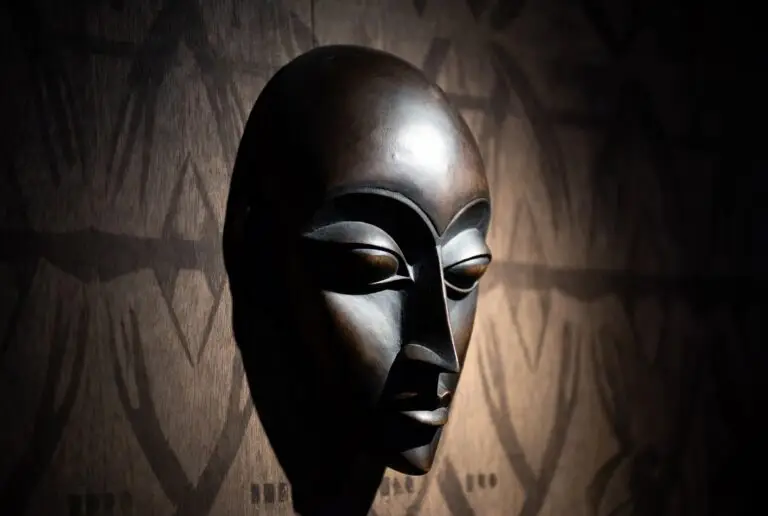
Across cultures, masks keep certain visual signatures. The shape of the head. The style of the eyes. The carved scarification marks on the cheeks or forehead. The hairstyle. The presence or absence of horns, beaks, or attachments. These features repeat within traditions.
Here are a few of the major signatures to recognise.
Bini and Edo masks from the kingdom of Benin in southern Nigeria often feature elongated necks, refined facial features, and the famous vertical scarification marks above the eyes. The Queen Idia ivory mask is the most recognised example. These masks usually carry royal symbolism.
Yoruba masks from southwestern Nigeria are diverse, but Gelede and Epa masks tend to feature large headdresses sitting above a calm face, often with figures, animals, or scenes carved on top.
Igbo masks from southeastern Nigeria, including the Mmwo and Agbogho Mmuo, are often whitened with kaolin and feature delicate, almost serene faces representing the spirits of beautiful young women. Other Igbo masks, like the Ogbodo Enyi, are aggressive, abstract, and elephant inspired.
Dan masks from Liberia and Côte d’Ivoire are smooth, oval, with high foreheads, narrow slit eyes, and pursed lips. They are some of the most copied masks in the world precisely because they look so refined.
Senufo masks from Mali, Burkina Faso, and Côte d’Ivoire often feature animal hybrids, especially the Kpeliyee with its serene face and outward projections, or the firespitter masks with horns, tusks, and aggressive geometry.
Dogon masks from Mali are tall, geometric, often architectural, with the famous Kanaga mask featuring a cross like superstructure rising above the face.
Bwa and Bobo masks from Burkina Faso are massive, abstract, painted in bold red, white, and black geometric patterns.
Fang masks from Gabon are elongated, white, heart shaped faces, often associated with the Ngil judicial society.
Chokwe masks from Angola, Zambia, and the Democratic Republic of the Congo include the famous Mwana Pwo and Pwo masks, representing female ancestors with refined features and elaborate hairstyles.
Some forms appear across the whole continent because they refer to universal phenomena. Sun masks. Moon masks. Animal masks honouring creatures that exist everywhere. These are harder to place. But most masks carry enough specific detail to be traced to a region, a people, sometimes even a workshop.
If you are not sure, send a clear photograph to michael@sevics.africa and I will look at it. Sometimes I can tell you instantly. Sometimes I have to dig. Either way, I will get back to you. There is also a Facebook group I run for mask lovers where members post their pieces and we figure them out together. The link is in the description of the video.
If you want to study this more deeply, I cover the regional traditions, the iconography, the meanings of specific features, and the spiritual frameworks behind them in my book Within Carved Lines. It is the resource I wish I had when I first started this work.
What Does Your Mask Carry?
This is the part that almost no one talks about, and it is the most important part. Every African mask carries energy. Three kinds of energy, in fact. If you understand these three, you understand your mask better than most people who own one.
The First Energy: The Material
The substance a mask is made of carries its own life.
Wood is the most common material, and not all wood is the same. Certain trees are considered sacred across African spiritual traditions. The kapok tree, also called the silk cotton tree, is sacred from West Africa to the Caribbean diaspora. The iroko in Yoruba and Igbo cosmologies is treated as a tree with a spirit of its own, and carvers seeking to use it must often make offerings before cutting. The baobab, the oldest living thing on the savannah, holds ancestral memory. The mahogany, the ebony, and the African rosewood each have their own associations.
When a carver chooses sacred wood, the mask inherits the qualities of that tree. Some woods attract good fortune. Some banish bad energy. Some are used because the spirit of the tree itself is believed to live in the carving. A mask carved from iroko by someone who did not first appease the iroko spirit is, in some traditions, considered dangerous to its owner.
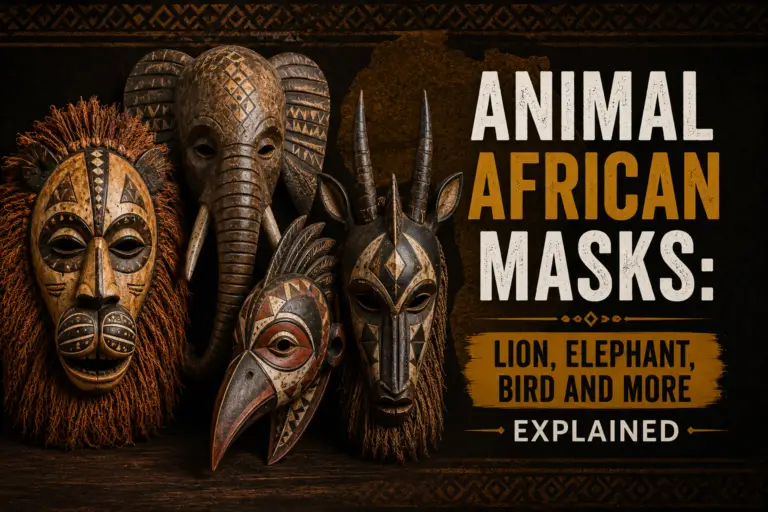
Other materials carry their own meanings. Ivory was historically reserved for royalty and high ritual because of its rarity and the spiritual weight assigned to the elephant. The Queen Idia mask is ivory for this reason. Bronze and brass were used in royal contexts, particularly in Benin and Ife. Bones, horns, teeth from specific animals, feathers from specific birds, all of these are chosen deliberately. A lion’s tooth set into a mask is not decoration. It is a transfer of qualities. Lion strength. Lion authority. Lion fearlessness. The same logic applies to leopard claws, antelope horns, and the feathers of birds associated with messengers between worlds.
Cowrie shells carry wealth and ancestor symbolism. Beads in specific colours carry specific meanings: red for power and danger, white for purity and the spirit world, blue for love and harmony, black for mystery and transition.
Then there are masks made from materials that do not belong to that world at all. Plastic. Resin. Polymer composites. Carbon fibre. Plaster of Paris. If your mask is made of any of these, it is almost certainly a modern reproduction. It is not necessarily worthless. But it is not a traditional mask carrying traditional energy. It is a representation of one. It can be beautiful. It can be meaningful to you personally. But spiritually, it is mostly silent.
The Second Energy: The Maker
The person who creates the mask leaves something of themselves inside it.
Mask making in traditional African societies is not casual craft. It begins with revelation. A carver receives an inspiration, sometimes through a dream, sometimes through divination, sometimes through a direct request from the spiritual authority of the community. Then comes consultation with elders or with the priest who oversees the relevant tradition. Then research into form. Then approval. Only then does the carving begin. By the time the wood is touched, the mask already has a destiny.
The essence of the carver enters the work. This is why three masks made in the same tradition, from the same wood, in the same style, can feel different from each other. One stands out. One vibes differently. That difference is usually the maker. A master carver in spiritual alignment with the tradition produces masks that are alive. A junior carver going through the motions produces masks that look right but feel hollow.
This is also why mass produced tourist masks, even when they are technically beautiful, feel hollow. There was no revelation. There was no consultation. There was a workshop and a deadline. The form is there. The essence is not. You can pick up two near identical masks at a market in Bamako or Accra, and one will feel quietly powerful while the other feels like wood. The difference is who carved it and what state they were in when they did.
This is also why there is a tradition, in many African mask making cultures, of the carver fasting, praying, abstaining from sex, or undergoing purification before beginning a ritual mask. The maker is not just shaping wood. The maker is preparing a vessel. What they bring to the work is what the work will carry forward.
The Third Energy: The Activation
This is the most important and the most misunderstood.
A mask can be activated. Activation is a ritual process where a mask is consecrated, charged, and commissioned for a specific purpose. After activation, the mask is no longer just an object. It holds a spiritual function. It does work. It can be used to summon, to bind, to protect, to communicate, to heal, to bring rain, to settle disputes, to mark a transition from boyhood to manhood.
A decorative mask sitting on your shelf is almost certainly not activated. But it can be. Any mask, in principle, can be activated by someone who knows the rites. And if a mask was activated by someone before it came to you, that activation does not necessarily disappear because the mask changed hands.
This is why I get comments on my channel from people saying things like, ‘I have a mask that comes alive at certain times of the year’, or ‘my mask demands an offering’, or ‘my mask speaks to me at night’, or ‘my house has felt strange since I brought it home’. These are not imaginations. These are activated masks that have ended up in homes that are not equipped to host them. A ritual mask that demands offerings belongs in a shrine, in the care of someone who knows how to maintain the relationship. Not on a wall in a living room in Berlin or Atlanta or Dubai.
Not every old mask is activated. Many are not. Activation requires deliberate ritual, and most masks were not made for that level of charge. But some were. And if you own one of those, you need to know.
You can learn to read these energies yourself. There are simple exercises that anyone with a little patience and openness can practise. But that is a conversation for another video.
Reading the Physical Features
Beyond the energies, the physical face of the mask tells you something. Every feature is a deliberate choice. Nothing on a traditional African mask is accidental.
Look at the eyes. Are they wide and shocked? Half closed and serene? Hollow? Round? Almond shaped? Closed entirely? Wide, staring eyes often signal vigilance, judgement, or supernatural sight. Half closed eyes suggest meditation, ancestral calm, or the otherworld. Hollow eyes suggest a vessel waiting to be filled by a spirit during ceremony.
Look at the mouth. Is it pursed, smiling, snarling, calm? An open mouth with bared teeth is almost always a sign of a banishing or protective mask. A small, pursed mouth often signals serenity and ancestral peace. A mouth pulled into an exaggerated grimace might represent a trickster spirit or a force that disrupts.
Look at the forehead and cheeks. Are there scarification marks? Lines, dots, raised ridges? These are not random patterns. Scarification marks on a mask reproduce the actual markings used by the people of that tradition to indicate clan, status, role, or initiation. The two vertical lines on the queen Idia mask of the Bini Kingdom are scarification marks that had specific meaning in the Edo court of the time.
Look at the hair, the headdress, and the attachments. Is there an animal sitting on top? A second face? A pair of horns? A whole figure carved above? These superstructures are often the most meaningful part of the mask. They name the spirit being represented. A mask with an antelope crowning it is invoking antelope qualities. A mask with a Janus face front and back is mediating between two worlds, two realms, two times.
Look at the colour. White, particularly white kaolin, is often associated with the spirit world, the ancestors, or female beauty in death. Red is power, danger, royalty. Black is mystery, transition, the unknown. Indigo is associated with deep wisdom in some traditions. Faded paint that was once vivid tells you the mask has lived.
Each of these is a sentence in a language. When you look at the whole face together, those sentences form a paragraph. And the paragraph tells you what the mask is for.
But here is a warning. The meanings are not always what they look like. A mask that looks ugly, fierce, or angry is often a good mask. African aesthetic logic does not equate beauty with goodness the way Western art often does. Many of the most fearsome looking masks were made to banish negative energy, to drive out illness, to protect the village from harm. Their job is to look terrifying because what they fight is terrifying. A serene, beautiful mask might be benign, or it might be the calm face of something far more dangerous than the snarling one beside it.
So do not judge your mask by whether it is pretty. Judge it by what it is trying to do.
Is Your Mask Worth Anything?
This is the question I am asked most often, and it is the one I am least suited to answer.
Yes, African masks have monetary value. Some pieces sell at auction for tens of thousands of dollars. The Fang Ngil masks have sold for over four million euros. Senufo and Dan pieces regularly clear six figures at Sotheby’s and Christie’s. Some sit in major museum collections. The market is real. There are appraisers, dealers, and auction houses who can give you a price.
But I am not one of them. I am not a collector. I do not buy or sell masks on this channel. And I will be honest with you about why.
I believe African masks belong in Africa. Not all of them, not as an absolute rule, but as a principle. These objects are tied to the spiritual and cultural inheritance of millions of people. When they are reduced to commodities, traded as decor, valued only by what someone is willing to pay for them, something important is lost. The mask becomes silent. Its language is forgotten. Its purpose is buried under a price tag.
The auction house that sells a Fang Ngil mask for four million euros has no interest in the village in Gabon where that mask came from. It has no interest in whether the mask was activated, whether it was taken with consent, whether the community it belonged to even knows it is being sold. The price is real. The transaction is legal. But the relationship between the mask and the people who made it has been severed entirely.
So if your question is, ‘what is this worth in dollars’, I am not the right person to ask. But if your question is, ‘what does this mean, where does it belong, and how should I treat it’, then yes, I can help you with that.
Should the Mask Even Be in Your Home?
This is the question very few people are willing to ask out loud. But it is the most honest one.
If your mask is decorative, made from non sacred materials, and was clearly produced for the export market, then it is fine. Enjoy it. Display it. It is a piece of art.
If your mask is genuinely old, made from sacred wood, possibly activated, and was acquired through unclear circumstances, then it deserves a different conversation. You did not necessarily do anything wrong by inheriting it or buying it. But now that it is in your home, you have a relationship with it whether you wanted one or not. And that relationship comes with responsibility.
Some owners eventually choose to repatriate. Some choose to donate to museums or cultural institutions that handle these objects with care. Some keep them but learn how to live alongside them respectfully, including small gestures like keeping the mask in a clean, undisturbed space and not treating it as a costume prop or a conversation piece.
There is no single right answer. But the question itself matters.
Frequently Asked Questions About African Masks
How can I tell if my African mask is real or a tourist replica? Check the material first. If it is plastic, resin, plaster, or a composite, it is a modern reproduction. If it is hardwood with hand carving marks, weight, and irregularities, it is more likely traditional. Check the back for wear, smoke residue, or rope marks indicating actual ceremonial use.
Are African masks safe to keep in my home? Most decorative and tourist masks are entirely safe. Older ritual or activated masks may carry energies that some owners find disruptive. If you sense unease around a particular mask, that is worth paying attention to.
What is the most valuable type of African mask? At auction, Fang, Dan, Senufo, Bambara, and Bini ivory masks have historically commanded the highest prices. But monetary value does not always reflect spiritual or cultural significance.
How do I find out which tribe my mask belongs to? Photograph it from multiple angles, including the back, and send it to someone who studies African masks. You can email me at michael@sevics.africa or join a community of mask collectors who can help with identification.
Can I use sage or other rituals to cleanse an African mask? Be careful. African masks were not designed to interact with sage smudging, which is a Native American practice. Each African tradition has its own cleansing rites. Imposing a foreign ritual on a charged African mask is not always neutral.
Do African masks have to be displayed in a specific way? There are no universal rules, but many traditions hold that masks should not face the bedroom, should not be placed on the floor, and should not be touched unnecessarily. Treating the mask with quiet respect is usually enough.
What to Do Next
If you own a mask and you have read this far, here is what I would suggest.
Look at the back of your mask. Decide whether it was made to be worn or to be displayed.
Look at the material. Identify, as best you can, what it is made from.
Look at the features. Note the eyes, the mouth, the marks, the attachments. Write them down.
Send me a photograph at michael@sevics.africa if you want help identifying the tradition. Join the Facebook group if you want to discuss it with other mask lovers.
And read Within Carved Lines if you want to go deeper than any video or article can take you.
Your mask is not just an object. It is a record of someone’s vision, someone’s hands, someone’s tradition. It deserves to be understood. That is the least we can do for it.
Do you own a mask like this?
Not sure what it is, where it comes from, or whether it was ever danced? Start with our free Mask Identifier.
If you want the full story, I offer an in depth reading of your mask. Readings start at around sixty dollars, and every one is quoted before anything begins.