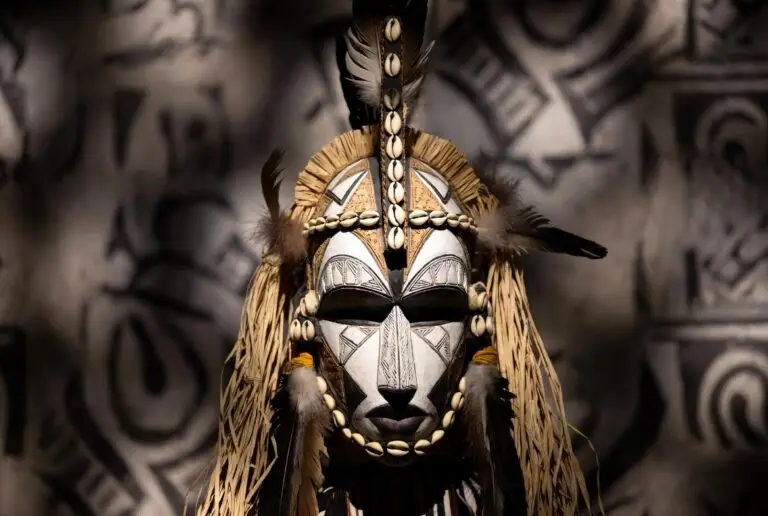
Marka Masks: A Courtship Performed in Pairs, Never Alone
New: the 2nd edition of Within Carved Lines: The Secret Meanings of African Masks is out now. Get the book →
Most masks documented in this book can, in principle, dance alone: a single performer, a single carved face, a single ritual moment. The Marka of Mali and Burkina Faso built their masking tradition around a structural rule that rules that out entirely. Marka masks always appear in pairs, and the pair is not incidental to the performance, it is the performance: a man’s courting of a woman, acted out in wood, metal sheeting, and colored cloth. That built-in requirement, one mask alone being simply incomplete, is the throughline worth carrying through this short but distinctive entry. It turns the Marka masquerade into something closer to a two-person scene than a solo appearance, a structural choice that sets it apart from the great majority of masking traditions in this book built around a single performer facing a crowd.

Who Are the Marka?
The Marka are a Mande subgroup living across Mali and Burkina Faso, independent from the Bambara as a people even though their artistic styles show strong Bambara influence. That combination, political and ethnic independence alongside deep stylistic borrowing, places the Marka among several communities in this book whose art reveals a closer relationship to a neighboring group than their separate identity might suggest.
A Bambara Style, Independently Owned
The Marka are famous for their masks and puppets, and the resemblance to Bambara work is immediate: Marka masks, like the ntomo society masks of the Bambara, are generally carved with horns, a comb, or a crest rising from the top of the head. The clearest point of departure is material rather than form. Where Bambara ntomo masks are carved and left in wood, Marka masks are often covered with metal sheeting, a finishing technique that gives the same basic silhouette a harder, more reflective surface. Masks carved with a comb, echoing the ntomo style directly, are danced specifically in the context of adolescent boys’ initiation rites.
Always in Pairs: Courtship as Performance
Beyond the shared silhouette and the metal sheeting, the detail that marks Marka masking as genuinely its own is how the masks are staged. The Marka dress their masks in gaily colored cloth costumes, and they always appear in pairs, built specifically to represent a man’s courting of a woman. Rather than a single masked figure commanding a crowd’s attention, the Marka masquerade stages a relationship between two performers, turning the mask tradition into a piece of social theater about courtship itself rather than a solitary display of ancestral or spiritual authority.
Frequently Asked Questions
Why do Marka masks always appear in pairs?
The pair represents a man’s courting of a woman, making the masquerade a staged two-person scene rather than a solo performance, a structural feature that distinguishes Marka masking from most other traditions in this book.
How are Marka masks different from Bambara ntomo masks?
Both share a similar silhouette, generally carved with horns, a comb, or a crest, but Marka masks are often covered with metal sheeting, while Bambara ntomo masks are typically left in carved wood.
When are Marka masks with a comb danced?
Masks carved with a comb, similar to the Bambara ntomo style, are danced specifically during adolescent boys’ initiation rites.
Are the Marka the same people as the Bambara?
No. The Marka are an independent Mande subgroup, distinct from the Bambara, even though their masking styles show strong Bambara influence.
See also: African Masks by Region and Tribe · Bwa Plank Mask of Burkina Faso: Insects, Spirits, and Geometric Art · Every Traditional African Mask You Should Know · African Coming-of-Age Ceremonies: How Different Cultures Mark the Transition to Adulthood