Salampasu Masks: Copper Faces of a Warrior Society in the Congo
New: the 2nd edition of Within Carved Lines: The Secret Meanings of African Masks is out now. Get the book →
Some African masks were inherited with a family name. A Salampasu mask was not one of them. To wear one, a man had to do something first: perform a specific deed, pay in livestock and drink, and be taught what the mask meant by the men who already owned the right to wear it. Nothing about a Salampasu mask was passive, and nothing about it was handed down simply because of who your father was.
That distinction is the throughline to keep in mind through everything below. A Salampasu mask was not decoration added to mark a rank a man already held. It was closer to a uniform that had to be earned rank by rank, in a very literal, transactional sense, before a man was permitted to put it on. Different masks existed because different ranks existed, and a man’s progress through Salampasu society could be read, quite literally, off the mask on his face.
Who Are the Salampasu?
The roughly 60,000 Salampasu live east of the Kasai River, on a savanna and forest frontier between the Democratic Republic of the Congo and Angola, a border region where control has historically been contested rather than settled. Their name is said to mean “hunters of locusts,” though that name undersold their reputation. Neighboring groups regarded them with genuine fear. The Salampasu were governed by territorial chiefs who oversaw village chiefs beneath them, but that formal hierarchy was balanced by a separate and powerful institution: a warriors’ society that ran parallel to political authority rather than underneath it.
Feared Neighbors on a Contested Frontier
The Salampasu maintained close commercial and cultural ties with two much larger, better documented neighbors, the Chokwe and the Lunda, to whom they paid tribute. But tribute did not mean submission in the way it might elsewhere. The Salampasu held onto a reputation as fearless, uncompromising warriors, and warring and hunting remained the most privileged occupations available to a man, while farming was left mostly to women. Living beside larger, wealthier, more centralized kingdoms without being absorbed by them seems to have sharpened rather than softened the Salampasu’s own warrior identity, and that identity is written directly into their masking system.
A Mask You Had to Earn
Boys entered Salampasu society through a circumcision camp. That was the entry point, not the endpoint. From there, a young man rose through a hierarchy of masks, and each step up that hierarchy had to be earned through specific deeds and payments of livestock, drink, and other material goods.
Ownership was not the end of the process either. Once a man “owned” a mask, the other men who already held that rank taught him the esoteric knowledge tied to it, knowledge that was not available to him before he had earned the position. A Salampasu mask, in other words, represented a documented, witnessed, paid for change in a man’s standing inside his own society.
Reading a Salampasu Mask: Wood, Copper, and Raffia
Salampasu masks were made from wood, crocheted raffia, or wood covered in sheets of copper, and the most famous examples made for initiation share a distinct, intimidating look: a bulging forehead, slanted eyes, a triangular nose, and a rectangular mouth set with a row of aggressive looking teeth. The head was often finished with bamboo, raffia, or rattan style decoration.
The fear these masks provoked was not incidental. Certain masks were considered so charged that women and children would flee a village simply on hearing the mask’s name spoken aloud, believing they risked death by staying. That is a level of social power very few carved objects anywhere are described as holding, and it only makes sense once you remember that the mask was never just an object. It was the visible proof of a man’s rank inside an institution built on war.
Three Ranks, Three Kinds of Mask
Salampasu masks were presented to initiates in a progressive order, and that order mapped directly onto the society’s internal ranking: hunters, warriors, and chief. Wooden masks, whether covered in copper sheet or left bare, were worn specifically by members of the ibuku warrior association, a status reserved for men who had killed in battle. Masks plaited from raffia fiber belonged to a different, separate tier of the society. Nothing about the mask type was interchangeable. Which mask a man wore told everyone watching exactly where he stood.
What the Mask Actually Tracked
Step back from the individual mask types and a clear pattern emerges: material and finish were never a matter of taste. Copper sheeting signaled the highest, most feared tier, reserved for men who had actually killed in battle. Raffia signaled a separate, lower path through the same society. The bulging forehead and aggressive teeth were consistent across ranks because the emotional register, fear, stayed constant even as the specific privileges attached to a mask changed. In a system with no written records, the mask itself was the record: a permanent, public, unmistakable statement of exactly what a man had done to earn the right to wear it.
Frequently Asked Questions
Why did Salampasu masks have to be earned rather than inherited?
Because they marked a documented change in social rank inside a warriors’ society. A man moved up the hierarchy through specific deeds and payments, and the mask he was entitled to wear reflected exactly where he stood.
What are Salampasu masks made from?
Wood, crocheted raffia, and wood covered with sheets of copper. The material and finish corresponded to which rank of the society a mask belonged to.
What do the copper covered masks mean?
Copper covered wooden masks were worn by members of the ibuku warrior association, reserved for men who had killed in battle, marking the highest and most feared tier of Salampasu masking.
Where do the Salampasu live?
East of the Kasai River, on the frontier between the modern Democratic Republic of the Congo and Angola, in close contact with the neighboring Chokwe and Lunda.
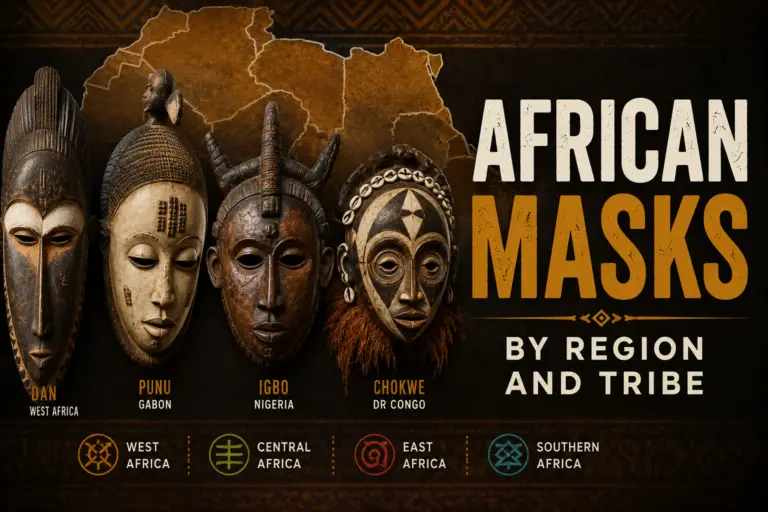
See also: African Masks by Region and Tribe · Pende Mask of the Congo: Types, Meanings, and Ceremonial Use · Kuba Kingdom: Art, Masks, and the Legacy of Central Africa’s Greatest Empire · How to Decode Your Traditional African Mask

Photo by Lionel Allorge, Royal Museum for Central Africa, Tervuren. Licensed CC BY SA 3.0.