Bemba Masks: The Honey Spirit’s Helmet, Hidden in a Cave and Forbidden to See
New: the 2nd edition of Within Carved Lines: The Secret Meanings of African Masks is out now. Get the book →
Many masks in this book exist to be seen, their entire function bound up in public display, in the crowd’s reaction, in being looked at. The Bemba of Zambia and the southeastern Democratic Republic of the Congo built a mask around the opposite principle: a mask whose viewing was expressly forbidden to the non-initiated, worn during initiation into the elanda male society, then hidden away entirely, entrusted to a dignitary and concealed outside the village in a secret place. That restriction, an object defined as much by who may not look at it as by anyone who may, is the throughline worth carrying through this piece. It sets up naturally against the Bemba’s other major mask, the ibulu iya alunga, which despite its own secrecy still had a job to do in the world: protecting the honey harvest that gave the Bemba their name.

Who Are the Bemba?
The name Babemba means “the people of the lake,” and the roughly 60,000 Bemba settled mostly in northeastern Zambia, with a smaller population in the southeastern Democratic Republic of the Congo. They share a number of traits with their neighbors along the shores of Lake Tanganyika, the Lega, the Buyu, and the Binji, all living across a territory of forest, plateau, and wooded savanna cut through by rivers. The Bemba have a reputation as a proud, hard people who mastered the hunt and the harvesting of honey, practicing slash-and-burn agriculture in villages of about thirty huts that were abandoned every three to four years once the surrounding soil was exhausted.
Bwami, Borrowed From the Lega
The Bemba borrowed the bwami association directly from their Lega neighbors, alongside other secret societies of their own. Once circumcision had been performed, bwami membership consisted largely of dances, songs, and the handling of ritual objects, initiates using figures sculpted from elephant tusks or wood, wooden masks, and, at the association’s highest levels, a stool or an anthropomorphic figurine as emblems of rank. That borrowing is worth noting on its own terms: rather than treating Lega ritual practice as something to imitate loosely, the Bemba adopted the bwami structure directly, while still developing masking traditions of their own alongside it.
The Mask No One Was Allowed to See
The initiation into the elanda male society culminated in the appearance of a specific mask, and viewing it was forbidden to anyone not yet initiated. This oval mask, which sometimes carries antelope horns, was not kept on public display or even stored in an ordinary location between appearances. Instead it was entrusted to a dignitary and hidden outside the village in a secret place, an arrangement that treated the mask’s very existence as something to be managed and restricted rather than simply displayed when not in use.
Ibulu Iya Alunga: The Protector of Honey
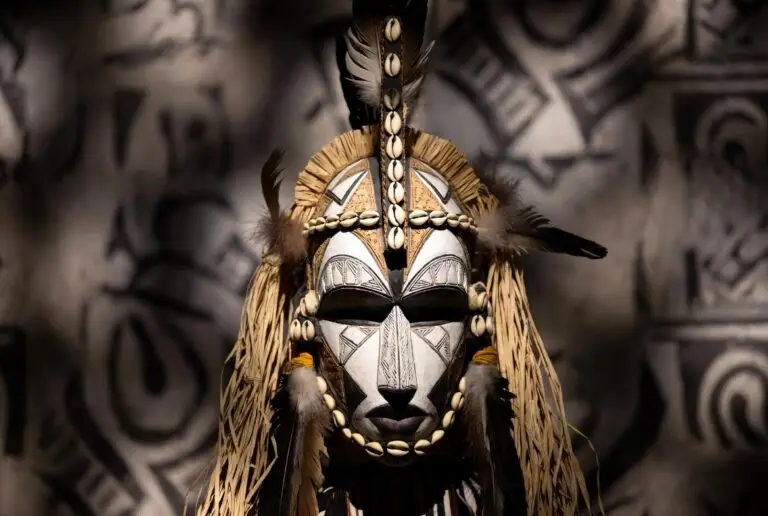
Alongside the elanda mask, the Bemba maintained the ibulu iya alunga, “the protector of honey,” used in the male alunga (kalunga) society and unique in form among the masks documented in this book. Worn on the head like a helmet, it sometimes ends at the top in a huge crest of feathers and porcupine quills, and it represents a powerful bush spirit. Kept in a sacred cave, the mask was brought into the bush specifically during the secret initiation of new members. The alunga association itself was responsible for the cult of the hunt, for social order, and for public dances, and the man who wore the mask, hidden completely beneath a fiber costume, held high rank and had mastered the specific dances, speech patterns, and guttural singing voice the role required.
Small Statuettes, No Large Statues
Unlike many of the neighboring traditions documented elsewhere in this book, the Bemba never produced large statues. Small statuettes, however, were made in the western part of their territory, and sorcerers and healers used them in rites of magic and healing. Certain female statuettes, standing on short legs with their hands resting on their abdomen, are thought to have served as fecundity figures, extending the same ritual concerns found in the mask traditions, protection, fertility, the management of unseen forces, into a smaller and more portable sculptural form.
Frequently Asked Questions
Why couldn’t non-initiates see the Bemba elanda mask?
The mask appeared only at the culmination of initiation into the elanda male society, and viewing it outside that context was expressly forbidden, with the mask hidden outside the village in a secret place between appearances.
What is the ibulu iya alunga?
It is “the protector of honey,” a helmet-style mask topped with feathers and porcupine quills, worn during the secret initiation of the alunga (kalunga) society and representing a powerful bush spirit connected to the cult of the hunt.
Did the Bemba make large wooden statues?
No. The Bemba never produced large statuary, but small statuettes, some believed to serve as fecundity figures, were carved in the western part of their territory and used by sorcerers and healers.
Where did the Bemba get the bwami association?
They borrowed it directly from their Lega neighbors, incorporating its dances, songs, and ranked ritual objects into their own practice alongside separate secret societies of their own.
See also: African Masks by Region and Tribe · Hemba Masks: The Were-Chimpanzee of the So’o Society · Lulua Masks: Faces From an Ethnic Crossroads in the Congo · Every Traditional African Mask You Should Know