Bijago Masks: Boys Who Danced as Sharks Because They Were Not Yet Men
Most masking traditions in this book reserve their most demanding, most elaborate objects for senior, initiated men, the people with the most standing to carry them. The Bijago, off the coast of Guinea-Bissau on an archipelago of some thirty islands, built the opposite hierarchy: their heaviest masks are worn by the age group not yet considered adult, boys and young men who have not been through initiation, dancing as wild bulls, sharks, hippopotami, and swordfish precisely because they are still, by the community’s own definition, untamed.
That inversion, physical weight and ritual demand assigned to the youngest and least initiated rather than the most senior, is the throughline worth carrying through this piece. It turns the mask itself into a mirror of the wearer’s actual social status: an uninitiated boy dances as an undomesticated animal because that is, in a very real sense, exactly what Bijago society considers him to still be.
Who Are the Bijago?
The Bijago archipelago comprises roughly thirty islands off the coast of Guinea-Bissau, and the Bijago people are known from early chroniclers’ accounts for daring raids on shipping along the African coast, carried out using huge canoes. The archipelago’s economy rests on rice cultivation, palm oil, and fishing, and Bijago society is highly structured through matrilineal clans, a council of elders, a system of age classes, and the office of the priestess. Age groups run through roughly seven levels among Bijago men, from infancy to old age, and martial virtues were deliberately cultivated through an age-set system that associated young men with powerful beasts of both sea and land, a link that runs directly into the animal masks discussed below.
A Matriarchal Order Built on Age
Bijago social structure is matriarchal to an unusual degree even within this book’s broader documentation of matrilineal societies: women selected their own husbands and could force a divorce on them, with custody of any children remaining with the father. Alongside that matriarchal authority, Bijago religious life runs through a demanding set of initiation rituals. Male initiation, which today may run no longer than two months but formerly extended over several years, sits alongside a distinct women’s initiation ritual offering access to adult status for boys who died before being formally initiated themselves, a recuperative ceremony performed by women who become possessed by the spirit of the deceased boy. That an uninitiated boy’s death did not simply end the possibility of his adult status, but instead triggered a separate ritual mechanism to grant it posthumously, says something specific about how seriously Bijago society treats the initiated-uninitiated boundary that also organizes its masking tradition.
The Heaviest Masks Go to the Youngest
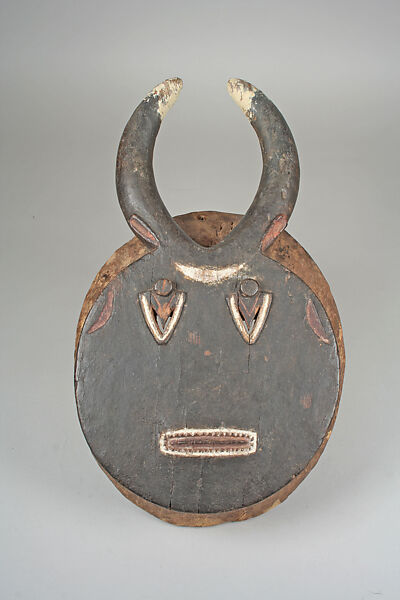
Sculpting among the Bijago is a voluntary undertaking. Any villager may carve initiation masks, head decorations, statuettes, and vessels, gaining familiarity with numerous ritual secrets through periodic involvement in ceremonies of initiation and worship. The heaviest masks specifically are worn by the age group not yet considered adult, and they represent, in realistic form, marine animals or wild bulls. Younger boys wear calf and fish masks, while older but still uninitiated youths take on wild bulls, sharks, hippopotami, and swordfish, the largest and most physically demanding forms in the entire tradition. The masks are worn either on top of the head or in front of it, and they appear during the ceremonies that precede and follow the phases of initiation. Beyond strictly ritual contexts, these masks today also appear in secular settings, at commemorations of historical events and on occasions when important visitors arrive.
Dancing Untamed
The performance style matches the logic of the masks themselves. Dances are unpredictable and violent, matched deliberately to the character of the animal being represented and to the dancers’ own undomesticated status, and the young performers imitate these dangerous creatures as a way of embodying beings still untamed, since they have not yet been initiated into adulthood. Read against the ordinary run of African initiation traditions, where masks more often instruct or guide the young toward adult behavior, the Bijago version does something more direct: it lets uninitiated boys perform their own current, unfinished status back to the community, wild animal standing in for wild boy, rather than performing the adult they are working toward becoming.
Iran: Figures Possessed by Divinities
Beyond the masks, Bijago sculpture also includes both realistic and abstract figures marked by a head with a pointed chin, a flattened face, rounded eyes, and semi-circular ears. These figures, called iran, are believed to be possessed by divinities and serve several distinct functions: as the focus of divination ceremonies, as protectors of households against curses, and as healers in their own right. Kept in small sanctuaries or in designated places within houses, iran figures receive sacrifices and libations, offerings that over time build up a thick patina on their surface, physical evidence of a long-running relationship between the figure and the household it protects.
Frequently Asked Questions
Why do the youngest, uninitiated Bijago wear the heaviest masks?
The heaviest masks represent wild marine animals and bulls, and they are specifically assigned to boys and young men not yet initiated, whose own untamed status the animal masks are meant to mirror and perform.
What animals appear in Bijago masks?
Calves and fish for younger boys, and wild bulls, sharks, hippopotami, and swordfish for older but still uninitiated youths, chosen as realistic representations of dangerous, undomesticated creatures.
What happened if a boy died before being initiated?
A separate women’s initiation ritual could grant him adult status posthumously, performed by women who became possessed by the spirit of the deceased boy.
What are iran figures?
Iran are Bijago sculptures believed to be possessed by divinities, used as the focus of divination, as protectors of households against curses, and as healers, kept in sanctuaries and given sacrifices and libations.
See also: African Masks by Region and Tribe · African Coming-of-Age Ceremonies: How Different Cultures Mark the Transition to Adulthood · West African Mask Styles: A Visual Guide to Regional Differences · Every Traditional African Mask You Should Know