Binji Masks: The Border Style Behind the Kuba Bwoom?
New: the 2nd edition of Within Carved Lines: The Secret Meanings of African Masks is out now. Get the book →
Attribution in Central African art history is rarely as tidy as a museum label makes it look, and the Binji are one of the clearest examples of that on this site. Their carvers produced rougher, less refined helmet masks than their famous Kuba neighbors did. And yet some specialists have proposed something that flips the usual assumption about who influenced whom: that a Binji mask type may actually be the prototype behind the Kuba bwoom, one of the best known mask forms in all of Central African art, rather than a cruder copy of it.
That possibility is the throughline worth holding onto here. It is easy to assume that a smaller, less documented people working in a rougher style must have been borrowing from their better known neighbor. The Binji case is a reminder that influence in this region often ran in directions the historical record only partially preserves, and that “rougher” carving is not the same thing as “later” or “derivative.”
Who Are the Binji?
Around 35,000 Binji live scattered across a wide area along the eastern border of the Kuba kingdom in the Democratic Republic of the Congo, in a region so heavily reshaped by successive population movements that a single village might contain families of Lega, Bemba, Buyu, Bangubangu, and Binji origin all living side by side, united mainly by hunting as a shared primary activity rather than by any single ethnic identity.
A Clan Splinter With Kuba Roots
The Binji’s own origin story traces their ancestry back to the Kuba, and the historical record backs that up with a specific account: the Binji people split away from the Bushoong clan, the ruling clan at the center of the Kuba kingdom, over a disagreement about the initiation process itself. That is a detail worth sitting with. The Binji did not simply drift away from Kuba influence over generations of geographic distance. They broke off deliberately, over a dispute about exactly the kind of ritual practice, initiation, that would go on to define their own mask tradition.
Living Alongside Lega, Bemba, and Buyu
The Binji’s territory on the eastern edge of the Kuba kingdom put them in constant contact with several of the peoples already discussed elsewhere in this book’s wider survey of the region, including the Lega, known for the ivory and wood art of their bwami association, and neighbors like the Bemba and Buyu. Each family among the Binji maintains its own sanctuary, a structure of religious life suited to a region where population groups of different origins were living in close, overlapping contact rather than in separated, homogeneous territories.
The Masks: Rough, Powerful, and Possibly First
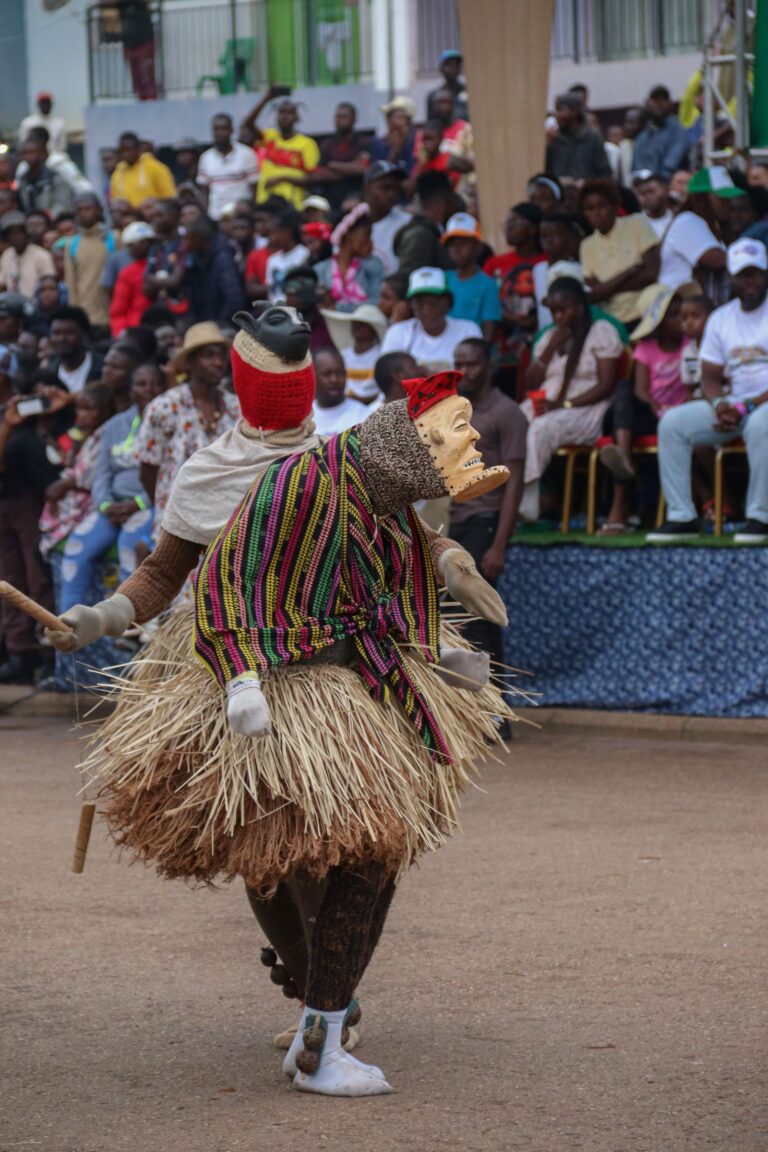
Binji artists carved helmet masks in a style similar to the Kuba’s own bwoom mask, alongside separate woven fiber masks used specifically during initiation ceremonies. The word most often used to describe Binji carving, compared with the more refined Kuba style it resembles, is rough. But rough did not mean weak. Binji masks are consistently described as powerfully formed, carrying real visual force despite, or perhaps through, their lack of the fine surface polish Kuba court carving is famous for. The other art forms produced alongside the masks, elaborate pipes, palm wine cups, and animal-shaped oracles, closely mirror equivalent Kuba forms, further evidence of how tightly the two traditions were bound together even as they diverged in style.
A Prototype Worth Taking Seriously
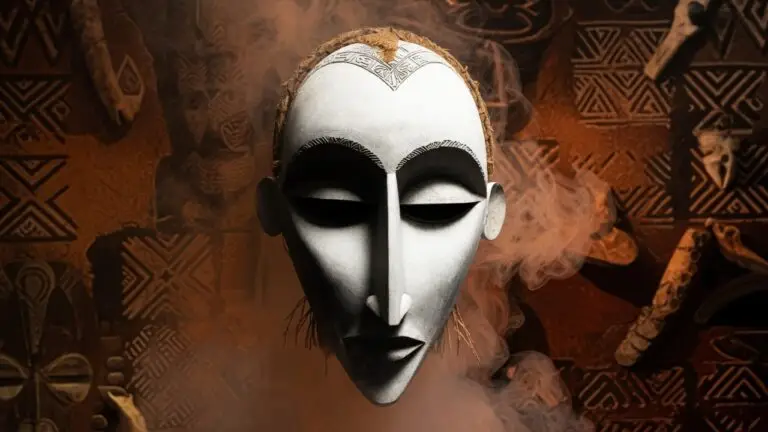
Here is the claim that makes the Binji genuinely significant rather than simply a minor footnote to Kuba art: it has been suggested that one type of Binji mask may be the actual prototype for the Kuba’s own bwoom mask, one of the three most important mask types in the entire Kuba masking system, alongside mwaash a mbooy and ngaady a mwaash. If that proposed sequence is right, then a piece of visual language now closely associated with one of Central Africa’s most celebrated kingdoms may have originated not at the Kuba royal court itself, but on its eastern border, among a smaller people who had broken away from Kuba’s own ruling clan generations earlier. The full range of Binji style is still not completely documented, which means this is a live question in the historical record rather than a settled one, but it is exactly the kind of open question worth taking seriously rather than smoothing over into a simpler story about a small tradition imitating a bigger one.
Frequently Asked Questions
How are the Binji related to the Kuba?
The Binji trace their origin to the Bushoong clan, the Kuba kingdom’s ruling clan, having split away over a disagreement about the initiation process. Their carving style and ceremonial objects still closely echo Kuba forms.
Did the Binji influence the famous Kuba bwoom mask?
It has been suggested that a Binji mask type may be the prototype for the bwoom, one of the Kuba’s three most important mask types, though the full picture of Binji style is not yet completely documented.
What were Binji masks used for?
Binji artists carved rougher helmet masks similar to the Kuba bwoom style, along with woven fiber masks used specifically during initiation ceremonies.
Who are the Binji’s neighbors?
Binji territory along the eastern border of the Kuba kingdom overlaps with the Lega, Bemba, Buyu, and Bangubangu peoples, with villages often containing families from several of these groups living together.
See also: African Masks by Region and Tribe · Kuba Kingdom: Art, Masks, and the Legacy of Central Africa’s Greatest Empire · Every Traditional African Mask You Should Know · African Masks for Sale: A Buyer’s Guide
%20-%20Kuba%20-%20Royal%20Museum%20for%20Central%20Africa%20-%20DSC06170.JPG)
Photo by Daderot, Royal Museum for Central Africa, Tervuren. Public domain (CC0). Note: no photographed Binji-attributed mask could be located on Wikimedia Commons; this is a Kuba bwoom mask, the related form discussed in the article. Source: Wikimedia Commons