Vili Masks: A Police Force in Paint, on the Atlantic Coast
New: the 2nd edition of Within Carved Lines: The Secret Meanings of African Masks is out now. Get the book →
Most masks on this site are built to communicate with ancestors, spirits, or the dead. Vili masks did that too, but they were also handed a much more immediate, secular job: keeping order at exactly the moments a coastal community was most likely to lose it. At funerals and other gatherings where grief or tension could tip into disorder, Vili masks appeared in groups and functioned, in a very literal sense, as a kind of police force.
That double duty, part sacred performance, part crowd control, is the throughline worth keeping in view. A Vili mask was never only a beautiful, painted face. It was also a functioning piece of social machinery, deployed at the specific moments a coastal trading society needed to manage large gatherings of people under emotional pressure.
Who Are the Vili?
The Vili are a matrilineal people stretched along the Atlantic coast of Gabon, Cabinda, and the People’s Republic of the Congo, occupying a stretch of shoreline that placed them, historically, at a genuine crossroads of maritime trade. Vili artists were prolific and diverse, producing naturalistic maternity figures, nail fetishes bristling with driven metal, and carved figures of dogs and monkeys often shown carrying mirrors, alongside nkisi power objects charged with magical materials in the same broad tradition documented among their Kongo cluster relatives elsewhere on this site.
A Coastal Branch of the Kongo World
The Vili sit inside the same wider Kongo cultural complex that also includes the Yombe and the Woyo, peoples whose artistic output, particularly maternity figures and nail fetishes, shares deep formal similarities with the Vili’s own. What sets Vili masking apart within that shared coastal world is not so much the underlying belief system as the sheer visual confidence of the finished object: a realistic design paired with a genuinely striking color scheme, rather than the more abstract or restrained treatment favored elsewhere in the wider Kongo art world.
Painted for Pathos: How a Vili Mask Looks
Vili face masks are built around real, believable human features rendered with unusual emotional openness for masks of this region. Vili carvers deliberately gave their masks what can only be described as an expression of pathos, painting them in black, white, and red and leaving the mouth slightly open, a small detail that does a great deal of work, turning a static carved face into something that reads as caught mid breath, mid speech, or mid grief.
Ndungu: The Two-Faced Mask That Called the Rain
The most striking single Vili mask is ndungu, worn in a massive costume of plumage and carved with two faces rather than one. Ndungu was not a mask for ordinary occasions. It was worn specifically by the medicine man, and called upon for three distinct kinds of high-stakes moment: the coronation of a prince, the invocation of the gods to bring rain, and the pronouncement of divine judgment. Lay those three occasions side by side and a pattern appears. Each one is a moment where a community needed an outcome it could not simply will into being through ordinary human authority, a new ruler’s legitimacy, a failing rain season, a dispute too serious for an ordinary chief to settle alone, and each one called for the same two-faced, elaborately feathered mask to mediate it.
Bakhimba: The Masks of the Bush School
Alongside ndungu, a separate category of Vili mask, painted with a symmetrical design in white and black rather than ndungu’s more naturalistic palette, was used in the rituals of the Basundi people’s Bakhimba sect, which ran what is described in the record simply as the bush school. This was a more restrained, geometric visual register than ndungu’s expressive, plumed presence, evidence that Vili masking was not a single style applied to every occasion but a set of distinct visual languages, each matched to a different institution and a different kind of ceremony.
Named Through the Costume, Not the Wood
One detail about Vili masking is easy to miss and worth calling out directly: each masquerade carries its own name, but that name is not attached to the carved wooden face itself. It is revealed through some other element of the costume, and the name itself refers to a proverb carrying a moral message. In other words, the identity and meaning of a given Vili masquerade lived partly outside the object a museum would eventually display on a wall. A carved Vili mask, seen alone in a case, is missing exactly the piece of the performance that told its original audience which proverb, and which moral lesson, they were watching unfold.
Masks as Crowd Control
Vili masks did not appear one at a time. They appeared in groups, dancing together at important funerals and other occasions understood in advance to carry real potential for disorder, serving, in the plainest possible terms, as a kind of police force embedded inside a ceremonial event. That framing, masks as an organized, coordinated presence tasked with keeping a large emotional gathering from tipping into chaos, is distinct from most of the individual, single-performer masking traditions covered elsewhere on this site, and it says something specific about Vili society: a coastal, trade-oriented world that needed a visible, respected mechanism for managing crowds, and built one out of paint, plumage, and proverb rather than out of force alone.
Frequently Asked Questions
What was the ndungu mask used for?
Ndungu, a two-faced mask worn in heavy plumage by the medicine man, was called on for the coronation of a prince, invoking the gods to bring rain, and pronouncing divine judgment.
How is a Vili mask’s name revealed?
Not through the carved wooden face itself, but through another element of the costume. Each name refers to a proverb carrying a moral message understood by the watching community.
Why are Vili masks described as a kind of police force?
Because they appeared in groups at funerals and other gatherings prone to disorder, using coordinated masked performance to help keep large, emotionally charged crowds under control.
How do Vili masks relate to the wider Kongo art tradition?
The Vili belong to the same broad Kongo cultural complex as the Yombe and Woyo, sharing themes like maternity figures and nail fetishes, though Vili masks stand out for their unusually naturalistic, emotionally expressive painted faces.
See also: African Masks by Region and Tribe · Where African Masks Are Traditionally Kept and Why · Every Traditional African Mask You Should Know · I Decoded African Masks and Their Color Symbolism

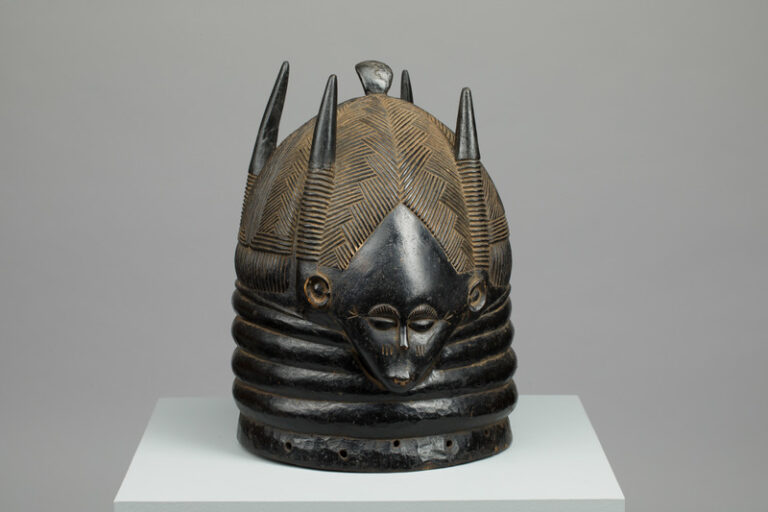
Photo by Daderot, Naturhistorisches Museum Nürnberg. Public domain (CC0). Source: Wikimedia Commons