Secrets of African Masks: Women in Masking Traditions, and How to Tell If Your Mask Is Activated
There are secrets about African masks you have never heard anywhere, and I am going to expose a few of them here.
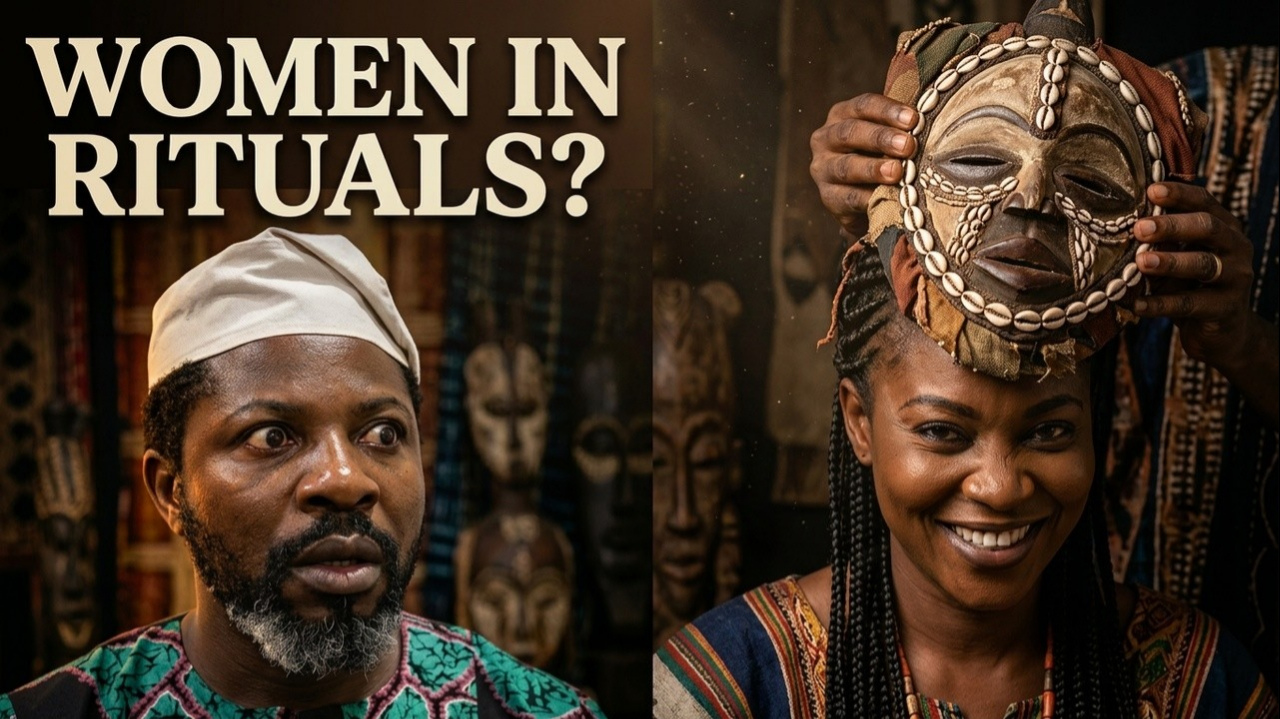
I want to talk about women in masking traditions. Are there cultures where women are allowed to put on masks? Which cultures are those? If you are really into this kind of thing, you probably know one. Here I will discuss three.
And maybe you own a mask. Maybe you wonder. Is this thing activated? Is there a spirit in it? I am going to teach you precise techniques that will help you tell, with some degree of accuracy, whether your mask is only a decorative piece or whether there is really a spirit behind it.
So strap in. Get yourself a drink. Let us dig right into it.
A Global Fascination
There is a global fascination with African masks. I know this because there is no continent on this planet without the presence of African masks. There are millions of them lying around. In private collections. In museums. In all kinds of places. And if you are reading this, you might be holding one of them right now.
Many people wonder, is this just art? Well, it is art. But beyond the physical form there is often a deeper spiritual significance to most African masks. And as you probably already know if you follow my work, not every African mask is spiritual. Many have no real spiritual function at all.
Five Types of African Masks
So are there types to this? Yes. Broadly I could discuss five.
The first, and hopefully what you possess, is the decorative piece. These are masks made for placement in your home. Beyond giving some beauty to a space, they have no other function.
The second is the ritual mask. These are popular. They are used to perform certain ritual practices. They come from societies with strong beliefs tied to the earth and to nature. At different points in the life of the community, a mask performs rituals. Sometimes a dance. Sometimes what most people would call a ritual proper, the sacrifice of grains, of animals, of drinks, libations, and so on. I do not want to call it voodoo or black magic, because those words do not capture the entirety of what ritual can mean.
The third is the mask as a learning resource. I covered this in another video years ago. I think it is the video that started this whole journey into African masks and spirituality for me. Masks are used to document the stories and histories of a people. They are designed with intricate symbols and messages, encoded in languages understood by initiates of a society or members of a community. Sometimes they are understood easily by the public too.
The fourth is the ceremonial mask. These are worn to perform at dances, in public, mostly for entertainment. These are most of the masks you find on YouTube and similar platforms. They are usually beautiful. Pleasant to watch. They dance, like the Zaouli, and they are super entertaining. We love all of those. Sometimes they interact freely with the people. That is how you know a ceremonial mask. It mixes freely with the crowd. People can dance with it. People can touch it. It socializes. It can share its paraphernalia with you. It gives you a hand fan, a horse whip, something. And you have fun and film it.
This is one of the major differences between ritual and ceremonial masks. There are ritual masks that are not for public viewing. Most ritual masks are not to be touched by any random person. But a ceremonial mask is fine. It can play with children, with women, with men, with anyone, without seeking permission.
The fifth and final type is the mask designed specifically for spiritual purposes. In that case it may represent a deity and is used in a shrine where it receives offerings and sacrifices. It is mainly a spiritual material and nothing more.
When Are Masks Used? The Circle of Life
Whatever type of mask you possess, the big question is what they are used for and when. One key term will help you understand this. The circle of life.
Every time there is a key event in the circle of life, masks are employed to help the community enjoy that stage. When someone is born, there are masquerades for that. When people die, there are masquerades for that. When it is time to plant, when it is time to harvest, when there is special spiritual activity, at every point in the life of a community where there is something worth celebrating, a masquerade is present to help the people make the best of it.
Understand this. Masks worn at performances or used by communities are not deities or gods, and they are not to be feared. Most often they are the spiritual component of the society, or they represent it. So the physical and the spiritual come together to acknowledge a historic event or to mark a symbolic time in the life of the community. Masks, whatever their form or type, help a community enjoy whatever stage of development it finds itself in.
Women in Masking Traditions
Now let us talk about women.
I have answered this question over and over again. Why are women not allowed to put on masks? For the longest time I would say it is probably because the mask often represents the spirit world and the spirit of the ancestors, who are dead. It is believed that men are better suited to wear masks that represent death and the spirit of the dead, compared to women, who are life bringers. And naturally you would not want to mix life and death.
But with time I have come to learn that in some cultures certain masks are worn specifically by women. That has been a joy to learn. Finally I can tell you that masking traditions encompass both male and female elements.
It is also important to say this. Even where masks are worn predominantly by men, the masks represent both male and female spirits. Sometimes it seems there are more female spirits represented than male. Look at the Zaouli, arguably one of the most popular masquerades to come out of Africa. The Zaouli is female. It represents feminine energy. Yet it is worn and performed by men. In many cultures you have female masks like the Gelede among the Yoruba, or the Agbogho Mmuo among the Igbo. The list goes on and on. These are female representations, even though men perform them.
But what about the cultures where women actually wear the masks?
Let us start with Nigeria. Among the Arochukwu people, one of the ancient Igbo subsets, there is a mask called Ojo. Ojo is a mask of assault, but it is worn only by women. It is not worn over the face. I should have mentioned earlier that there are all kinds of masks. There are helmet masks that cover the entire head. There are masks that cover only part of the body and leave other parts exposed. There are masks where you can clearly see who is behind it. The emphasis is never the design. It is what the mask signifies. Ojo is one of those masks worn by a woman where you can clearly see who is carrying it. And it is beautiful to see, because it is a society of all women. No male involvement at all.
I promise it gets better.
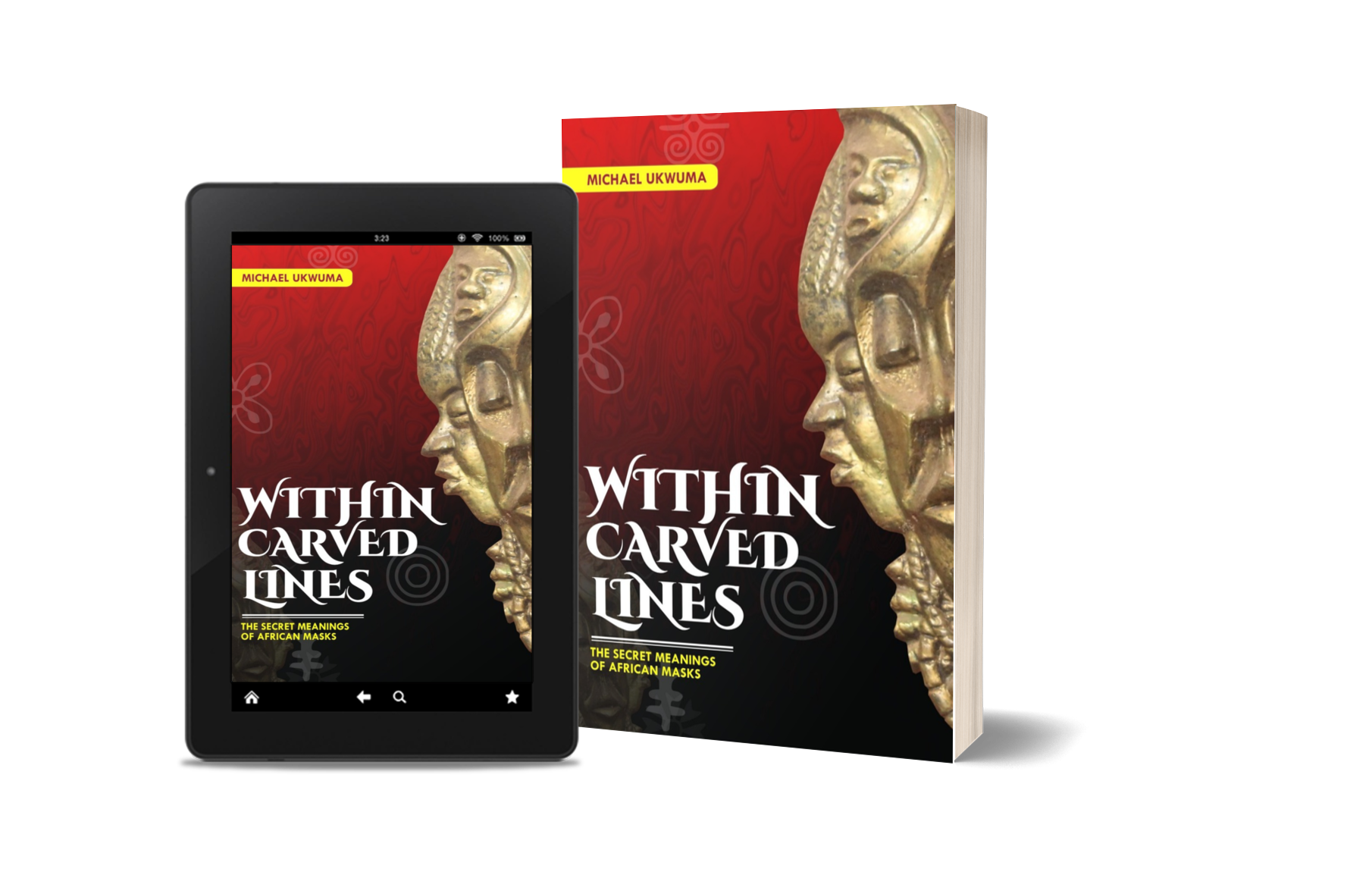
Next, Sierra Leone. Among the Mende people there is a society similar to the Ojo, the Sande society. They have a mask peculiar to them called the Sowei. The Sowei is worn by women who are senior initiates of the Sande society. They wear it during initiatory rites and ceremonies. It is rich with beautiful symbolism, and I cover it in detail in my book, Within Carved Lines. If you have not seen it, you should go and check it out. The link is in the description and the first comment. Please buy my book. It would make me really happy. And when you do, do not forget to give us a five star rating.
Back to the Sowei mask. Look at it and you will see features that represent the collective wishes, prayers, and intentions of the society for its young initiates. We go much deeper into the mask itself, its construction, and its place as the only major African masking tradition owned and worn entirely by women in Sowei Mask of the Mende: The Only African Mask Tradition Owned by Women.
For the third example we return to Nigeria, this time to Abia State. Honestly I did not know about this until I was researching another video. I came across Isuobi, a masquerade also worn by women. In this community it was originally worn by men, but at some point there was a crisis. Consultation with the gods of the land revealed that women would have to wear the mask to avert the troubles of the time. And so the female version of Isuobi was born. That changed history.
So the real question about women in masking traditions shifts. It moves away from possibility toward ability and willingness. We must stop asking whether it is possible. It can be done. We should ask instead whether there is a need for it. When there is need, it happens. Right now I do not know that we need parallel societies for men and women. But if a mask is solely for entertainment, then why not?
Understand this though. Neither the Sowei nor Isuobi are ceremonial masquerades. They are ritual masquerades. Let that sink in.
How African Masks Are Made
I cover this in detail in my book, but let me explain in a minute or two.
African masks can be made out of all kinds of materials. Fabric. Wood. Metal. Feathers. Bones. Almost any material can be put together to make a powerful mask. The thinking is simple. If you bring together enough things to symbolize the different components you want, you can channel the right kind of energies.
So to make a mask for a warrior spirit, you would combine the elements that make a spirit a warrior. Maybe horns. Big, scary horns. Sometimes more than two, because in the animal kingdom horns signify strength and elegance, and they are a weapon for fighting. If you want to understand why African masks have horns, I have a video on just that.
So you put it all together. Horns for strength. Large bared teeth, as though it wants to bite, for danger, to repel negative forces. A weapon, a spear or a machete. For a royal mask, like some Chokwe masks, you might add exotic bird feathers around the head, a crown of a sort. For feminine energy you build a nice, complex head, so that anyone who sees it knows this is a beautiful and elegant female spirit.
The vision has to come, and it has to be interpreted and approved. By whom depends on who you are making it for. If I were making a mask for myself, I would just do it. But if I were commissioning one for a community, I would talk to the right persons, get the right approval, find the artist, and get the right material. This matters. A decorative piece can be made out of anything. But a ritual mask, something sacred, must be made out of sacred wood, combined with the other elements that amplify the powers of the primary material.
But the making is not the most important thing. The usage is. Will it be activated? Will it become a spiritual tool? That is where the real work starts.
How to Tell If Your Mask Is Activated
I am not going to teach you how to activate or deify a mask here. I am going to teach you how to tell whether the piece in your home is already activated.
Have you accidentally bought a ritual mask while thinking it was decorative? Sometimes you inherit things from people and you do not know what you own. In my years of making mask content I can tell you plainly. Many people own masks and have no idea what the thing is, where it comes from, or what it was used for.
So the big question. Can you tell if the mask in your home has been activated? Yes.
In the past I would offer to give a reading, or find someone to give one. Then I got a lot of emails that I did not answer. If you ever sent me an email asking for a mask reading and I did not reply, I apologize. It was a lot, and I got overwhelmed. So instead I want to teach you to do this yourself. I have done the research. I know it will work. And trust me, it is nothing weird.
Technique One
Put your mask on the wall, at eye level, so that when you sit upright you are looking straight at it. No straining up or down. You can also prop it on a chair facing you.
Do this at a quiet time. Morning, afternoon, night, it does not matter. I prefer late at night. Maybe because I am a night owl, but also because it is quiet and it is easier to tap into your own energies. You do not need any experience with meditation.
Sit facing the mask. Put your feet flat on the bare floor. No shoes, no socks, no flip flops. Just your bare feet on the floor. Rest your palms on your laps. You can sit cross legged on the floor instead if that is more relaxed. What matters is that you are relaxed.
Now take slow, deliberate breaths. In and out. Create a rhythm. Just breathe. What happens is that your consciousness begins to enlarge. You begin to feel more. You vibrate a little more, and you begin to feel your environment.
Do this for five to ten minutes. If the mask in front of you is activated and has been used for rituals in the past, you will begin to sense a presence. You will feel as though someone is sitting in front of you. It might be faint at first, especially if you have no experience with this, but anybody can achieve a result.
Then open your eyes and look at the mask. If it is activated, you will feel it. For people with great senses and experience, you may feel the presence within the first sixty seconds, as though something else is in the room with you.
Do not be scared. It is nothing scary. It will not attack you. It will not do anything. But do not do this for too long. And do not try to talk to the mask. Do not try to establish contact. Do not interrogate it or hold a conversation. The purpose is only to see whether something is in there. If you feel nothing, that is fine. What you have is a decorative piece. Keep it and use it as you see fit.
Technique Two
This one may be more intense, and it might not work for everyone. If the first one did not work, try this.
Do it very early in the morning, as soon as you wake. It is still quiet and your body is still relaxed. Go to where you keep the mask. Stand about two feet away, not too close. Have it at a level where you could almost reach out and touch it.
Let your fingers come close, maybe six inches from the mask. Do not make contact. Close your eyes. Within a minute, in that state where you have just woken up, where you have not touched your phone or distracted your energies, you may feel it. Tiny sparks. As though you are making contact with an energy field. Like a faint electric tingling at the tips of your fingers.
If you feel it, congratulations. Your mask is activated. It has probably been used in at least one ritual at some point.
And if you practice a naturalist religion, or you are interested in nature, try this same technique with plants. You might feel something. It is pretty awesome.
What to Do If Your Mask Is Activated
So what if you discover that what you have is not a decorative piece but a ritual mask? What do you do?
For starters, the safest thing is to give it back, if you know where it came from. If you do not know anything about your mask, take it away from your living area. Put it in a box. Store it in the basement or the garage. Somewhere people do not make contact with it often. Because occasionally, masks that have been used in rituals come to life. If you want to learn about that, I have a video on the subject.
If you love this kind of work and want to see the channel keep growing, consider becoming a channel member. Members get deep dives into the things we talk about here. Every little bit helps us keep the work going. Thank you.