Mbagani Masks: The Last Carvers of an Extinct People’s Name
New: the 2nd edition of Within Carved Lines: The Secret Meanings of African Masks is out now. Get the book →
Not every masking tradition on this site comes with a settled explanation. The Mbagani are a useful reminder of that, and being honest about it is more useful than pretending otherwise. Their masks are striking, distinctive, and confidently attributed to them by collectors and museums. What those masks were actually for is something the historical record itself is not entirely sure about.
That uncertainty is the throughline worth holding onto here, and it is not a weakness in the story. The Mbagani are a small people who absorbed the identity of a vanished neighbor, nearly lost their independence to a much larger one, and left behind an art tradition that later observers have had to piece together from incomplete, sometimes conflicting evidence. Reading their masks honestly means reading them alongside that uncertainty, not around it.
Who Are the Mbagani?
The Mbagani live in the Democratic Republic of the Congo, having migrated to their present territory from the east during the sixteenth century, a very long settlement history by regional standards. Economically they survive by farming, and politically they are organized into small chiefdoms rather than any single centralized authority, a pattern common among peoples in this part of the Kasai region who never consolidated into a single kingdom the way some of their neighbors did.
A People Named After One That No Longer Exists
Here is the detail that makes the Mbagani genuinely unusual among the peoples covered on this site: they belong to an extinct group called the Mpasu. That name will likely already be familiar to readers of this site’s piece on the Salampasu, whose own name, Asalampasu, carries the same root. The Mbagani are, in effect, one of the surviving threads of a broader Mpasu identity that has otherwise disappeared from the historical and ethnographic record as an independent group. Their neighbors to the south, the Lunda, left a further mark on Mbagani culture through direct influence, part of the same web of contact and absorption that shaped so much of this region’s identity over the centuries.
Nearly Absorbed by the Chokwe
Toward the end of the nineteenth century, during the same period of Chokwe territorial expansion that saw the Chokwe challenge and temporarily overthrow the Lunda Empire itself, the Mbagani came close to being colonized by their increasingly powerful neighbors. They were not absorbed, and the Mbagani identity survived the encounter intact, but the episode places the Mbagani directly inside the same expansionist history already documented elsewhere on this site in the piece on Chokwe masking. Two small peoples, the Mbagani through the Mpasu connection and the Salampasu through their shared name, both sit in the historical shadow of the same nineteenth century Chokwe expansion, from two different directions.
What the Masks Look Like
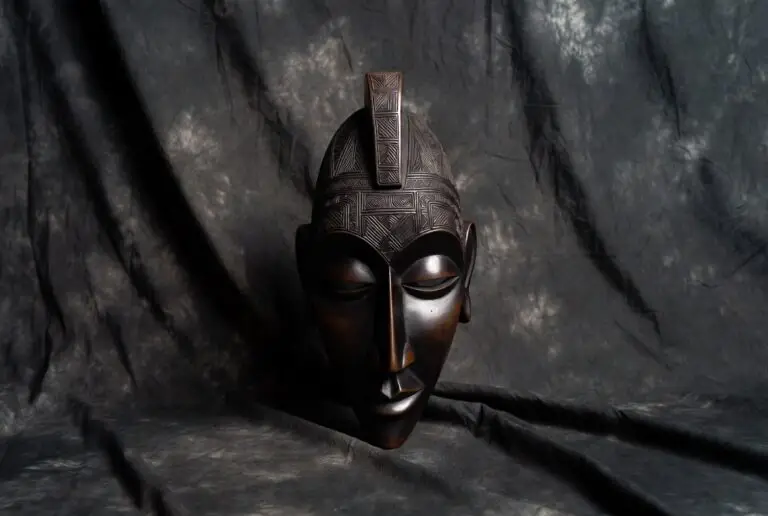
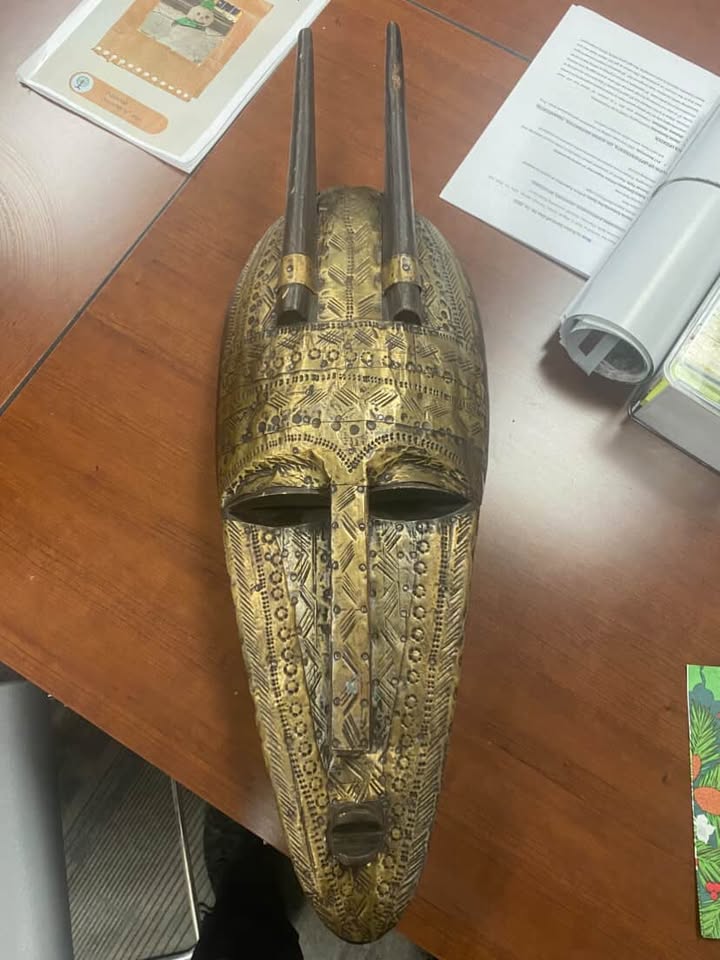
Mbagani carvers are recognized for beautiful carved statues and masks with a distinctive, easily identifiable face: very large eye spaces painted white, small coffee bean eyes set beneath a domed forehead, a notably pointed chin, a protruding mouth, and a triangular nose. It is a face built from strong, legible contrasts, white against dark, small features against a large domed brow, that gives Mbagani masks real presence even to someone encountering the style for the first time.
What the Masks Were Probably For
This is where the honesty matters most. The most commonly cited explanation is that Mbagani masks were used in circumcision ceremonies or in the initiation of secret societies, a function shared with a great many masking traditions across this region of the Congo. But a separate source ties the same masks to healing ceremonies instead, a genuinely different kind of occasion. Both explanations may be partially true. Masks in this part of Central Africa were frequently put to more than one use across different ceremonies, and a mask closely tied to a men’s initiation society could plausibly also be called on for healing without contradiction. What the record does not offer is a single, confirmed answer, and it would be dishonest to present one here as though the question were settled.
Living Between Bigger Neighbors
Put together, the Mbagani story is really a story about smallness and proximity: a small people carrying forward the name of a vanished one, shaped by a powerful southern neighbor’s influence, nearly absorbed by an even more powerful eastern one, and now known to the outside world almost entirely through carved objects whose original purpose survives only in partial, sometimes contradictory accounts. That is not a lesser story than the more fully documented traditions covered elsewhere on this site. It is a more common one than most museum labels let on, and the Mbagani masks are worth looking at with that context in view rather than in isolation.
Frequently Asked Questions
What does “Mbagani” mean in relation to the Mpasu?
The Mbagani belong to the Mpasu, an ethnic group that no longer survives as an independent people. The Mbagani are one of the threads of that broader identity that continued into the present.
Are the Mbagani related to the Salampasu?
Not directly as one people, but both names trace back to the same Mpasu root, “Asalampasu” for the Salampasu and Mpasu for the Mbagani’s own ethnic origin, making them linked more through shared name history than shared territory.
What were Mbagani masks used for?
The most cited explanation is circumcision ceremonies or society initiations. A separate source instead connects the masks to healing ceremonies. Both may be true; no single confirmed answer exists in the record.
How did the Mbagani nearly come under Chokwe rule?
Toward the end of the nineteenth century, during the same period of Chokwe expansion that saw the Chokwe temporarily overthrow the Lunda Empire, the Mbagani came close to being colonized by the Chokwe but retained their independence.
See also: African Masks by Region and Tribe · Salampasu Masks: Copper Faces of a Warrior Society in the Congo · Chokwe Cikungu Mask: Chiefs, Ancestors, and Power in Angola · Every Traditional African Mask You Should Know

Photo by Daderot, Royal Museum for Central Africa, Tervuren. Public domain (CC0). Source: Wikimedia Commons