Duma Masks: The Boatmen’s Faces Whose Sacred Past Went Undocumented
New: the 2nd edition of Within Carved Lines: The Secret Meanings of African Masks is out now. Get the book →
Several masking traditions documented in this book carry a clear, unbroken line from sacred origin to present-day use. The Duma, or Aduma, boatmen of Gabon’s Ogooue River, present a harder case: their masks are well documented in their current form, used for the last half-century in celebratory dances tied to major social rituals, while their earlier, evidently more sacred role is explicitly noted as less well documented. The masks survived; the record of what they meant before survived less completely. That asymmetry, a present clearly described and a past only partially recovered, is the throughline worth carrying through this piece. It leaves Duma masking as an art form caught mid-transition, secular enough today to be confidently described, sacred enough in its origins that the earlier chapter is largely lost.

Who Are the Duma?
The Duma are located in the Ogooue River region of Gabon. The Aduma, as they are also known, are the great boatmen of the Ogooue, a river that shaped both their economy and their identity as skilled navigators of Gabon’s interior waterways. They believe in a God who made the world, in an immortal soul, and in retribution for evil, a cosmology that sits alongside a belief in spirits and ghosts. The Duma are under the sway of sorcerers and secret societies, whose authority is described as significant enough that even the power of their own chiefs must yield to it.
Spirits, Sorcerers, and Secret Societies on the River
Duma religious life centers on a tension between formal chieftaincy and the less visible authority of sorcerers and secret societies. Belief in spirits and ghosts runs alongside belief in a single creator God and an immortal soul, a combination that blends what might look like separate religious registers into a single lived system. The explicit note that even chiefly authority must yield to sorcerers and secret societies marks a distinctive power structure among the traditions in this book, one where formal political office does not automatically outrank spiritual or occult authority.
Flat Faces With an Angular Nose
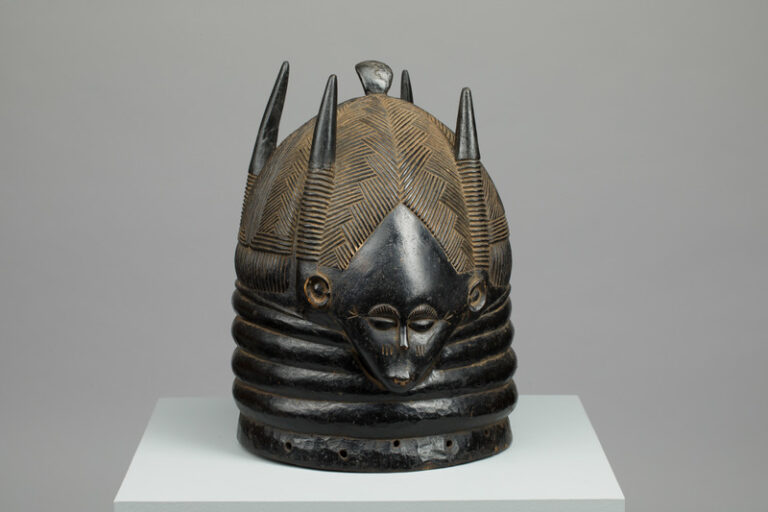
Duma masks are immediately recognizable for their flat surface, a domed forehead, and an angular nose, producing an interesting interplay of flat, convex, and angular forms across a single face. These masks are mostly polychrome, some carrying a painted design pattern layered over the sculpted geometry. The combination of flatness and angularity gives Duma masks a graphic, almost architectural quality, closer to a composed arrangement of planes than to a naturalistic rendering of a face.
A Ritual Role That Went Undocumented
For the last half-century, Duma masks have been used for celebratory dances associated with major social rituals, a role that is well attested in the documentary record. Their former role, whatever it was before that half-century window, is explicitly described as less well documented, a rare admission that the earlier, presumably more sacred function of these masks simply wasn’t recorded with the same care as their present secular use. The masks themselves persisted across that gap; the meaning attached to them earlier did not travel with the same completeness.
Frequently Asked Questions
What do Duma masks look like?
They have a flat surface for the face, a domed forehead, and an angular nose, creating an interplay of flat, convex, and angular forms. Most are polychrome, some with a painted design pattern.
What are Duma masks used for today?
For the last half-century, they have been used for celebratory dances associated with major social rituals.
Do we know what Duma masks were used for before that?
Not fully. Their former role is explicitly described as less well documented than their current, more secular use.
What do the Duma believe?
They believe in a God who made the world, an immortal soul, and retribution for evil, alongside belief in spirits and ghosts and the significant authority of sorcerers and secret societies, which even chiefs must yield to.
See also: African Masks by Region and Tribe · Every Traditional African Mask You Should Know · African Funeral Traditions: How Different Cultures Honour the Dead